

Origins of Secret Mantra • Day Three
27 July 2026
The four factions according to Xuanzang’s translation – the third explanation, based on the level of practice
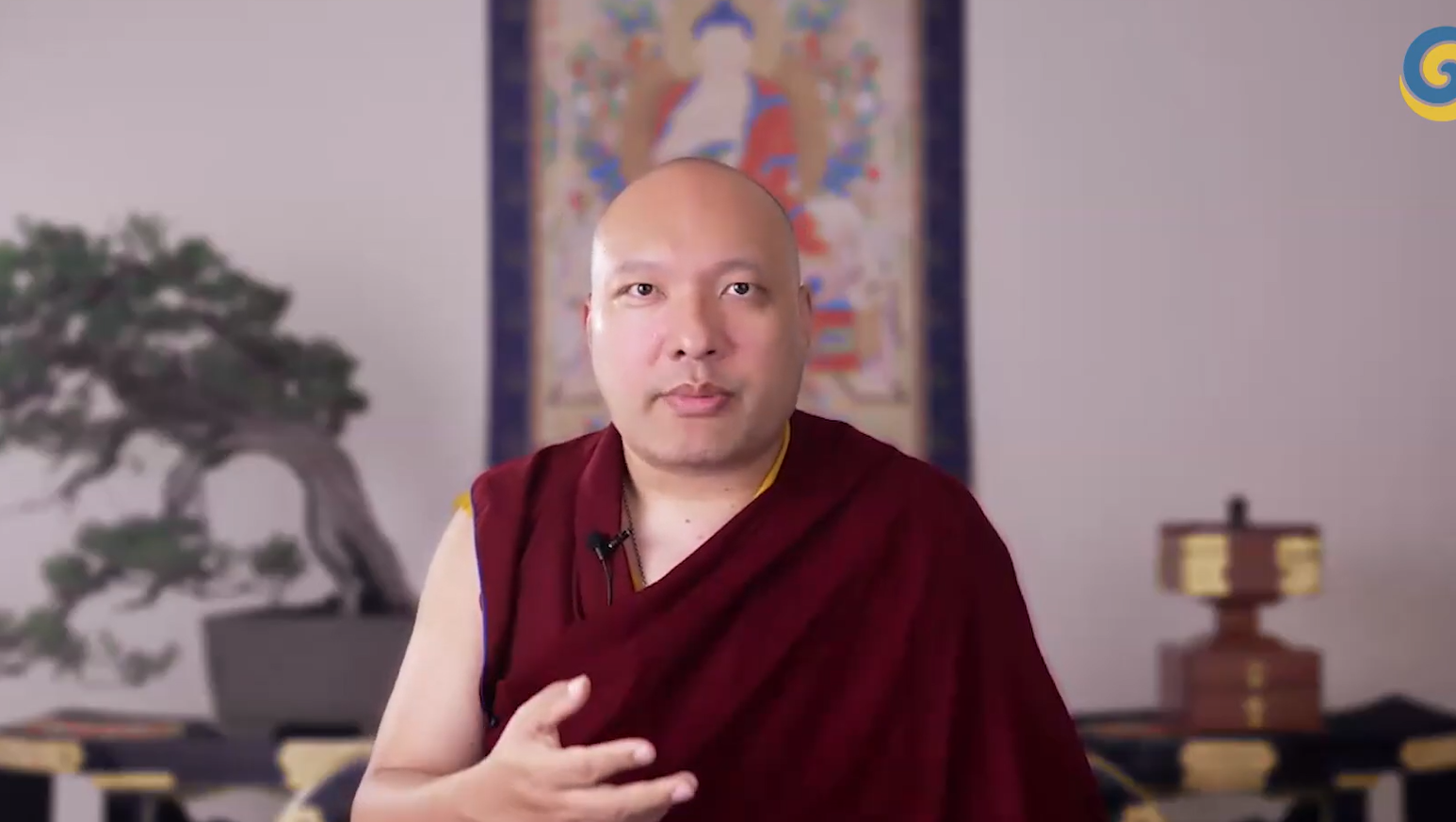
HH Karmapa started by offering greetings to everyone listening over the internet, both the noble community of the sangha and dharma friends, male and female.
In this teaching session, HH Karmapa continued the exploration of the Wheel Distinguishing the Differences Between the Scriptural Traditions [Skt. Samayabhedoparacanacakra] according to the Chinese translation by Xuanzang.
At the time of King Aśoka there were different views, or disagreements about positions, that led to there being four different factions in the sangha. Recapitulating from the previous teaching, HH Karmapa recalled the four factions as being: the Nāga, the Outlying, the Learned and the Venerable. The commentary on Xuanzang’s translation, from notes made by Xuanzang’s direct disciple Kuiji, gives three different explanations about these factions. In the previous teaching HH Karmapa covered the first and second explanations, now he proceeded to cover the third.
The third explanation is primarily in terms of the difference between ‘noble’ and ‘ordinary’ beings, or alternatively, in terms of the difference due to their level of practice. According to this explanation, the Nāga faction was made up primarily of people who enjoyed disputes, who liked to argue, and who sought conflict. In this account, they were called the Nāga because they were supporters of those who had violated their vows, they were ‘friends of the wicked’, therefore they were as fearsome as nāgas or elephants. The second faction, the Outlying faction, was associated with remote places without much development. The third explanation characterises them as people who wouldn’t have ever heard the [true] Dharma, whose mouths had never spoken the [true] Dharma. The Outlying faction was, thus, understood to be those whose mental conduct was outside the Dharma. The third faction, the Learned faction, is described as those ordinary individuals who had perfected discipline, and who in addition had learned a lot. They were very learned and dwelt in the conduct of the learned, and that was the reason for the name of this faction. The fourth faction was the Venerable faction, and according to this third explanation, they were the ‘noble’ beings who had the wisdom of realising the nature of the truth, who by following the nature of phenomena had realised the meaning of truth.
There was, then, disharmony and disagreement amongst these four factions, and the locus of the dispute was the five points of Mahādeva. Because of their different understandings, their different ways of explaining these points, they came into conflict. In this conflict, there were two factions who supported the five points of Mahādeva and two factions who were against them, and in this way the sangha was split into two: thus, the original split into two schools occurred.
This concluded the three explanations of the factions involved in the original split into two schools in Kuiji’s commentary on Xuanzang’s Chinese translation of the Wheel Distinguishing the Differences Between the Scriptural Traditions.
The four factions according to modern scholars
Next, HH Karmapa proposed to discuss the explanations given by modern scholars for the four factions. The main way modern scholars explain the factions is primarily according to the geographical areas in which they were located; by combining the study of geography with their research into the spread of Nikāya Buddhism, they identified geographical differences amongst them. This is an explanation put forward, for instance, by a modern Chinese scholar, Yinshun, from the time of the Republic of China, as well as the Japanese scholar Hirakawa Akira. According to them, the eastern and southern regions of India were the places where people who wanted change primarily lived, an early form of Mahāsāṃghika [even though, HH Karmapa stressed, at that time, the Mahāsāṃghika had not yet been established as such]. In the sangha from these eastern and southern regions of India there were two groups, and they both supported the five points of Mahādeva.
In terms of geography, the first group, identified with the Nāga faction, were from the eastern and central regions of India. People from this group would have been based in Pāṭaliputra, the capital of Magadha; in Vaiśālī; and also in the lower and central parts of the Gangetic Plain. These regions were the political and cultural hub of the Maurya Empire, with numerous sangha communities which had become well-known. The royal caste and courtiers also gave a lot of support and protection to the sangha. For this reason, the sangha in these regions had irresistible political strength, and this is how they came to be understood as the Nāga faction.
The second group is identified as the Outlying faction, and in terms of geography, it was based in southern India, particularly in the southwestern areas. These were areas that were far away from the cultural and political hubs of the Gangetic Plain, and places to which Buddhism had recently spread. People from the more conservative, western regions of the sangha, which would eventually become the Sthaviravāda school [but which at that point, HH Karmapa stressed, would not yet have been called the Sthaviravāda] saw these newly formed communities in the southwestern regions and said that they did not know Sanskrit well, that they did not have a lot of education, or that they did not respect the precepts well. For example, in the Vinaya there is a chapter on leather, which suggests that differences might exist between central India and elsewhere as regards observing precepts on the wearing of leather shoes. These kinds of criticism from the conservative, western, Sthaviravāda sangha led to the southern sangha being called the ‘Outlying’ faction as a derogatory term. In actuality, people from the outlying regions were a new force who wanted to promote reforms, and later on, the seeds of the spread of Mahāyāna in southern India came from this Outlying faction; for example, the Caityaśaila school was notable in this area. They wanted to change things, they had a more relaxed and wider view. HH Karmapa pointed out that we will come back to this when we discuss the Mahāyāna.
In contrast to the factions from the eastern and southern regions, that is, the Nāga and Outlying factions, the people from the western and northwestern regions were grouped into two more conservative factions, with a stronger attachment to the old ways. They were like an early form of the Sthaviravāda school, before the Sthaviravāda were formed as such. They had very traditional views and a very traditional practice, which had been preserved this way. Also, they studied and researched the Abhidharma; they were abhidharmikas, upholders of research into the Abhidharma. The first of these two conservative factions was the Venerable faction, which in terms of geography were from central and western India, including Mathurā, and from some northwestern regions, including Kashmir and Gandhāra. The northwest of India at that time was a place with a very strong traditional culture, and the Vinaya precepts were held very strictly; the expectation was that Vinaya discipline should be followed precisely as it had been preserved and practised before. They focused their studies on the Abhidharma, and this shows up later in the development of the Kashmiri Sarvāstivāda from the Sthaviravāda, and from this very conservative background. Also, the sangha in these regions considered the Elders to be arhats and, according to HH Karmapa, treated them practically as gods. In this sense, the Elders were seen as constituting the ‘noble’ community and were accorded great importance.
The second conservative faction was the Learned faction, which were people from the central and upper Gangetic plain. Their geographical location was basically in the areas around Śrāvastī and around Ṛṣipatana [Rishipatana], in modern-day Sarnath: that is, places where the Buddha actually lived and travelled during his lifetime. The sangha in these areas belonged primarily to the lineage of Ānanda, and they upheld the sūtras. They had a really great tradition of study, and great understanding of the oldest Buddhist scriptures, such as the Four Āgamas. They had great affection and devotion for tradition, but they were a little bit more relaxed in their views. The Learned faction had, in this sense, slightly more liberal views than the Venerable faction.
The factions according to the Tibetan translation
This concluded the explanation on the way contemporary scholars examine the four factions described in Xuanzang’s Chinese translation of the Wheel Distinguishing the Differences Between the Scriptural Traditions. But HH Karmapa suggested we needed also to compare these explanations with the Tibetan translation of this same work.
HH Karmapa recalled that Xuanzang’s translation lists four factions, the Nāga, the Outlying, the Learned, and the Venerable Faction. whereas the Tibetan translation of the Wheel Distinguishing the Differences Between the Scriptural Traditions says something a little bit different:
Proclaiming and propagating the five points, there arose the Elder Nāga, the Eastern, and the Learned. Having proclaimed and propagated these same five points, two schools were established: the Mahāsāṃghika school and the Sthaviravāda school.
If we look at this Tibetan translation, it speaks of the Elder Nāga, the Eastern and the Learned: apparently, it teaches about only three factions, not four. However, HH Karmapa expressed his belief that there is another way in which this can be understood. The translation uses the single term ‘Elder Nāga’, combining together the words ‘Elder’ and ‘Nāga’, but HH Karmapa argued that these should be taken, rather, as two separate terms. The reason is that, in the Chinese translation, the word that appears as ‘Venerable’ can also be used as a translation for ‘Elder’. So, instead of there being the Elder Nāga faction, we should read this as there being the Elder faction and the Nāga faction, and then the two others. Likewise, the Eastern faction in the Tibetan translation refers to the sangha in the eastern regions. There was a tradition of calling them the ‘outliers’, from whence the ‘Outlying’ faction; in other words, what is being referred to differently as the Eastern and the Outlying is, in actuality, one same faction of the sangha. HH Karmapa remarked that the Tibetan translation of the Wheel Distinguishing the Differences Between the Scriptural Traditions is difficult to understand, with many scribal errors and mistakes. In the future, if we were able to compare this Tibetan translation to a Sanskrit original [if one were to come to light], it would be necessary to do so.
The split into schools according to Tibetan translations
When the Tibetan translation of the Wheel Distinguishing the Differences Between the Scriptural Traditions discusses the four factions, it doesn’t mention Mahādeva particularly, but it does point to the five views as the source of the disagreement amongst the Elder, the Nāga, the Eastern and the Learned, and that this disagreement led to the split into the two schools.
Looking at the accounts of how the original schools split according to Tibetan translations was described by HH Karmapa as somewhat difficult, because the treatises preserved in the Tengyur explain the split into schools in some cases by saying that there is one root school, in other cases two root schools, or three, or four; so, all in all, there are four different traditions as to the number of root schools.
Account of a single root school
HH Karmapa proposed to start with the account that says that there is one root school. This is primarily according to Śākyaprabha’s Illuminating Commentary of the Verses for Novices of the Noble Mūlasarvāstivādins (Skt. Āryamūlasarvāstivādiśrāmaṇerakārikā-vṛttiprabhāvatī) which says:
Formerly, there was only the Sarvāstivāda alone. After the Bhagavat’s parinirvāṇa, other schools arose based on it and it became the foundation, therefore it is called Sarvāstivāda, ‘those who assert that all exists.’
The way this text describes it, there are basically no other schools, only the Sarvāstivāda school. Later, after the death of Dharmarāja Aśoka, the other schools of the sangha split off from it, and this was based on their reciting the scriptures in various different dialects. So the account in this text is that, in the beginning, before the other schools split off, there was only one original school, and that was the Sarvāstivāda school, or rather the Mūlasarvāstivāda, and no others.
Accounts of two root schools
HH Karmapa considered next the account according to which there were two original schools. This tradition comes from Explaining the Differences Between the Schools (Skt. Nikāyabhedavibhaṅgavyākhyāna), by Ācārya Bhāvaviveka (also known as Bhāvya). This text is actually found within his great treatise refuting the non-Buddhist schools, the Tarkajvālā or རྟོག་གེ་འབར་བ་ in Tibetan, and it is a section from that. It teaches three different ways in which the schools split. The first of these describes a split into two original schools:
When 160 years had passed since the Bhagavat’s parinirvāṇa, at the time when King Dharmāśoka ruled in the city called Kusumapūra [Pāṭaliputra – City of Flowers, modern day Patna], because of the arising of certain points of dispute, a great schism occurred in the sangha. At that time it first divided into two schools: the Mahāsāṃghikas and Sthaviravādins.”
So, this account states that during the reign of King Aśoka, there were several disputes and great disagreements amongst the sangha, and that this was the situation that led to the formation of two different schools, which are identified as the Mahāsāṃghika and the Sthaviravāda.
There is a similar account in the Ornament of the Sage’s Intent (Skt. Munimatālaṃkāra) by Ācārya Abhayākaragupta. What it says is:
Moreover, according to the Vinayavibhāṣā, one hundred years after the parinirvāṇa of the Lord of Sages, due to differences regarding the teachings, it first divided into two schools, the Sthaviravādins and the Mahāsāṃghikas.
This account is also very similar to the one in the Wheel Distinguishing the Differences Between the Scriptural Traditions. Additionally, it is said in Tāranātha’s History of Buddhism in India (Tib: རྒྱ་གར་ཆོས་འབྱུང་) that this is a Sthaviravāda account of the original split, which HH Karmapa suggested to be correct, since it agrees with the accounts preserved in the Sthaviravāda schools.
There is an older tradition [found in Xuanzang’s translation of The Great Exposition (Skt. Mahāvibhāṣā)] that says that, because of the dispute over the five points of Mahādeva, there was a split into the Sthaviravāda and Mahāsāṃghika schools, and then there developed a further split into four schools. This is a slightly different way of explaining the original split.
To examine this claim on the five points, HH Karmapa jumped forward to the third explanation for the split into two schools found in Ācārya Bhāvaviveka Explaining the Differences Between the Schools. This version, however, places the split in a different chronology from the other accounts, and associates it with a different ruling dynasty rather than with King Aśoka, which might seem incorrect when compared to the previous explanations. The account goes on to mention that at the time, in the sangha, there was a great Kāśyapa; this would be a second Mahākāśyapa, not the same as the original one who was a direct disciple of the Buddha:
When 137 years had passed since the Bhagavat’s parinirvāṇa, in the city of Kusumapura, under the rule of King Nanda and Mahāpadma, while most of the noble ones gathered there for the compilation of the scriptures […] Māra the wicked one, who opposes all that is good, took on the appearance of a bhikṣu and displayed various miracles. [And because of that,] those called ‘Elder Nāga’ and those called the ‘Confident Ones’, the Learned, praised the five points […]
So, in this passage, the ‘Elder Nāga’ and the ‘Confident Ones’ are the people who supported the Māra and the spread of the five points, and this was the reason for the split into the two schools.
In relation to this, it is also said, in Tāranātha’s History of Buddhism in India, that after Mahādeva passed away, there was someone called Yidtenpa, ‘the confident one’, who fully proclaimed the five points. And it also says that the first person who talked about the five points was Mahādeva, but the person who actually disseminated them widely, the one who spread them widely in the sangha, was a bhikṣu named Bhadra. And as a result, there was a great dispute that led to the original split. The History of Buddhism in India says this is the assertion of the Saṃmitīya school; and it is said in the Blue Annals that it was thought that Ācārya Bhāvaviveka held this third explanation, that his own position was the one of the Saṃmitīya school.
HH Karmapa pointed out that there is another way of understanding, and reconciling, these two stories, from Bhāvaviveka and from Tāranātha, of the wicked bhikṣu Bhadra, or the wicked Māra Bhadra. Bhāvaviveka’s own text doesn’t say that there is a wicked Māra named Bhadra; it says that the Māra wore the robes of a bhikṣu, so it describes his features, not his name. But it does say that the Māra was ‘the opponent of everything good’. Now, the name Bhadra, or Zangpo in Tibetan, means ‘everything excellent’. So saying that the Māra is a ‘wicked Bhadra’ could be understood as saying that he was actually the opposite of everything excellent. So the Tibetan text’s recording that the wicked Māra was named Zangpo or named Bhadra may have meant rather that the Māra was a ‘wicked Bhadra’, in Bhāvaviveka’s sense of ‘the opponent of everything good’.
In any case, we have now had two explanations of the way that the split into two original schools occurred, both of which appear in Ācārya Bhāvaviveka’s text [as the first and third explanations], as positions of different schools.
Account of three root schools
HH Karmapa turned next to the tradition asserting that there were three original schools. Among the three explanations taught by Ācārya Bhāvaviveka in his Explaining the Differences Between the Schools, this is actually the second of his explanations:
Others say the following: the basis should be explained as before. The root divisions are three, namely the Sthaviravādins, the Mahāsāṃghikas, and the Vibhajyavādins [those who make distinctions].
This division into three, according to Tāranātha in his History of Buddhism in India, is said to be a tradition of the Mahāsāṃghika school.
Accounts of four root schools
The fourth tradition relates to the assertion that there are four original schools, and there are two different explanations for this. One of these is the tradition of Vinītadeva. In his Treatise on the Differences Between the Schools, [Skt. Samayabhedoparacanacakrenikāyabhedopadarśananāmasaṃgraha], he presents what is basically a ‘digest’ of the Wheel Distinguishing the Differences Between the Scriptural Traditions, starting with:
Dwelling in the East, the West, and in the Himalayas […] the Lokottaravāda school […]
There is a lot more to what Vinītadeva writes, but according to HH Karmapa, his Treatise basically enumerates that the Mahāsāṃghikas have five sub-schools, the Sarvāstivādins have seven, the Sthaviravādins three, and the Mahāsāṃmitīyas have three sub-schools. [Which would thus account for eighteen sub-schools.] In line with this breakdown, one would have to accept that there are four root schools.
Within Tibet, Vinītadeva’s position that there are four original schools is the most widely held. For example, Üpa Losal’s very old text on the philosophical schools, the Tenets, says:
Here, the eighteen schools that branched from the four root schools should be explained according to the text of Ācārya Vinītadeva.
Likewise, the Jonang scholar Tāranātha’s History of Buddhism in India says:
Moreover, it is stated in many tantric scriptures that there are four root schools. And since this way of enumerating the four does not follow the assertion of the Vātsīputrīya schools, but instead agrees with this one, only this system should be adopted; since it is said to be compiled from the teachings of Ācārya Vasubandhu, and its source is excellent.
HH Karmapa pointed out that here, basing the reason for the choice of account on the use of the Tantras as a source is a little strange, because the Tantras appeared later. Using the later appearing Tantras as a source for the earlier schools risks getting things chronologically mixed up. At any rate, the gist of the message is that the tradition compiled from the teachings of Ācārya Vasubandhu, coming from his lineage, is excellent and is the one that should be followed.
The other explanation for there being four root schools is Ācārya Padma’s, from the text called Questions on the First Year of a Novice [Skt: Śrāmaṇeravarṣāgrapṛcchā]. HH Karmapa pointed out that it was not sure whether this text’s author was Padmasambhava or another Ācārya Padma, saying only that the author presented themselves as the Khenpo who first asks the novices their age. The text says that the Sarvāstivādins have four sub-schools, the Mahāsāṃghikas six, the Saṃmitīyas five, and the Sthaviravādas three. Ācārya Padma’s enumeration is a little different from Vinītadeva’s in terms of the internal subdivisions, the number of sub-schools within each of the great schools, but it is the same as regards the root schools themselves. As HH Karmapa reiterated, in Tibet, Vinītadeva’s presentation of the four original schools remains more influential.
Distinguishing characteristics of the schools
A final way of distinguishing the four schools surveyed by HH Karmapa is that they are also said to have their own distinct lineage of teachers, their different languages, measurements of robes, conventions for the endings of monks’ names, and so forth.
For example, with the Sarvāstivāda, in terms of the lineage, it’s the lineage of Rāhula, the Buddha’s son; the language used for the recitation of the sūtras is Sanskrit, the language of the Vēdic gods; monks’ robes have from twenty-five down to nine strips of patches, and the insignia on the robe is a blue lotus or other similar flowers; and their monastic names end in, or include, ‘śrī’ [glory], ‘prabha’ [light], ‘kīrti’ [renown], or ‘bhadra’ [excellent]: for instance, Rāhulaśrī and Śribhadra.
Likewise, with the Mahāsāṃghika school, in terms of their lineage, they’re the lineage of the arhat Mahākāśyapa. As for the language of recitation, some texts say it is Apabhraṃśa, while other texts give a different language; they don’t completely agree, and different scholars explain it slightly differently, so this is not absolutely certain. In terms of the robes, they have from twenty-three down to seven strips of patches, and the monastics’ insignia is a conch shell. Their names have endings in ‘jñāna’ [wisdom], ‘gupta’ [hidden], or ‘sāra’ [essence].
For the Saṃmitīya school, the lineage is that of Upāli, and the language of recitation is Paiśācī, which is the language of the paiśācī spirits. Their robes have between twenty-one and five strips of patches and the monastic insignia is the sotsika flower; HH Karmapa indicated that we’re not quite sure what the sotsika is, apart from there being a flower with this name. Their names end with ‘dāsa’ [subject] or with the name
of the school, or alternatively in ‘śīla’ [discipline] or ‘siṃha’ [lion].
The Sthaviravāda is the lineage of noble Kātyāyana and of his disciples. The language in which they recite the sūtras is Prakrit. Their robes have the same number of strips as the Saṃmitīya school, and their monastic insignia is the wheel.
Their names end with ‘deva’ [deity], ‘ākara’ [source], or ‘varman’ [armor]: for instance, Ratnākara and Prajñāvarman. They also have names ending with ‘rakṣita’ [protected] which is related to the Tibetan title ‘khenpo’, such as the great preceptor Śāntarakṣita.
HH Karmapa concluded by remarking that this last account is a well-known explanation given by Tibetan scholars about the particular defining characteristics of the four different schools. In terms of its sources, it probably comes from the Vinaya, and possibly from another lesser-known text.