

 October 30, 2026
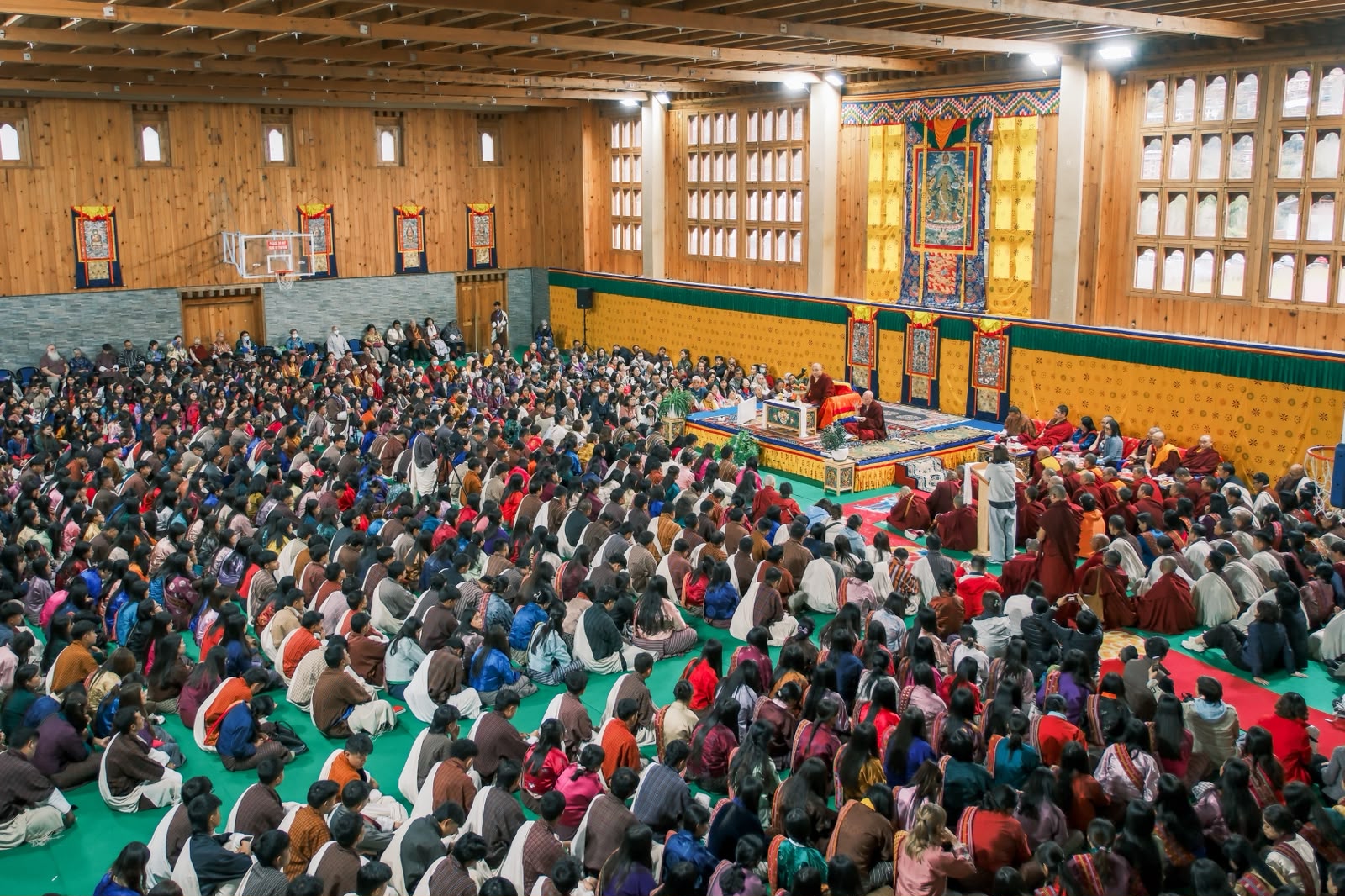
The president of Paro College of Education, Dr Phuntsho Wangdi, warmly welcomed the Karmapa, his entourage, and distinguished guests, and expressed his profound gratitude to the Karmapa for visiting Bhutan and. the wish that “the merit of this auspicious occasion contribute to peace and harmony in our country and throughout the world”.
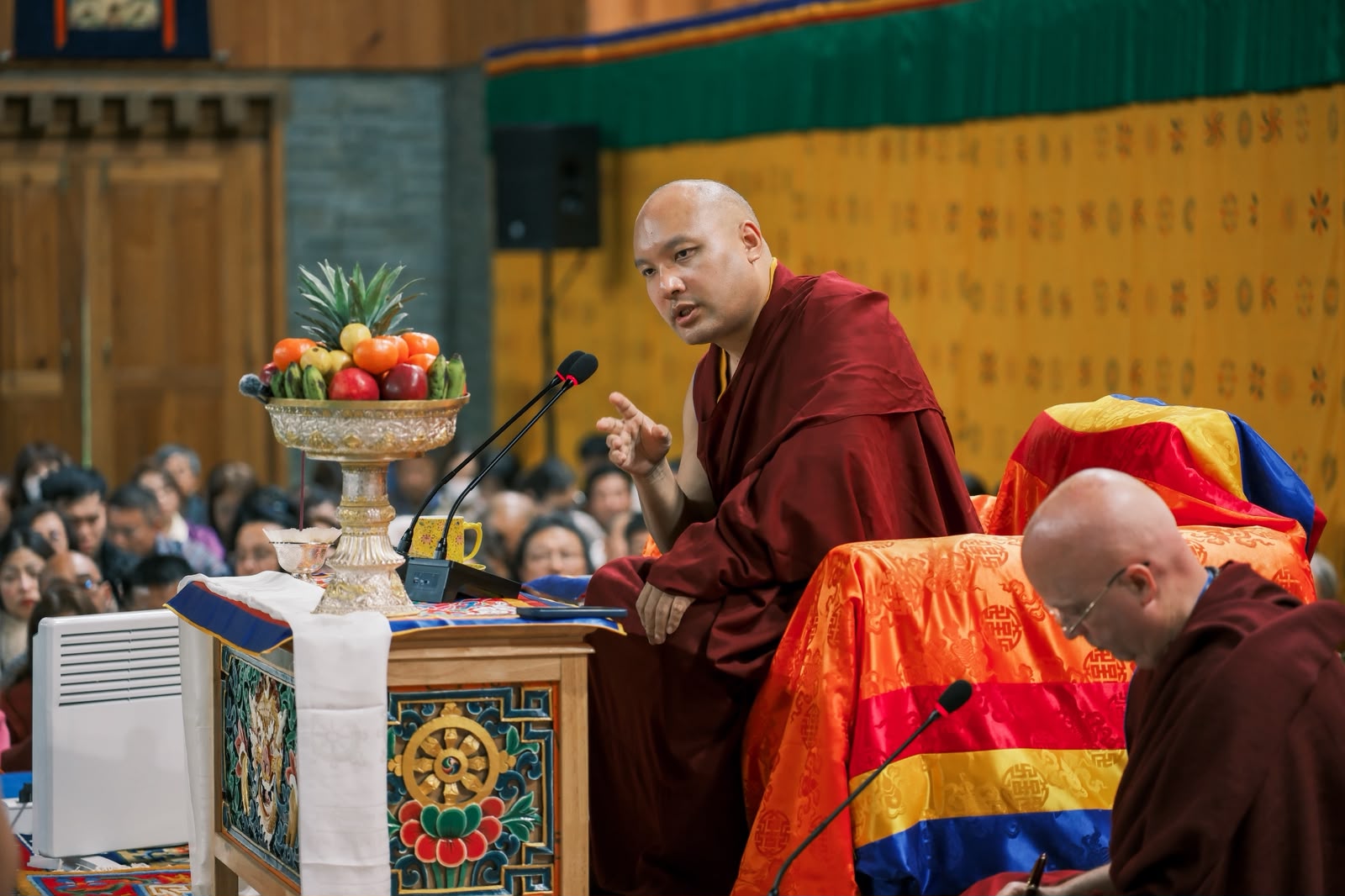
The Karmapa then gave a short address, followed by a question-and-answer session.
I would like to begin this afternoon by giving my best greetings to Her Majesty’s Yabyum, as well as to all the faculty and students of the Paro College of Education.
The Karmapa switched briefly to English: “Actually, I think I should speak in English, but my English is very, very bad. That’s why I specially invited a very professional translator, all the way from America,” and then returned to Tibetan.
For me to be able to come to Bhutan and to arrive here today, to speak about it personally, is to fulfill a wish that I’ve held in my heart for a very long time, the wish to come, and finally, this wish has been fulfilled. As I was flying in to land at the airport here in Paro, it felt like a dream; it didn’t feel real. I have held this hope for so many years and it’s finally happening! It’s an inexpressible feeling.
If we think about it in terms of history, the first Karmapa, Dusum Khyenpa, about 800 or 900 years ago, came here to Paro on the instructions of his guru, Dakpo Rinpoche, LordGampopa, the founder of the Dakpo Kagyu lineages. Gampopa instructed him to come here to Paro to do a retreat. So, he came and did his retreat here in Paro. So, this is the place where the first Karmapa came eight or nine centuries ago, and since that time, there has been a real connection between the Buddhist kingdom of Bhutan and the Gyalwang Karmapa. This connection has been unbroken, and, in particular, there has been an uninterrupted connectionbetween the Karmapas and Paro. For this reason, I feel that for me to come here is a historically important and significant thing.
Now, concerning this glorious kingdom of Bhutan, in this world there is only one countrythat is a Secret Mantra Vajrayana country and that country is Bhutan. Because of the kindnessof successive kings, whether we discuss it in terms of the internal happiness within our mindsor external development, Bhutan has become a place that’s different than anywhere else in the world. I think that all of you know this. Not only that, but when you’re born in Bhutan, just by being born in this country, you have all the eight leisures and ten resources of a precious human life. They’re naturally all complete. You have everything you need to practice Dharma, to practice positive, virtuous karma.
So, this is a really wonderful environment. For you all just merely to be born in a country like this should give you all great confidence, and it is something that you should also treasure.
We are here in this college of education, and the main point of a college of education is to train teachers. No matter where you are in the world, education and the training of teachers is really important. You can’t do without it. But when we talk about education, we have to remember that education is not only something that comes out of books and textbooks. It’s not something you only get in school. Real education comes from our life experiences: when we see how parents care for their children, when we see how a husband and wife care for each other, when children learn how to respect their elders and their parents.
Our actual education happens within our daily life. We gain experience. We encounter somedifficulties. We get some more experience. And gradually we actually get a real education, Education comes from living; it is not merely something that we get from books and from classrooms. If we only rely on those, it’s actually difficult for us to get a real education.
For myself, I never went to school. You could say I’m uneducated. I’m unschooled. I wanted to go to school, but I didn’t. Instead, I received a traditional [monastic] education, but I never had a school education. When I was little, I often thought to myself, “I’d like to go to school.”I hoped that I could go to school. I often thought this because I would see the other kids going to school. They would go to school, they had their school friends, they had their pals, they could play games and do things, and I couldn’t do that. I was just stuck on my own, spending all my time following a traditional education. Everyone around me was twenty or thirty years older than me, and they were scowling at me the whole time. I really hoped that I could go to school, but it just didn’t happen.
At one time a school in Lhasa, a middle school, got word that I wanted to go to school.Knowing that I wanted to go, they made me a fake school pass and then they made a couple of fake certificates stating that I’d attended the school, and they gave them to me. I really treasured them. I thought they were really wonderful certificates, and I kept them. They’re still in Tibet; I couldn’t bring them with me when I left. I really wanted to go to school, it was a great hope that I had, but I never got the chance, so I’ve never shared your experience of being able to go to school. You have all been able to go to school; you’ve had the experience of school life and school friends. I had that hope but that’s what happened to me.
As I said before, our actual education, especially if we talk about it in terms of the Dharma, iswhen we turn our attention inwards and examine what is important to us. What is it that actually gives us meaning? What is this “me”? What is “I”? Then, we see that we are all dependent upon each other; we do not exist independently. When we realize that, we feel we should have a lot of love and respect for each other. We see how important that it is.Education is turning inwards and looking at our own lives. Also, as I was saying earlier,actual education is in our life experience. We experience happiness and we experience pain in our lives, and that’s what our actual education really is. By going through this, we gradually improve. This is what is important for us to do. This is how it is in terms of the Dharma.
Education is not just a question of knowledge. It’s not just a question of learning. Education means being able to apply it in our hearts and minds. It’s something that we have to bring into our actions. It’s like when we’re practicing the Dharma, just having an idea, a mere understanding and thinking, “That’s what it is,” doesn’t really help us much. Instead, we have to have a feeling within our mind stream, something that’s going to move us and get us to do something, so that we can actually put it into practice. Only then does it in fact become truly meaningful. So, education isn’t just about ideas and knowledge; it’s something that you need to really use in your life and apply to your own actions. That is the most important thing.
Question & Answer Session
Q1. Your Holiness, as future teachers, what inner quality should we cultivate to inspire our students to become kind and responsible human beings, while developing the equanimity to value every child equally and nurture their fullest potential, regardless of their abilities, backgrounds, or behaviour?
HHK: In Buddhism, we call the teacher the spiritual friend, the kalyāṇamitra. So “spiritual friend” means teacher, and the texts talk about many different characteristics that a spiritual friend should have. But the most important one is that a teacher should have love for their students. You absolutely must have love. You must have a genuine wish to help them, without even thinking about it, without any selfishness, but just having the wish to help them. Whether we’re talking about a spiritual friend, a Buddhist teacher or a classroom teacher, to have love for your students is the most important quality.
And if you have that love for your students, you will naturally take an interest in their own specific situations. What level are they at? What are the joys and sorrows in their lives? What do they need? If you have that love, you will really be able to pay attention to what they need.But if you don’t have that love when you’re a teacher, then teaching becomes just a job. It’s work that you do, and at the end of the day, you go home. It’s over. The time is done and you’ve finished.
So, it’s really important for us to have that love and to care for our students.
Q2. Your Holiness, in a world where we are constantly influenced by society, our teachers, and even spiritual leaders, how can a young person learn to distinguish genuine wisdom from borrowed beliefs, understand their own limitations, and discover their own path without losing humility and respect for others?
HHK: I’m not certain that I understood the question entirely, but basically, we need wisdomwith discrimination. In Tibetan, the word we use is namchö [Tib. རྣམ་དཔྱོད; En. discernment]. If we’re not going to always be following others, if we’re not going to be solely influenced by others, we must be able to find our own way. We need discernment, our own knowledge of what to do. When we talk about this word “discernment” or “namchö”, it can also mean “knowledge”, but there’s a difference between discernment and knowledge. Knowledge is knowing how to do something, knowing what you’re doing. If you know how to drive a car,that’s knowledge; you know how to do it. When you don’t know how to swim, and then you learn to swim, you’ve gained a new skill, and so that’s knowledge, learning how to do something. But when we are considering ourselves, thinking about what we really want to do in this life, contemplating what is important for us to do in this lifetime, firstly we need to recognize what our life mission is. When we have a clear idea of our mission or aim, what we want to do with our lives, we won’t be influenced as much by others. We aren’t going to be led astray by following others. Because, if you are not clear what your life mission is, and you lack the discernment of being able to tell what you want to do, one person is going to say one thing, then another person is going to say something else, and you will find yourselfswayed by all the other people around you. You’re going to be influenced by social pressures.
In order to prevent this, we need discernment, not just knowledge. We need to be able to tell what is important. We need to know what our life mission is and then be able to hold on to it.We have to have an aim for what we want to achieve in our lives. We need to have a life mission in order to make our lives meaningful. We need to understand clearly what it is and then understand what our limitations are. If we have that mission, we won’t be excessively influenced by others.
Q3. Your Holiness, as future teachers, what inner transformation should we undertake to become wiser and more compassionate, so that we can nurture both knowledge and good character in our students and be a source of peace and benefit to others?
HHK: The prime thing is compassion, and for compassion, the environment is extremely important. For example, Bhutan is a kingdom where it’s very easy to develop compassion. It’s a good environment for compassion, where people naturally have compassion for all six classes of beings, not just for humans, but also for animals, animals as small as insects and fish. So, it’s easier to develop compassion here in Bhutan than in other countries, where it is slightly more difficult.
If we’re going to develop compassion, the first thing that we need is to have a good environment for it. Our parents also provide an environment for developing compassion, so that we begin to have respect and care for all sentient beings.
Nowadays we live in the information age, and sometimes we have so much information that it actually creates difficulties for us. It’s as if we have too much information coming at us,and that‘s actually harmful for us, because we become desensitized. It all becomes normal.
For example, when you hear about something like a natural disaster that has happened in another country, the first time you are overwhelmed and think it’s terrible. But then, when you hear about one natural disaster after another, it becomes something that’s remote. At first,you have a really strong reaction, and that’s good, but later it becomes merely another item in the news. You’re just swiping right [on your phone] as you go past each article. Then, yousee another article and there’s no emotional reaction there at all, to any of it.
What happens is that our mind streams have become hardened. It’s as if previously they were moist, moist with caring, but now the this moisture has dried up and our minds have become hardened. We need to do something about this, however small it may be.
We often recite the prayer, “May all sentient beings, as limitless as space, be happy and free of suffering.” But sometimes the scope of that prayer for all sentient beings throughout space is just too vast. There’s nothing wrong with a vast prayer but there’s no feeling. Even if we were to make the prayer that each of the people in this room might be happy, we’d really have to start thinking about it, because we would look at some people and think, “Oh yes, may they be happy.” We’d look at others and think, “Yes, may they be happy.” But then, when wecame to look at some other faces, we might think, “I’m not so sure!”
When we want to train our minds in loving kindness and compassion, the sequence of training always begins with someone close to us, such as our parents, because it’s easier to generate some feeling for someone who’s close to you. And you begin with that. This is only the beginning, not the whole training. It’s how we have to start. You begin by thinking about loving kindness and compassion for your parents, or you think about it for your friends. You start with the people for whom it’s easy to feel it. Otherwise, if we don’t do that, it’s impossible to really develop any feelings of loving kindness and compassion for others. It just won’t be vivid.
And then, as we train in it, we have to make it a reality in our lives. Not just an aspiration, but an actual reality in our lives. Otherwise, it will be difficult for our compassion to be really strong and live.
Q4. Your Holiness, if our thoughts, emotions, relationships, and the roles through which we define ourselves are constantly changing, who are we, truly? How can we understand the Buddhist teaching of non-self while maintaining a sense of purpose, taking responsibility for our actions, and striving to become better human beings?
HHK: It’s my first day on my first trip to Paro, and to get such a profound question, it’s giving me a bit of a headache.
[Laughter]
When we talk about selflessness or egolessness, there are many different ways in which we can understand it, and many different levels of profundity with which we can address it.
But to explain it simply:
Generally, when we talk about egolessness in Buddhism, it sounds difficult, as if it creates a lot of problems for us. But actually, when you think about it, what’s problematic isn’t the idea of a “me”, that’s not the issue. What really gives us difficulties is when we cling to it, when we fixate on it. That’s when it becomes a problem. When you have ego clinging, when youhave fixation on a ‘me’, that is what creates a problem. Just thinking “me” is not an issue. It’s when we get self-centered and we think, “I am important. I have to think about this. I have to do it this way. Other people are not as important as me. What I have to say is most important.” Then we have ego clinging. We have fixation. And it’s that fixation which createsproblems for us.
In Buddhism, the function of teachings about selflessness or egolessness is to block that fixation, to block that ego clinging. Simply saying ‘me and you’ or ‘me and them’ is no big deal.
When the Buddha taught the Dharma, he would say “I.” He would say “me.” But there’s a big difference between the Buddha’s “I” or the Buddha’s “me” and our “I” or “me.” The reason isthat he had no fixation, whereas we do have fixation. When we have fixation, we are only thinking about ourselves, our own needs and our own thoughts. That’s what makes difficultiesfor us, because, in reality, all of us are interdependent. We’re dependent–each of us is dependent upon all others. No one exists completely autonomously. If we ignore others, that creates problems for us in our own lives.
In order to live our own lives, we have to care for other sentient beings. In order to improve ourselves, we have to care for other sentient beings. So, when we think about egolessness or selflessness, this means not having a narrow-minded view which constantly thinks, “Me. My ideas are the best. My opinions, the things I say, are the best.” Instead, we need to be open so that we can actually listen to and appreciate what other people say and their opinions. If we do that, we’re able to improve ourselves. But if we do not actually consider what others say, if we don’t care, we will be unable to improve ourselves. So, when we talk about selflessness or egolessness, the main thing is that we shouldn’t be narrow-minded in our way of thinking.We shouldn’t have closed minds.
If we really think about it, there are many more profound ways to speak about selflessness as well, but this is not the context for that.
Q5. Your Holiness, when a person is suffering from a serious illness such as cancer, and despite sincerely praying for healing, maintaining faith, and practising the Dharma, their condition does not seem to improve, how should they understand this suffering? How can they continue to have faith in the power of prayer without becoming discouraged andquestioning their beliefs? And when healing does not come despite all their prayers, what should they hold on to find meaning, peace, and hope in their lives?
HHK: [His Holiness began his answer in English.] “Every day, lots of people are coming to see me because they have lots of problems, I think. Some people are sick, some people have this and that problem, even those people who want to go to Europe or Australia or somewhere but have a visa problem. [Laughter] They will also ask me.”
[His Holiness then resumed in Tibetan.]
So, people often come and ask me about illnesses. According to the traditional explanation,there are different types of illness and disease. There are those that can be cured through medical treatment, and so you should follow the medical treatment. There are illnesses that come from demons and other spirits, which medical treatment won’t help to cure. You have to do something else, so you perform rituals or whatever else is necessary to take care of the spirits. Finally, there are some illnesses which are incurable, and there’s nothing you can do about them. For this reason, we have to say that not all illnesses can be cured. Because if all illnesses could be cured, everyone would live forever without getting sick.
Death is something that no one can stop. Even the Buddha could not prevent death. The Buddha himself actually displayed the manner of passing into parinirvana. So that’s how it is.When we get sick, what’s really important is that we have the resolve or strength of mind, because with some illnesses, the treatments are really difficult: you have to undergo a lot of horrific treatments. However, there are some people who just don’t let go. They don’t give up. Maybe they’re not letting go of their parents, maybe they’re not letting go of their spouse, or maybe they’re not letting go of their children. They’ve got that fighting spirit. They’ve got that strength of mind, that resolve: they’re going to do it. Having that strength of mind, that resolve is really important. Even when you’re reciting prayers to get better, if you’re doing them with that resolve, they’re going to have much more power.
Sometimes, in the end, you know that you’ve done everything that you could have done, that nothing helped, and thus you have no regrets. At that point, you have some sort of acceptanceand that capacity comes from your strength of mind. Because of this, at the time of death, some people are able to accept it. They’re able to die joyfully and peacefully, as a result of that capacity of mind.
Recently, a friend of mine passed away. He underwent all sorts of treatment, but none of themhelped, and in the end, he accepted it. Because he accepted it, he died peacefully. Of course,it was very sad to lose a friend, but because he was accepting of it, it was also very reassuring for everyone else.
In Buddhism, we teach that we’re all going to die– not just a few of us, but all of us are going to die. But what happens when we die? There’s one way of thinking about this that Ipersonally have found helpful, and that is that in actuality, death is not real. Rather, it’s as ifwhen you die, what happens is that you‘re exchanging one body for the next. We‘re just exchanging bodies. We call that moment death.
An analogy would be going to a hotel and spending the night there. The following day we check out and move to the next hotel. We’re changing hotels, but the guest, the person, is the same. Likewise, when we die, the body is like the hotel and our consciousness is like the guest, the person who’s changing hotel rooms. That consciousness is actually what we think of as “me”, our mind. The consciousness, that “me”, doesn’t die, it continues. I think if we look at death in this way, it gives us a different way of understanding.
So that’s just one way I thought of saying that.
Q 6. Your Holiness, what inner transformation should we undertake to become not only wiser ourselves, but also a source of peace and benefit to others?
HHK: When we want to be able to help others, the biggest difficulty is when we have expectations of receiving something in return. So, it’s important that we hold no hopes or expectations of anything in return. Sometimes what happens is that we do something to help someone and afterwards something else happens and we feel disappointed. We think, “I did good for them, but they didn’t respond the way I wanted them to do.” Or maybe they even did something harmful to us. We had had an expectation or hope for something.
When we’re trying to benefit other people, having these hopes and expectations creates difficulties for us actually being of benefit to them, because if we sincerely want to benefit others, there shouldn’t be conditions attached. We shouldn’t have an expectation of gaining a benefit for ourselves, whether in this lifetime or in some future lifetimes.
Instead, our motivation should be simply to help other people. That’s what’s important. We’re doing it to benefit others. Otherwise, it will be more difficult. You should be happy that you’ve done something to benefit someone else, without expecting any reciprocation andwithout any conditions for doing it. If this is your approach, you’ve really become able to benefit others.
If you’re unable to do this, you might still achieve a little bit of benefit for others. However,sometimes it will get difficult, or sometimes you do something to benefit someone and they don’t appreciate it; they might react negatively or respond in a way that is harmful to you. So,you become discouraged. That’s why if you really want to benefit others, you can’t have hopes and expectations.
If we consider the conduct of all the great bodhisattvas, if we want to benefit others like they did, then we have relinquish any hope of receiving something in return.
We just do it for the joy of doing it, of benefiting others, and that is what is most important.
Thank you.

