

Origins of Secret Mantra • Day Four
31 July 2026
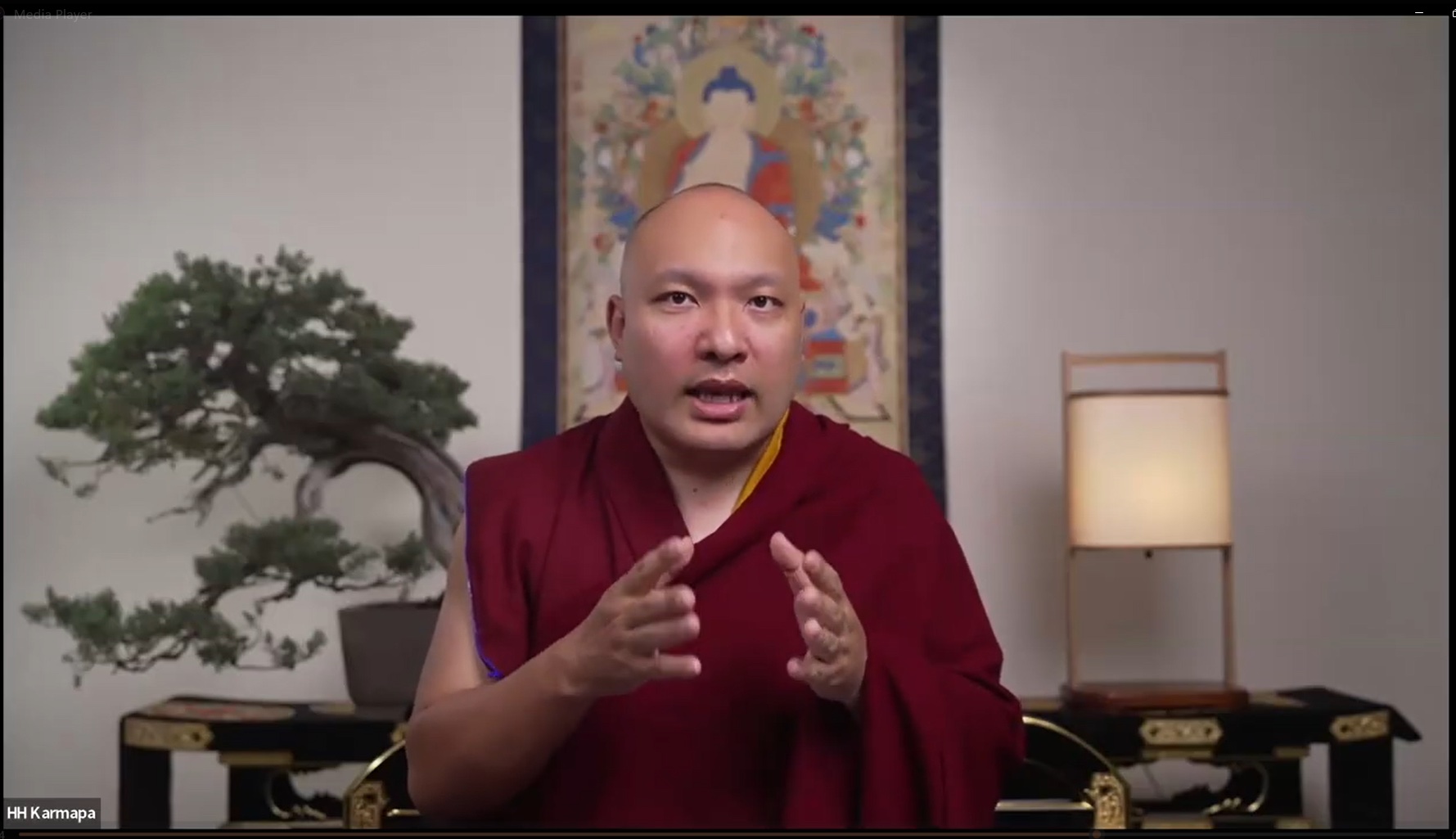
Today, his Holiness Karmapa provided a discussion of the original split of the Buddhist sangha considering both traditional and contemporary views, as well as by considering similarities and differences between the Northern and Southern transmissions.
The Summary of the Northern Transmission
The main sources on this topic are primarily Chinese sources, but they also include all Tibetan sources. One important resource is the work of a great Chinese scholar named Lǚ Chéng who lived during the end of the Qing dynasty and the beginning of the Republic of China. He was very learned and knew Sanskrit, Pāli, and Tibetan. Another influential researcher was Yin Shun, who was a Chinese scholar of Buddhism as well as a monastic. These men and others primarily referenced Vasumitra’s text The Wheel Distinguishing the Differences Between the Scriptural Traditions (Skt. Samayabhedoparacanacakra) and supplementary sources, including the notes on it by Xuanzang’s student Kuiji, and the Tibetan translation of Ācārya Bhāvaviveka’s Explaining the Differences Between the Schools (Skt. Nikāyabhedavibhaṅgavyākhyāna,), to reconcile and compile the development of the split into Buddhist schools in a framework called the “Five Stage Chronology of the Split into Schools.”
A Summary of the Five Stage Chronology of the Split into Schools
Here we will examine the original split of the Buddhist sangha by considering five different points.
- Initial split of the sangha over disputes in the Vinaya
Time and place: About 100 years after the Buddha’s parinirvāṇa during the second council of Vaiśālī.
Causes and results: Disagreements occurred regarding minor differences in keeping the precepts. In particular, the issue arose of whether the ten points were permissible or not – this was the first internal controversy within the sangha. Due to this disagreement, the initial forms of the Sthaviravāda and Mahāsāṃghika split into two groups. However, at this point these names had not yet been applied to these different factions.
- Debate about the Dharma
Time and place: Within 100-150 years of the Buddha’s parinirvāṇa within the City of Flowers (Skt. Kusumapura, another name for Pāṭaliputra), which is present-day Patna.
Causes and results: Disagreements about doctrine occurred, especially related to the controversy over the five points that raised doubts about the Arhats. Because of these disagreements, the Sthaviravāda and Mahāsāṃghika factions again opposed one another.
In the Tibetan tradition, Tārānātha’s History of Buddhism in India is often referenced, and this work states that Mahādeva was the first person to put forth and explain the five points, but they were then propagated by the bhikṣu Bhadra. However, it is worth noting that the earliest Chinese translation of the main source text The Wheel Distinguishing the Differences Between the Scriptural Traditions, produced in the Qin dynasty and titled The Treatise on the Eighteen Schools, and the second oldest translation, The Treatise on the Differences Between the Schools by Paramārtha, mention the five points but do not mention Mahādeva. As such, it is possible the version of the manuscript they translated predated Mahādeva, or that the character of Mahādeva was a later invention by Sarvāstivādins to make it appear as though the Mahāsāṃghika faction began the controversy.
- Official split into the original schools
Time and place: About 160-170 years after the Buddha’s parinirvāṇa during the reign of the dharma king Aśoka in the city of Pāṭaliputra.
Causes and results: By this time, the sangha was fully immersed in the debate about the five points, and reconciliation became impossible. As a result, the different groups split into the Sthaviravāda and Mahāsāṃghika schools. Before this time, there were different factions and members held differing positions, but now the official split between the two schools occurred. In addition, this was also the beginning of the later split into sub-schools.
- Sub-schools splitting off from the Mahāsāṃghika
Time: More than 200 years after the Buddha’s parinirvāṇa.
Causes and results: Of the two schools, the Mahāsāṃghika was the first to experience internal division, and various sub-schools arose. According to Vasumitra’s The Wheel Distinguishing the Differences Between the Scriptural Traditions, divisions continued to arise until eventually, there were nine different major Mahāsāṃghika schools including Ekavyāvahārika, Lokottaravāda, Kukkuṭika, and others.
- Sub-schools splitting off from the Sthaviravāda
Time: Between 200-300 years after the Buddha’s parinirvāṇa.
Causes and results: After some time, the Sthaviravāda school also experienced internal disagreements. The Wheel Distinguishing the Differences Between the Scriptural Traditions records disagreements over doctrine that led to a split into eleven major Sthaviravāda schools including Sarvāstivāda, Haimavata, Mahīśāsaka, Dharmaguptaka, Kāśyapīya, Sautrāntika, and others.
How Contemporary Scholars View the Five Stage Split into Schools
Modern scholars have noted that this view of the Five Stage Chronology of the Split into Schools is heavily biased towards the Sarvāstivādin accounts, such as The Wheel Distinguishing the Differences Between the Scriptural Traditions. Through engaging in comparative research and reviewing texts from other traditions, scholars now have a more nuanced picture of these events. We will discuss some of their refinements below.
1.The primary cause of the split into schools. It occurred due to developments in the Vinaya, and not due to debates about philosophical points
Traditional view: The split occurred because of Mahādeva’s five points, which raised doubts about arhats.
Contemporary view: When comparing the Vinaya (particularly the prātimokṣa sūtras) of the various schools, we see that the Mahāsāṃghika Vinaya is the oldest and shortest. We can thus conclude that the Sthaviravāda increased the number of precepts in the Vinaya, while the Mahāsāṃghika maintained the simpler form closer to what the Buddha had originally developed. Due to this disagreement over changing the precepts, a split in the sangha occurred.
The five points of Mahādeva were a doctrinal discussion that occurred later, only after the Caityaśaila sub-school of the Mahāsāṃghika had appeared. So it could not have been the cause for the original split. Much later, the Sarvāstivāda, such as the Great Exposition (Mahāvibhāṣā), called him a horrible person who had committed three of the five heinous deeds before he became a monk, and blamed his five points for the original split into schools in order to denigrate the Mahāsāṃghika school.
The other schools do not say that he committed any of the “five heinous acts”.
2.The story of Mahādeva is not factual history
Traditional view: Mahādeva was a horrible but clever person who had previously accumulated negative karma from committing several of the heinous deeds. For this reason, he developed and spread his view of the five points, thus destroying harmony in the sangha.
Contemporary view: At the time of the actual split into schools, the dispute of the five points of Mahādeva had not yet occurred. At a later date, Sarvāstivādin practitioners began to blame Mahādeva for the split in order to make their faction look better. The Chinese scholar Yin Shun reports that there may have been two venerable masters named Mahādeva – one was a scholar of the Mahāsāṃghika school at the time of Aśoka, and the other was the founder of the Caityaśaila school. There are also Mahāsāṃghika texts and other sources that report that Mahādeva was an elder who was worthy of great respect.
3.The influence of the dharma king Aśoka. He sought to resolve disputes and maintain harmony within the sangha; he did not wish to cause its destruction
Traditional view: The original split of the sangha occurred at the Council in Pāṭaliputra during Aśoka’s reign and Aśoka supported the Council, so he must have likewise supported the split.
Contemporary view: The disagreements within the sangha began before Aśoka ascended the throne [he was born at the end of the fourth century BCE and ascended the throne c.268 BCE]. Moreover, inscriptions on Aśokan pillars show he paid great attention to maintaining harmony within the sangha and supported the resolution of disputes.
4.The manner in which the rift between the two schools developed. It occurred gradually due to geographical separation, not because of disagreements that arose during a single council
Traditional view: At a certain time and place, many sangha members had gathered and a dispute on view led to disharmony and an immediate split of the sangha.
Contemporary view: As Buddhism spread throughout the whole of India, it spread into communities that were geographically distant from one another and that had different languages and customs. It is thus unsurprising that the scriptures evolved to meet the needs of the local populations. Then as these communities convened once more, disagreements naturally arose, and this led to the creation of different schools and lineages.
5.The text The Wheel Distinguishing the Differences Between the Scriptural Traditions is the account of one school of Buddhism and should not be taken as a comprehensive description of the entire historical picture
Traditional view: Vasumitra’s The Wheel Distinguishing the Differences Between the Scriptural Traditions is regarded as the authoritative text for understanding the framework of the split of the sangha.
Contemporary view: While acknowledging the importance of this work, modern scholars see the text as just one side of the story. There are large differences between The Wheel Distinguishing the Differences Between the Scriptural Traditions and sources like the Dīpavaṃsa, Mahāvaṃsa, and other sources of the Southern tradition. Compared to these sources, Vasumitra’s work is heavily biased towards the Sarvāstivāda. As such, we can see that a single text alone cannot show us the entire form and nature of the split that occurred in the sangha at that time, and we should be using multiple texts to understand what happened.
A Summary of the Southern Transmission Account of the Original Split into Two Schools
When we speak of Indian Buddhist history and the split into schools, it is important to understand that the Southern transmission, or the Pāli dharma lineages, have their own description of how the sangha split apart. To properly understand what happened, we must therefore study this tradition as well. The main texts of the Southern transmission that address this topic are the Dīpavaṃsa (Chronicle of the Island), the Mahāvaṃsa (The Great Chronicle), Buddhaghoṣa’s Samantapāsādikā (All-Pleasing), which is a commentary on the Vinaya, and The Debates Commentary [Pali. Kathāvatthu-aṭṭhakathā]. These texts report that the initial split occurred 100 years after the Buddha’s parinirvāṇa due to a controversy, in Vaiśālī regarding the ten impermissible points, after which they held the Great Council, the Mahāsaṃgīti. Studying these texts in depth and performing a comparative analysis, we see that while this controversy played a role in the split, it is not the whole reason for the split, but rather the picture is complex and many causes led to the eventual division.
Within the source texts of the Southern transmission, different accounts are reported. For example, the earliest manuscript, the Pāli Tipiṭaka (Skt: Tripiṭaka), provides a different account than later commentaries and histories.
In the Pāli Vinaya Piṭaka, in the twelfth section of the Minor Topics (Pali. Cullavagga) it states that an elder, Yasa [Skt: Yaśa], objected to the Vajjiputtaka [Skt: Vṛjiputraka i.e. Sons of Vṛji] bhikkhus engaging in the Ten Points and said it was contrary to the Vinaya. To address this issue, he gathered seven hundred arhats from the Eastern and Western regions in Vesālī [Skt: Vaiśālī] and held the Second Council, where they determined the ten points were impermissible. This is described in great detail in the chapter on “The Council of the 700”. However, in this text, the discussion of the topic ends here, and there is nothing said about this split of the sangha or the creation of the Mahāsāṃghika school. (This is very similar to the Tibetan tradition found in the Mūlasarvāstivādin Minor Topics, which mentions the ten impermissible points and the Council of the 700, but has no discussion of the original split into schools at this time.) Thus, this seminal text includes mention of the debate about the ten points at the Second Council, but it says nothing about the split of the sangha.
This observation gives us a basic timeline of events. Since the split is not mentioned in this text, we can assume that either the Sthaviravāda and Mahāsāṃghika had not completely split into separate institutions at this point, or that the compilers of the Vinaya wished to hide the circumstances surrounding the split. One reason they might wish to hide it could be that the Mahāsāṃghika Vinaya only includes one of the ten impermissible points related to accepting gold or silver; the other nine points are not taught. However, both the Mahāsāṃghika and Pāli Vinaya describe the Council of the Seven Hundred, so there is no doubt that this council is a historical fact. Yet the original split into schools is not mentioned in either of these Vinayas, so we can assume that this event likely did not occur during this council.
The clearest account of the original split into schools in the Southern transmission comes from the Dīpavaṃsa, which was written between the third and fourth centuries CE. This account is the first description of the split into schools. The later, fifth-century texts the Mahāvaṃsa and the Samantapāsādikā commentary on the Vinaya provide further detail of the event. These two later texts report that there were two key outcomes of the Second Council. First, the sangha attained the support of King Kalāśoka, who supported the council meeting. Second, the 10,000 bhikkhus who had broken the rules lost the conflict. In protest, they held their own “Great Council,” the Mahāsaṃgīti, where they formed the new Mahāsāṃghika.
Reviewing these sources, we can see that even within the Southern tradition, the split of the sangha was explained in different ways. There’s a great discrepancy between the account in the Pāli Vinaya Piṭaka and later accounts in the Debates Commentary and the historical texts. These later accounts are a compilation of later scriptures and texts compiled by historians of the Mahāvihāra schools to prove the orthodoxy of their own school.