

29 July 2026
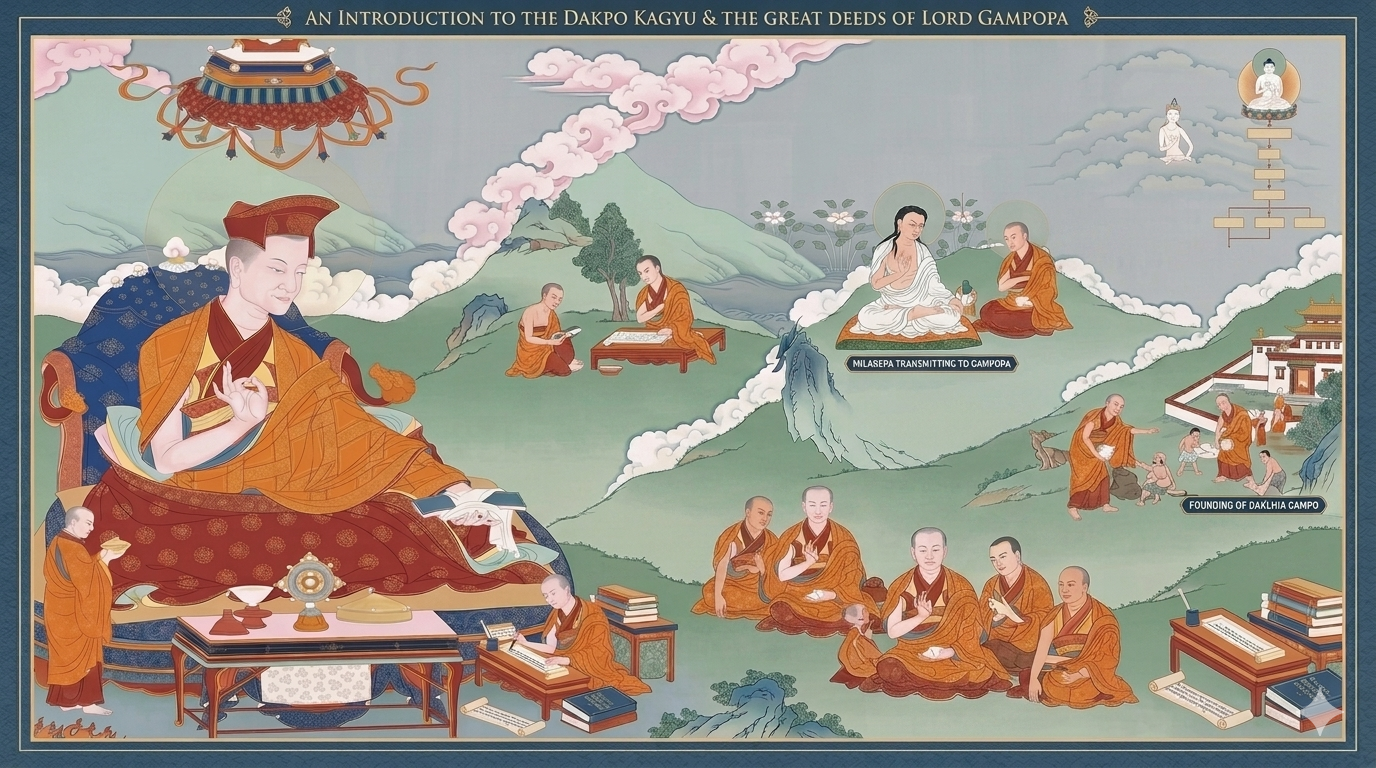
On the anniversary of Lord Gampopa’s parinirvāṇa, the 17th Gyalwang Karmapa gave the following special talk.
Today is the anniversary of the peerless Gampopa, the King of Dharma in the land of Tibet, and I thought it would be very good for all of us to remind ourselves of the great qualities of the Dharma Lord Gampopa, of his deeds, as well as of the particular qualities and important points of this lineage that’s come to be known as the “Precious Dakpo Kagyu”. I thought that if I pointed out a few of them, it would be extremely meaningful for everyone.
During the development of the Later Transmission of the Dharma in Tibet, the founder of the
Dakpo Kagyu, the peerless Gampopa Sönam Rinchen (1079–1153 C.E.), was a single irreplaceable figure. He unified the tantric tradition of Mahāmudrā passed down from the Indian mahāsiddhas Tilopa and Nāropa, through Marpa the Translator and Milarepa, with the Kadampa Stages of the Path (lamrim) passed down from Lord Atiśa, and in this way, he founded the fine tradition that became known in Tibetan Buddhist history as the “confluence of the Kadampa and Mahāmudrā.”
Life Changes: From a Physician to Master of the Teachings
Gampopa was born in Dakpo in the eastern part of Tibet. When he was a child, he was very intelligent, so starting at the age of seven, he studied medicine with thirteen learned Indian, Newari, and Tibetan physicians, and completed his medical education. Due to this he became very well-known as a great skilled physician, and was given the name Dakpo Lhaje, the physician from Dakpo.
When he was twenty-five, his wife, son, and daughter suddenly died in an epidemic, and because of this tragedy, Dakpo Lhaje, Gampopa himself, developed a profound recognition of impermanence and the suffering of birth, ageing, sickness, and death.
He gave up all worldly affairs completely and made a commitment to practice the dharma
single-pointedly. So, at the age of twenty-six, he took full ordination from the Kadampa Geshe Maryul Loden Sherap, becoming a Kadampa monk. For many years afterwards, he studied the Kadampa texts on philosophy, and in particular, he completed his study of the stages of the path of renunciation, bodhichitta, and so forth. By the time he had completed his studies, he had developed excellent experience and realization.
Now the event that was a turning point not only in his own life, but also in the development
of Tibetan Buddhism as a whole, was when he heard the name of Jetsun Milarepa, and went to receive dharma teachings from him. When Gampopa first met Jetsun Milarepa at Trodey Tashi Gang (Tib. སྤྲོ་བདེ་བཀྲ་ཤིས་སྒང་ ), Milarepa gave Gampopa—a fully-ordained bhikshu—a skull-cup of Tibetan beer (chang) and told him to drink it. Gampopa hesitated at first because he was a bhikshu, and drinking the beer would violate his bhikshu vows, but in the end, he drank it all, without any reservation, the entire skull-cup of beer. This shows that he was not one who only held external appearances to be important; he also was someone who held the ultimate practice to be paramount.
And so, in this way, through Milarepa’s instruction, Gampopa developed complete realisation of all the stages of the path, and he became able to practice the path of tantra in union with the path of philosophy and the sutras. In any case, through Milarepa’s instruction, Gampopa developed complete realisation, and in the end, Milarepa prophesied that he would be the main holder of his lineage.
The Confluence of the Kadampa and Mahāmudrā: The Key Points of the Three Vehicles
One of Gampopa’s most important deeds was that he instituted what we call the “confluence of the Kadampa and Mahāmudrā”, a method that teaches how a single individual
should practice the stages of the path from the discipline of the śrāvakas to the bodhichitta of the Mahāyāna and the mahāmudrā of Secret Mantra.
When Buddhism first spread in the world, it was the dharma or vehicle of the śrāvakas that spread initially. In the śrāvaka tradition, renunciation of saṃsāra and the discipline of personal liberation are considered most important. Likewise, when the Buddha first taught the Dharma, what he taught was the Four Truths, and the first of these four is the truth of suffering. As Ācārya Āryadeva writes in his Four Hundred Verses:
If there is not any end
To this ocean of suffering,
Why is it that you childish beings
Who drown in it have no fear?
Unless we have no attachment to saṃsāra, this ocean of suffering, and recognise suffering
to be suffering, we will not be able to practice the dharma of any of the three vehicles properly.
This is why Lord Atiśa wrote in his Lamp for the Path to Enlightenment:
Those who by whatever means
Pursue for their own sake
Merely the pleasures of saṃsāra
Are known as the lowest persons.
As this teaches, those who seek only the pleasures of this life, or only the higher realms and the next, are considered lesser individuals. It is difficult for them to become people who will be able to practice the dharma of all three vehicles.
The Discipline of Personal Liberation
And so, though Gampopa was married at first, because of an epidemic, he lost his wife and
children and this caused him to develop an uncontrived renunciation of saṃsāra, Due to this, he went forth and became a bhikshu. As Nāgārjuna said:
Just like the earth for the moving and unmoving,
Discipline is the basis of all qualities.
As Buddhism teaches, among the three trainings, the training in discipline is like the basis
or foundation. Generally, when we talk about vows in Tibetan, there are three types of vows:
those of personal liberation, bodhichitta, and mantra. We do speak about these three types of vows, but the ones that are best known to all Buddhists are the prātimokṣa vows of personal liberation. The prātimokṣa vows of personal liberation include both monastic and lay vows, but it is the monastic vows that are primary, and monastics are the primary upholders
of the teachings, as both sutra and tantra agree. Lord Gampopa himself went forth in the presence of Lama Ngari and others and took the vows of a bhikshu with a complete set of precepts. Because of this, the disciples who upheld Gampopa’s lineage—Pakdru Dorje Gyalpo, Dusum Khyenpa, Barom Darma Wangchuk, among others, and their disciples, are almost all bhikshus.
In the past a large gap had existed between the yogis who practised with hardship in solitary mountain retreats and the monastic sangha who practised the three trainings of listening, contemplation and meditation together in groups, but Gampopa erased that gap.
He transformed the way of practising Secret Mantra, previously scattered in mountain retreats and isolated spots, into a structured system for the monastic community to practice.
With this, he created a solid foundation for the systematic practice of the Dakpo Kagyu overall,
and the four elder and eight younger lineages in particular.
Bodhichitta and the Middle Way View
The discipline of the śrāvakas alone is the foundation and is not enough to achieve the cause for attaining buddhahood. It is also important for us to have the Mahāyāna, for the essence of the Mahāyāna is bodhichitta. As Nāgārjuna stated:
If I and this whole world should wish
For unexcelled enlightenment,
The root of that is bodhichitta,
As stable as the king of mountains…
This teaches how important bodhichitta is for the practice of the Mahāyāna.
Gampopa saw that, at that time in Tibet, there were no instructions about the general Mahāyāna view superior to those of the Kadampas, and specifically instructions on the generation of bodhichitta. Since the main hub of the Kadampa teachings was in the Phanpo region, he travelled there and received instructions on generating bodhichitta from the Kadampa master Geshe Nyukrumpa. Gampopa generated uncontrived bodhichitta in his mind stream. He said that Nyukrumpa had uncontrived bodhichitta, and the same thing happened for him. He also said that from that time on, he was never without bodhichitta in his mind.
Another thing that Atiśa said in his Lamp for the Path of Enlightenment is:
Prajñā without skillful means
And means that lack prajñā
Are bondage, it is said, and thus
Don’t discard either one.
It’s also said in the Sublime Continuum:
Generosity produces wealth,
Discipline the higher realms, and meditation
Eliminates the afflictions.
Prajñā eliminates the afflicted and cognitive,
So it is supreme. Its cause is listening.
To attain Buddhahood, bodhichitta alone is insufficient; it must be embraced by the view of emptiness. In Tibet, the view of emptiness was later pursued primarily through the Consequentialist-Mādhyamaka tradition, which was first introduced to Tibet by Lord Atiśa. Lord Atiśa taught the Mādhyamaka view and Mahāmudrā mainly to Geshe Gönpawa, who then taught Gya Yöndak. Gampopa then received the Mādhyamaka view originating from Atiśa through Gya Yöndak, who told him, “I will teach you the traditions on the Middle Way that have been passed down from Atiśa without any interruption, so now I shall give them to you.” This is one of the primary reasons why the view of the Kagyu tradition is said to be Middle Way in general and Consequentialist in particular.
Likewise, there is Gampopa’s treatise on the stages of the path The Jewel Ornament of Liberation. It’s like a garland that strings together the Kadampa and Mahāmudrā lineages.
In this text, Gampopa presents buddha-nature as being the cause, the precious human body
as the support, and the spiritual friend as the conditions. In this way, he teaches how we should practice the Kadampa paths of the three types of individuals, and ultimately it leads into Mahāmudrā. By doing so, he eliminated the division between scholars who only studied, and tantric practitioners who only practised meditation. He taught that there is no difference between them. He taught the union of Sūtra and Tantra, the view and practice in union.
Condensing the Key Points of Meditation Practice
Another really amazing deed of Gampopa was the way that he taught meditation to other
people. This is a particular quality of Gampopa. Meditation practice is the root of all worldly and supramundane qualities. There are many different ways we can meditate but if we summarise them, all ways of meditating are contained within śamatha (En. calm abiding; Tib. ཞི་གནས་) and insight (Skt.vipaśyanā; Tib. ལྷག་མཐོང་.) Of these two, śamatha and insight, at the beginning, it is śamatha that is more important. As Śāntideva wrote in The Way of the Bodhisattva:
Realising that afflictions are destroyed
By śamatha and insight in conjunction,
He is teaching that we should devote ourselves to śamatha and it is indispensable for benefiting sentient beings; without śamatha, clairvoyant powers will not arise, making it impossible to know another person’s level.
As Lord Atiśa stated in the Lamp for the Path to Enlightenment:
Just as a bird whose wings aren’t fledged
Cannot fly in the sky,
Without the powers of clairvoyance,
One cannot benefit beings.
As Shantideva says, unless you have clairvoyant powers, you will not be able to understand
how to benefit beings, and you will be unable to benefit them.
It also says in the Lamp for the Path to Enlightenment:
Without achieving śamatha,
Clairvoyances will not occur.
Thus, make repeated efforts to
Accomplish śamatha.
Recognizing the importance of accomplishing śamatha, from the time he took monastic vows, Gampopa practised śamatha meditation under masters like Lama Ngariwa. He also took teachings which included instructions that had been passed down from Milarepa. Gampopa said that he achieved excellent experience in śamatha, remaining in single-pointed concentration for up to thirteen days, experiencing hazy rainbow-like appearances and other meditative signs. As he received these instructions from Gya Yöndak, who had received them directly from Milarepa, Gampopa had an incredible experience that he was unable to describe.
When we talk about our Mahāmudrā practices, we talk about the unified practice
of śamatha and insight. Consequently, the transmissions of meditation instruction in Tibet generally, the sūtra-tradition śamatha that comes from Lord Atiśa, and the insight instructions in particular, have come down in the instructions of the Dakpo Kagyu.
Likewise, among the instructions in Secret Mantra Vajrayana and the Land of Snows, there are none that are superior to those from the Indian paṇḍita Nāropa, and his heart-son Lhotrak Marpa Lotsāwa, the translator. By practicing these instructions, you can achieve the state of Vajradhara in a single lifetime and become like a king of siddhas, and the one who did this, who was the crown ornament of accomplished masters, the king of siddhas, is Jetsun Milarepa
.
He endured immeasurable hardships under Marpa, who ultimately bestowed upon him the empowerment of Vajravārāhī and instructions on the Six Dharmas of Nāropa, primarily on tuṃmo (inner heat).
Now the Six Dharmas of Naropa, as it is said in the tradition of Marpa and his disciples,
are called the “King of all Completion Stages”. Karmapa Mikyö Dorje said that
the illusory practice and luminous clarity taught within the illusory body and the luminous
quality represent the main completion practices of the father tantras such as the Guhyasamāja. Tummo is like the core completion stage of the mother tantras such as Cakrasaṃvara and Hevajra. And other aspects, such as the dream practice and bardo include many of the key points of the completion stages of several tantras. Gampopa not only heard all of these from Jetsun Milarepa, but he thoroughly put them into practice.
In the end, Milarepa praised him and said, “You don’t need me anymore. Rather than staying with me, you can go anywhere. You don’t need to remain with me.”
Then he made prophecies such as: “According to my dreams, in the future you will be able to benefit beings even more than I have,” before sending him back to his home region.
Gampopa himself, after he had returned to his homeland, continued to practice
for over seven years and as the power of his realisation of luminosity matured, all thought
became luminosity and then, whether he was in meditation or not, his realisation of luminosity was uninterrupted.
And so, as Jetsun Milarepa had taught, if a meditator’s power of realisation of luminosity is perfected, even in death there is no appearance of the bardo, and one awakens in the state of the dharmakāya luminosity; Gampopa later told Düsum Khyenpa that this had occurred for him.
One of Gampopa’s greatest innovations was the establishment of the “sūtra-tradition Mahāmudrā.” According to the Eighth Karmapa Mikyö Dorje’s Chariot of the Dakpo Lineage, when Marpa and Milarepa taught Mahāmudrā guidance, they taught it in connection with the luminosity of the Six Dharmas rather than as a separate system. There is no way of teaching Mahāmudrā separate from luminosity. Because of Gampopa’s own experience and realisation of thought arising as luminous clarity, through Milarepa’s instructions, Gampopa gave the instructions on the co-emergent yoga of Mahāmudrā —pointing out conceptual thoughts as the dharmakāya. This aligned with the instructions on the mind expressed in the vajra dohā songs spoken by great Indian mahāsiddhas such as Sarahā, Śavaripa, Virūpa, Kṛṣṇācārya, Tilopa, Nāropa, and Maitrīpa when they developed the power of realisation matured, and so this became universally known as Mahāmudrā.
Because of this, many ordained masters, primarily Kadampas, became Gampopa’s
disciples. The Jonang master Tāranātha noted that even many young monks attained high realisations, and, according to Tāranātha, the tradition of giving direct mind-guidance, mind instructions, in Tibet originated with Gampopa.
In short, according to traditional Indian tantric practice, Mahāmudrā was a completion stage practice and, because it was a completion stage practice, practitioners must have the empowerments of the unexcelled yoga tantra and go through the creation and completion stages of the meditational deity (yidam). However, Gampopa taught that for those with sharp faculties, even without receiving tantric empowerments, if the nature of mind is pointed out, based on the view of the Prajñāpāramitā Sūtras, they can directly realise the indivisible nature of clarity and emptiness. Furthermore, Gampopa taught the special meditation method of co-emergent yoga. From the perspective of the view, he united the Cittamātra tantra concept of the mind’s “luminous awareness” with the Mādhyamaka reasoning that all phenomena are “unborn.” By showing that co-emergent mind and co-emergent appearance share a single essence, he taught how to directly sustain the natural state from a condition of ordinary, unfabricated mind.
By making the stages of Mahāmudrā meditation widely accessible to the public, teaching it in accordance with the Sūtra system, and turning it into a widespread path, the gateway to practicing Mahāmudrā was made extremely broad and accessible. As a result, hundreds of thousands of followers were able to engage in the practice of Mahāmudrā through a systematic and safe approach. And this comes down to Gampopa.
Systematising Meditation Practice: The Four Dharmas of Gampopa and the Four Yogas
Not only did Gampopa create a grand framework uniting the Secret Mantra, but he
also innovated a clear sequential path of instructions that condensed the vital essence
of the actual practice. Among these, the most important are “The Four Dharmas of Gampopa” and “The Four Yogas of Mahāmudrā”.
The Four Dharmas of Gampopa
These are the ones recited daily in the Dakpo Kagyu as a daily prayer or aspiration.
This is one of the things that we all recite and this actually gives us a really profound
guide on how to train gradually in the path. They really present the important points.
1. Bless us that our minds become the dharma. Thinking that at the time of death we must leave behind body, wealth, and loved ones to depart alone, rather than committing various misdeeds for the sake of this life alone, we need to work hard, we need to strive on the path to achieve a good rebirth in our future lives. And so without this, it’s difficult for us to develop a positive, wholesome dharma.
2. Bless us that the dharma become the path. Recognising that none of the phenomena of saṃsāra transcend suffering, we arouse a mind seeking liberation. We understand that the only way to achieve this is to practice the Dharma, and this means that no matter what practice we do, it actually becomes a path to liberation. If this doesn’t happen, it becomes difficult for it to become the authentic Buddhist Dharma of any of the three vehicles.
3. Bless us that the path dispel confusion. Although the previous steps lead onto the path of Śrāvakas and Pratyekabuddhas, they are not enough on their own. From the Mahāyāna perspective it is still mistaken. We need to rely on the Mahāyāna view of emptiness and on bodhichitta, so that we can achieve the unerring path that leads to Buddhahood, that does not dwell in either existence (saṃsāra) or peace (nirvāṇa). Without this, it will not become Mahāyāna Dharma.
4. Bless us that confusion arise as wisdom. Even if we train in aspiring and engaged bodhichitta, it is difficult for us to stop all confused appearances. In order to do this, we need to meditate on all phenomena arising as the ultimate freedom from arising and ceasing; we need to recognize that they arise as a display of the mind. We need to look at the nature of that mind and realize that mind is this co-emergent wisdom. Only then does it become the yoga of Mahāmudrā.
These four dharmas must be practised progressively, like steps on a staircase or ladder.
The first two lines contain many of the points of the Kadampa instructions, while the
last two lines contain the key points of the Secret Mantra and Mahāmudrā practice.
The Four Yogas
Gampopa expressed the arising of Mahāmudrā realisation not merely as “textual explanations,” but through experiential application as the “Four Yogas.” Although the Four Yogas were clearly detailed earlier in Lord Atiśa’s Mahāmudrā instructions to Gönpawa (meaning Gampopa was not the first to speak of them), he was the one who made them widely known. The Four Yogas are: single-pointedness (Skt. ekāgratā); simplicity (Skt. niṣprapañca); one taste (Skt. samarāsa); and non-meditation (Skt. abhāvana)
When each of these four is divided into lesser, medium, and greater degrees, they form the “Twelve Stages of the Four Yogas.”
Just to give a brief introduction to these four points, the first is the yoga of one-pointedness. One-pointedness means that no matter what focus the mind is directed towards, it is able to remain stable, one-pointedly focused on that object, so that you become able to recognise the meditative state that you wish.
The second is the yoga of simplicity. It means that when the mind remains on a single object without wandering or being distracted, we realise that all phenomena are free of all the attributes of conceptual elaboration. At that point, we see the actual nature as it is, and the previous understanding of listening and contemplation becomes like a mere outer husk that falls away, and we have the actual realisation.
The yoga of one-taste: if we are able to remain within that state of realising
the unelaborate nature, the multiple arises as one thing. At that point, all appearances are known to be mind, the mind becomes one taste with emptiness, and emptiness is of one taste with the unborn.
The fourth is the yoga of non-meditation, after realising the meaning of one-taste, and
as that realisation increases, it becomes the realisation of non-meditation, and at that point, it becomes the realisation of Mahāmudrā.
Concluding remarks
To sum up, Lord Gampopa was like a master of the teachings who combined within a single
lifetime, the love required of a father for his family, the care required of
a great physician caring for their patients, the discipline of a Kadampa
monk in terms of the discipline and mind-training practice, and the level of realisation
required of a great tantric yogi—he was a master of the teachings who had all of these qualities. In this way, he united Lord Atiśa’s sūtra-tradition Stages of the Path
with the tantric teachings of Mahāmudrā, transmitted from Jetsun Milarepa, he developed
a lineage combining sūtra and mantra, view and meditation, and textual tradition with oral instruction.
Rather than using dharma as a way to accomplish the eight worldly concerns— such as
a long life, freedom from illness, removing obstacles or gaining the victory in battle— he taught this as a supreme method for actualising the state of Vajradhara in this very life.
Thus, it is said that many of Tibet’s accomplished masters arose from the Kagyu tradition.
On this anniversary of Lord Gampopa’s parinirvāṇa, we are recognising the greatness and vital importance of the Dakpo Kagyu Dharma in connection with Lord Gampopa’s namthar (sacred life story). I think that this is immense good fortune and very meaningful, so I’d like to say “thank you” to everyone.