

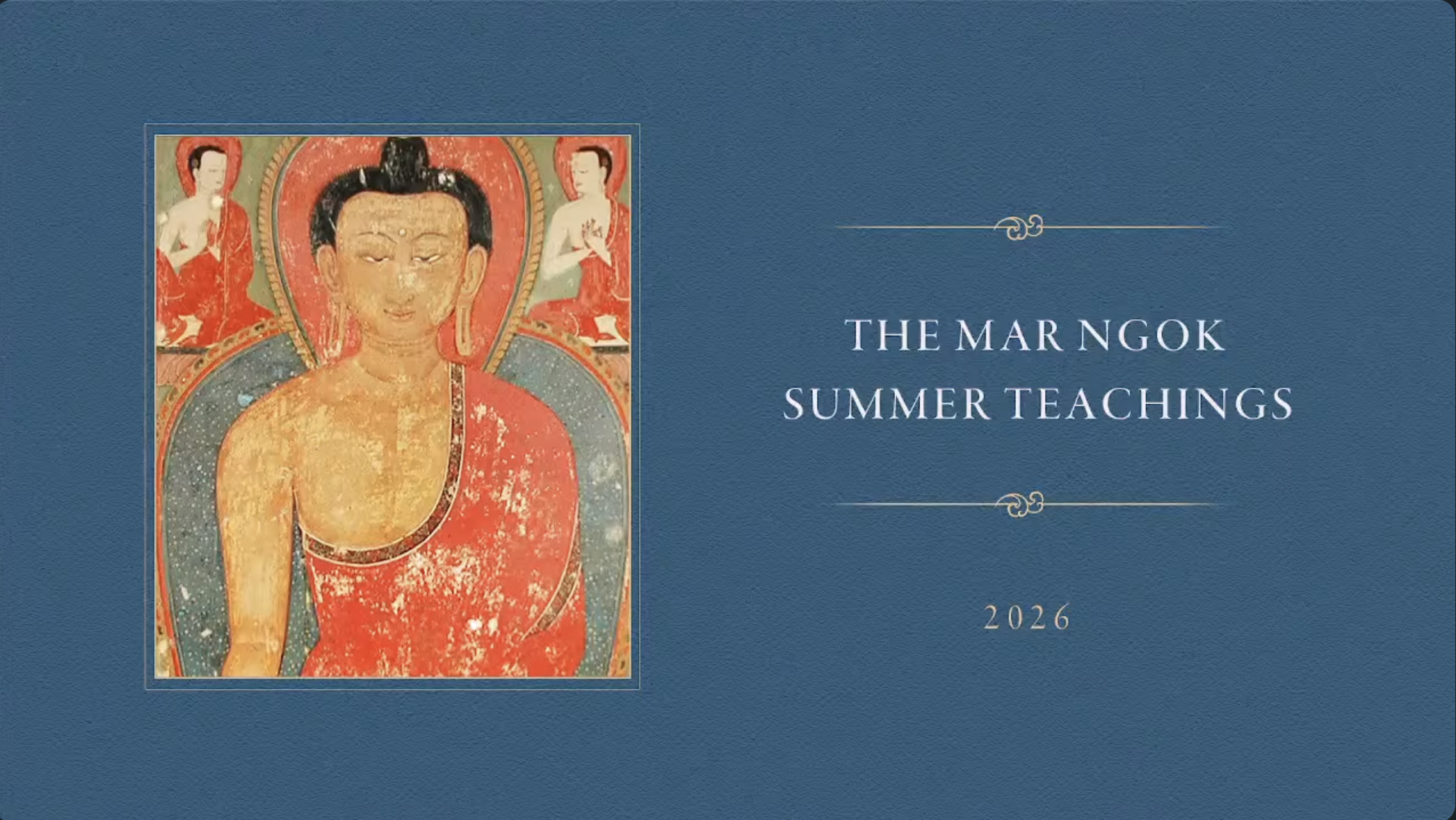
Origins of Secret Mantra • Day One
21 July 2026
A Perspective on the Teachings
After greeting everyone and wishing them well, the Gyalwang Karmapa began the first session of this year’s Mar Ngok Summer Teachings with a recap of the teachings he has given over the last few years and an explanation of the intentions behind them.
He explained that from one perspective, their primary intention is to increase understanding of the development of ancient Buddhism in India, using a broader base than the traditional accounts in Tibetan scriptures. Consequently, he has drawn on descriptions in the Theravādan and Chinese traditions. Additionally, he wanted to introduce a better knowledge and understanding of contemporary academic research by contemporary Asian and Western scholars. He has tried as much as possible “to bring together all the words of Indian, Chinese and Tibetan scholars, ancient and modern, Asian and Western”.
From another perspective, the teachings aim to nurture traditional Buddhist study skills of proper listening and contemplation. With the Secret Mantra in particular, they first began with teachings on the Fifty Verses on the Guru (Skt. Gurupañcāśikā) by Vāpilladatta/Bhabilha. These teachings have been completed, and the Karmapa hopes to continue with The Infinite Ocean of Samaya (Tib. དམ་ཚིག་རྒྱ་མཚོ་མཐའ་ཡས་པ་ཞེས་བྱ་བ།) by the Third Karmapa Rangjung Dorje and other topics in future.
Thirdly, for the benefit of those in the shedras and monastic colleges, the Karmapa thought he should speak about the transmission of the Mind Only (Cittamātra/Yogācāra) school teachings. These have been preserved in their entirety in the Chinese Buddhist scriptures, but language barriers have precluded the majority of students from studying them: “I thought that it would be good if I could offer a bit of service in this area, and so I have begun teaching on the Thirty Verses of the Mind Only [Skt. Triṃśikā-vijñaptimātratā by Vasubandhu]. My intention is to be able to continue this and I’m making preparations to do so.”
The Mar Ngok Summer Teachings have covered ancient Indian religion and philosophy prior to the spread of Buddhism, the deeds of the Buddha, the situation in society, events following the Mahāparinirvāṇa, the seven Elders of Buddhism, the patriarchs, the second, third, fourth and other councils, and the various differing presentations and opinions about those. This year, the Karmapa will start with the spread of the eighteen schools and so forth and continue on to the development and spread of the Mahāyāna.
The rationale for studying the history and development of Buddhism during the Mar Ngok Summer teachings is to counter the lack of understanding or even interest these days among sangha members of the period of the 18 schools in Buddhist history and the philosophies of those schools. Without an understanding of this:
It would be difficult for us to have a complete understanding of the Mahāyāna Dharma that followed from them and the secret mantra that then followed from that…They’re each dependent upon the other. So, at a fundamental level, if we do not understand early Buddhism and the Buddhism of the period of the schools, Nikāya Buddhism, we’ll be unable to have a good understanding
of the history of and philosophy of Buddhism as a whole.
The Karmapa explained that he would present the work of Asian and Western scholars to the best of his ability, but, as there are innumerable books and articles, it would be beneficial if those who know the relevant languages undertook more reading and research.
The Background to the Development of Nikāya Buddhism
The topics for this year, based on Nikāya Buddhism and its supporting history, will be:
- the origins of Nikāya Buddhism;
- Buddhist followers: lay and monastic;
- the tradition of monasticism;
- the tradition of donors;
- the role of the merchant class;
- the development of the Abhidharma scriptures.
The Origins of Nikāya Buddhism
The term refers to the time of the 18 schools. Early Buddhism had been unified, but about 100 years after the Buddha’s parinirvāṇa, the monastic sangha split into two sects: the Sthaviravāda and the Mahāsāṃghika schools. That is the beginning of Nikāya Buddhism, the period of the schools (Pali. nikāya means ‘group’ or ‘assembly’). It lasted for several centuries.
Buddhist Followers: Lay and Monastic
During the time of early Buddhism, the term śrāvaka (listener or disciple) could be applied to lay disciples of the Buddha as well as monastics. However, during the period of Nikāya Buddhism, the term śrāvaka is used only for those who are monastic students within the 18 schools. So, during the time of Nikāya Buddhism, it seems that the use of the term ‘śrāvaka’ became restricted to monastic disciples.
There were many devout lay followers, primarily householders, who had great faith in the Buddha, but they were not included in the schools, and historical records do not describe in detail how lay practitioners practised dharma. Many of the world religions, including Hindus and Christians, have two distinct communities of laypeople and monastics. Some religions, such as Islam, clearly prohibit monasticism and celibacy, and do not have both lay and monastic communities.
In Buddhism, both communities exist, however, the monastic community is considered the primary and more important of the two. That doesn’t mean that lay followers have no status. We often speak about the fourfold community of Buddhist followers. The fourfold community comprises male and female lay practitioners– the upāsaka and upāsikā – as well as monks and nuns, and the household followers are actually considered to be equally as important as the monastic sangha. In general, in terms of achieving a high level of teaching and study of the Buddhist scriptures– listening to them, contemplating them, and meditating on them–the monastic community is extremely important because this is its function: to study the Buddhist scriptures, and to listen, contemplate, and meditate on them. Lay practitioners lack the time to focus entirely on listening, contemplating, and meditating because they have so much work to do. In terms of protecting the teachings, the foundation is the monastic sangha. However, in order for the monastic community to exist, they need financial resources, they need the support of society, and the opportunity to follow the life of monastics. In order for that to happen, there has to be a lay community.
However, in later times, there were many invasions, and Islam spread through India. During that time, Hinduism survived but Buddhism disappeared. Many scholars posit the reason for this was that Buddhism had become a religion solely for the monastic sangha, and when the
monastic sangha was destroyed, then Buddhism ceased to exist.
Ancient historical documents do not describe clearly what lay followers did to
preserve Buddhism, but there are some details preserved in the texts that show how lay followers were extremely active and diligent in spreading Buddhism throughout ancient India. To give one example, after the Buddha passed away, there were four sacred Buddhist sites: the place of the Buddha’s birth; the place of Buddha’s awakening; the place where he first turned the wheel of Dharma; and the place of the Mahāparinirvāṇa. It was primarily lay followers who built and maintained monuments and stupas at these pivotal sites.
Likewise, after the Buddha’s parinirvāṇa, the relics were divided into eight
parts and distributed to eight different kings, lay followers, who then returned to their own kingdoms and built the eight reliquary stupas. These stupas were not erected inside the grounds of monasteries but at places where ordinary people gathered such as crossroads.
According to the Mahāparinirvāṇa Sūtra, extant now in Chinese and Tibetan, King Aśoka
opened these eight stupas, divided the relics into smaller amounts, and built stupas throughout all of India. This shows that the practice of worshipping at stupas or having faith in stupas had already developed and spread widely by the time of King Aśoka, so it must have developed during the period of early Buddhism. From this tradition of worshipping stupas during the period of early Buddhism, there gradually developed the traditions of worshipping the Buddha and praising the Buddha’s qualities. This was a critical point in the later spread of the Mahāyāna. Hence, it would be inappropriate to disregard or ignore the contributions that lay practitioners made.
However, regarding Nikāya Buddhism, at that time, the main upholders of Buddha’s lineage were the śrāvakas, who were monastics. They held an unbroken lineage passed down from Mahākāśyapa and Ānanda, direct disciples of Śākyamuni Buddha.
Nikāya Buddhism is characterised as “The Buddhism of the disciples (śrāvakas), or the Buddhism of the appearance of different doctrines.”
During the time of Nikāya Buddhism, there were many disagreements about philosophy and doctrine leading to the split into different schools. The term ‘śrāvaka’ means ‘listener’ and originally referred to those people who had heard and listened to the teachings given by the Buddha, but, basically, it came to mean ‘disciple’, and, although in early Buddhism it could be used for both lay and monastic followers, during the period of Nikāya Buddhism it’s use became limited to monastics. Later Mahāyāna would call Nikāya Buddhism the listener vehicle or the śrāvaka vehicle.
The Tradition of Monasticism
One of the particular features of Nikāya Buddhism, the Buddhism of the schools, is it was a tradition primarily upheld by monastics: those who had gone forth from home to homeless and then taken vows and become bhikṣus (bhikshus). They then had to keep their vows purely and practice the Dharma. There was a very clear distinction made between householders and monastics. Householders had not gone forth and monastics were not householders.
Monastics primarily practiced the Vinaya. They stayed in isolation, kept the vows of the Vinaya, and concentrated on listening, contemplation and meditation. Their way of life was
one of few desires and contentment with what they had, focused one-pointedly on listening, contemplation and meditation. The monastic lifestyle was not one practised in the marketplace or among large groups. Instead, they distanced themselves from the general public and lived in isolated monasteries, sometimes far away from towns and villages, where they could devote themselves to perfecting their own practice first. The aim was not
to liberate other people. For that reason, later followers of Mahāyāna Buddhism, who emphasised benefitting and liberating others, called this tradition the Hinayāna or lesser vehicle, implying that it was inferior.
.
The Tradition of Donors
The tradition of donors made the growth of monasticism possible.
Monastics were free to concentrate on their Buddhist practices; they did not need to earn a livelihood because the monasteries at that time were prosperous. They were thriving. They were financially secure. Kings, queens and wealthy merchants had gone for refuge to them and given them great financial support. These sponsors donated large tracts of land to monasteries. For example, there’s the well-known story of King Kaniṣka who went for refuge to the Sarvāstivāda school and then supported them significantly.
Even earlier than that, ancient rock and pillar inscriptions record how various rulers in northern India and others donated land to the sangha. Likewise, in southern India, inscriptions record how the kings and queens of the Andhra dynasty supported the monks and nuns of the sangha. A significant number of pillar inscriptions dating from the second century BCE until the fifth century CE record many instances where stupas were built, land was offered for residences for the sangha, caves were offered and so forth.
Also, it is important to know that, though in Tibetan we always talk about 18 śrāvaka schools, these inscriptions evidence the existence of more than 20 schools.
The Role of the Merchant Class
Not only did the Sangha receive support from royalty, it also received support from the merchant class.
From the very start of the spread of Buddhism, merchants played an important part. After the
Buddha awoke to enlightenment, his first students were the merchants Trapusa and Bahalika.
These two were also the first to offer him alms after he reached the awakening, and he gave them teachings. Then the Buddha went to Sarnath, converted the Good Group of Five and turned the wheel of Dharma for the first time. Following this, many of his followers were merchants: among the many important disciples of the Buddha, one was Anāthapiṇḍada, a very wealthy merchant.
Later, merchants more than monastics were instrumental in bringing the Buddhadharma to other countries such as China. The reason is that travellers were mainly from the merchant caste and it was not easy for monastics to travel at that time. Not just Buddhism but also Islam and Christianity were spread similarly by merchants through trade routes. Travelling itself was difficult, dangerous and full of hardship. Merchants would gather together to travel overland in large camel caravans through dense forests or across deserts to do business in distant towns and cities, or they would embark on ships to cross the oceans to engage in trade with other nations. To do this, they needed decisiveness, courage and endurance, and the Buddhadharma fitted their needs perfectly. Moreover, Brahmanical religion with its very strict caste system, rituals, regulations and taboos made it difficult for Indian merchants to interact with foreigners or people of different castes or social status. Buddhism, in contrast, had no caste system; it was more tolerant and gave them more freedom. Again, it matched their needs exactly, so many merchants became Buddhists and developed faith in Buddhism.
From another perspective, farmers were tied to the land and lived the life and traditions followed by generations before them, maintaining a strong connection with Brahmanism, whereas merchants travelled widely, encountering other nationalities and different customs.
From the time of early Buddhism onwards, many of the most famous Buddhist figures were merchant captains, and merchant captains frequently appear as students the Buddha taught in the Mahāyāna sūtras, which suggests that they were important supporters of the sanghas of each of the schools. Anāthapiṇḍada, already mentioned, was a merchant captain. Likewise, Ugra the Householder was also a merchant captain [ed. Ugra features in the Questions of Ugra Sūtra (Skt. Ugraparipṛcchā) which is extant in Tibetan and Chinese translations.]
Within the Mahāyāna, there are many references to merchant captains. The main figure in the Gaṇḍavyūha Sūtra (The Stem Array Sūtra), Sudhana, [ed. full name Sudhanakumāra meaning “Child of Wealth”], was the son of a merchant captain and a merchant captain himself. In his quest for enlightenment, he finally meets Bodhisattva Samantabhadra who teaches him the Noble Aspiration for Excellent Conduct, which we always recite.
Thus, it seems that from early Buddhism onwards, many of the most important figures within the Buddhist community were merchant captains, and in the Buddhist sūtras merchant captains frequently appear as the students to whom the Buddha was primarily teaching.
The Development of the Abhidharma Scriptures
Monastics were able to devote themselves to pursuing the path to awakening because they had no worries about livelihood. They were fully supported by generous lay sponsors–kings, queens and merchants– and were able to focus entirely on research and practice. Consequently, within this supportive environment, the monastics were able to develop the scriptures of the Abhidharma, which is basically making fine distinctions on the nature of phenomena and being able to determine the fine distinctions of the presentations of all phenomena. They were able to practice listening, contemplating and meditation and
examine the nature of phenomena in great detail. Thus, they were able to develop the full presentations of the Buddhist scriptures and the doctrines of the various schools.
During the time of early Buddhism and during the time of the Buddha, there were not such different philosophical distinctions as there were later. But later, as the sangha grew more numerous, complicated presentations of the nature of all phenomena developed, and their level of learning grew as well. Therefore, at that point, their philosophical understanding reached a high level and became more encompassing.
An Introduction to the Split into Schools
The Background History
The Karmapa reminded everyone that in the previous year’s teachings there was a discussion of the two factions contesting the Ten Impermissible Points (https://kagyuoffice.org/the-ten-impermissible-points/ and https://kagyuoffice.org/the-ten-impermissible-points-comparing-the-traditions/). The teaching also covered the Five Points or the Five Views of the bhikṣu Mahādeva (https://kagyuoffice.org/saint-or-sinner-unravelling-the-story-of-mahadeva/ and https://kagyuoffice.org/saint-or-sinner-the-validity-and-authenticity-of-mahadevas-five-points/). So, this year there is no need to go into those in detail, only to mention them in general. Basically, about 100 years after the Buddha’s parinirvāṇa, a dispute arose in the sangha over the 10 points. This led to the Second Council, also known as the Council of the Seven Hundred, held at Vaiśālī, which led to the first schism in the sangha between the Sthaviravāda and Mahāsāṃghika.
Textual Sources
The split into sub-schools is best known in Tibetan as the “split into eighteen schools.” From ancient times, there have been various texts describing it. To summarise them, there are those of the northern transmission and those of the southern transmission.
The Southern Transmission
The Pali scriptures say that the 700 elders investigated whether the 10 points were permissible with the vinaya or not, and for that reason, they call it the ‘compilation of the Vinaya’, but there is no mention in the Pali texts of whether they also recompiled the sūtras.
There are many other scriptures in the Chinese sources that are similar to the Pali ones, and one of them says that there was a compilation of the sūtras. However, within the
background sources, it only speaks about the dispute over the Ten Points, and does not
mention compilation of the sūtras.
There are two important texts from Sri Lanka, the Mahāvaṃsa (En. The Great Chronicle)
and the Dīpavaṃsa (En. Chronicle of the Island). They mention the arhat Revata, who is the primary figure in the compilation of the Dharma, that is compiling the sūtras. It took him eight months, and this is referred to as the Second Council. What it also says in the Dīpavaṃsa is that it was called the Second Council, because the elders at that time kicked out the ‘wicked’ bhikṣus who had transgressed the vinaya. As there were about 10,000 of them, they were in the majority, so they were known as the Mahāsaṃgha, the majority sangha, hence the origin of the term Mahāsāṃghika. The Mahāsāṃghika gathered together and made a compilation of the sūtras. This event became known as The Great Compilation or The Great Council and is recorded in the Mahāsāṃghika code of Vinaya.
Likewise, the Sri Lankan scriptures also describe that after the split into these two schools,
the Sthaviravāda and Mahāsāṃghika, the two groups held separate councils.
The Northern Transmission
In the northern transmission, the most important textual source for the split is The Wheel Distinguishing the Differences Between the Scriptural Traditions (Skt. Samayabhedoparacanacakra) written by the Indian Master Vasumitra of the Sarvāstivāda school. This exists these days in a Tibetan translation and several Chinese translations, including an earlier one by the Tang Dynasty Master Tang Xuanzang. The Wheel Distinguishing the Differences Between the Scriptural Traditions does not say that the two schools developed because of disputes in the Council. Instead, it describes how, a hundred years after the Mahāparinirvāṇa, at the time of King Aśoka, there were four different factions who discussed Mahādeva’s Five Points, with differing opinions. As a consequence of this, they split into two different schools. The Chinese tradition and the Tibetan text seem to differ. Whereas the Chinese mentions four factions–Naga, Outlying, Learned and Venerable– the Tibetan text seems to mention only three. This, however, may be a misreading of the Tibetan text. The Tibetan translation is not very good, and it is quite possible that it is a list of four that is translated improperly as a list of three—it reads “Elder nagas” which could actually mean “Elders (Venerable) and Nagas.”
In summary, at the time of our Teacher the Buddha and during the early Buddhist period,
there was a unified sangha, but it later divided into two school– the Sthaviravāda and Mahāsāṃghika–and this is known as the original split into schools. Gradually, within a further 100 to 200 years, these two major schools developed internal factions, and this led to the secondary split into sub-schools, known in Tibetan as the split into 18 schools. This is evidenced by many texts, but generally the texts can be divided into two traditions, the northern and the southern. Taking a broader view, the northern transmission includes both Chinese and Tibetan Buddhism. But sometimes the term is used solely for the Chinese tradition, in which case we have to talk about three different transmissions: northern, southern and Tibetan. When we discuss Master Vasumitra’s The Wheel Distinguishing the Differences Between the Scriptural Traditions, we can consider that the Tibetan transmission is included within the northern transmission.