

The Series of Events Leading to Atisha’s Arrival in Tibet
7th February 2025
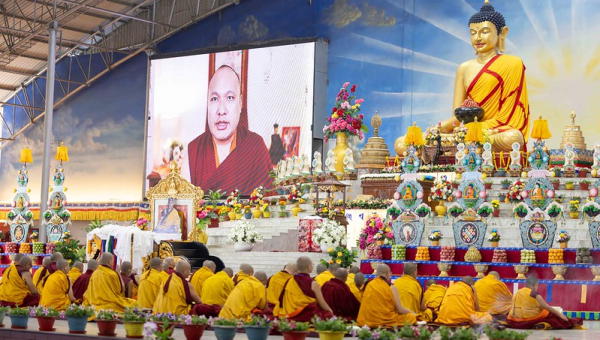
Before imparting the teaching, His Holiness the Gyalwang Karmapa offered gracious greetings to all of the trulkus, khenpos, teachers and spiritual friends, as well as all of the monks and nuns, generous sponsors, and all the laypeople attending the teachings and wished them well. He then continued recounting the Life Story of Atisha (Atiśa Dīpaṃkara Śrījñāna).
Before his arrival in Tibet, Atisha had already been an illustrious teacher renowned throughout India. What’s more, as is explained in Tāranātha’s History of Buddhism in India, Atisha was the abbot of the great Vikramashila (Skt: Vikramaśīla) monastery and an abbot of the Odantapuri (Skt: Uddaṇḍapura) monastery. Still further, it is noteworthy, as many of Atisha’s biographies agree, that he was revered as a guru, without any dissension, by all four foundation schools that were extant in India at the time. Therefore, it is safe to say that Atisha was already very well known in India as a prominent guru with vast activity before coming to Tibet.
The Situation in Tibet
In ancient times, things functioned very differently from how they do now. It was very difficult to bring Indian panditas to Tibet or for students to travel to India to learn. This presented a strenuous endeavour and a very important part of one’s life. Since Atisha was one of the most renowned Buddhist gurus of his time in India; bringing him to Tibet presented a great challenge. The Indians would not be willing to let him go very easily.
So, in order to understand how they were able to make such a thing happen, first we have to analyse why he was brought and what circumstances aligned for him to arrive in Tibet. For this, we need to understand a fair amount of historical background.
It was a rather difficult time in terms of the political and the ritual situation in the Snow Land of Tibet in those days.
At the beginning of the 7th century, during the time of the Tibetan King Songtsen Gampo, Buddhism began to spread into Tibet. Later, it was probably during the time of King Tri Songdetsen. The teachings of Buddha spread very widely throughout Tibet. However, four generations later, starting in 841 C.E., during the time of Langdarma Udum Tsen, the persecution of Buddhism began. These events led to a severe decline of the stainless teachings of Buddhism that had been established during the time of the earlier Dharma kings.
Langdarma had two sons, Ösung and Yumten. The prince Ösung had a nephew named De Nyima Gön. He was forced to flee central Tibet, and so he travelled to the area then called Shangshung, today known as Ngari. De Nyima Gön became the king of that area. He had three sons. Wishing to avoid conflict among them, the now King of Shangshung (Ngari) divided his kingdom into three areas – one for each of his three sons to rule. That is how the term “three regions of Ngari” originated.
One of these three areas was called Purang and it was ruled by the second son Tashi De Gön. Later the famous Guge dynasty originated in that area. The king of Purang, Tashi De Gön, had two sons. The elder son, named Song-nge eventually went forth and was given the monastic name Lha Lama Yeshe Öd. As a king (Lha) who also went forth and became a lama, he was known by the name Lha Lama or King Lama.
Lha Lama Yeshe Öd had a very strong influence on Tibetan history. He left a vast and an enduring legacy with his three main accomplishments.
King Yeshe Öd’s Threefold Legacy
Firstly, the teachings of the Buddha spread from Ngari (Upper Ngari, more precisely). This was the primary source from which the teachings of the Vinaya could spread. The reason for this is that Yeshe Öd had invited the panditas from India and established the vow transmission so that the teachings could then spread further from Upper Tibet. He also built a new monastery in Ngari called Tho Ding, the earliest monastery in the history of Ngari. And to this day, the Tho Ding monastery has been preserved to a significant degree.
His second great legacy is that he brought Atisha to Tibet.
And the third achievement with far-reaching results is that he fostered many translators, including the great translator, Rinchen Sangpo, so that many texts of the new transmission of the Secret Mantra could be translated.
In the one hundred years since Langdarma’s persecution of the teachings, some five generations had passed and Buddhism had declined severely. During Yeshe Öd’s rule, the area under his control, Ngari (Shangshung), was the origin of the Bön religion. Most people there followed Bön; few knew about the Dharma.
In addition, at that time in Tibet, people couldn’t distinguish the pure view and conduct so wrong views and misconduct spread far and wide throughout the country. It wasn’t only the Tibetans who spread the false Dharma but many Indian panditas as well. In those days, Tibetans held everyone who came from India in exceptionally high regard, and they had a custom of offering them gold. A side-effect of such generous behaviour was that many strange panditas, knowing there were deposits of gold in Tibet, came from India and taught all sorts of Dharma. This was particularly evident in the misinterpretations of the sensitive doctrines of the Secret Mantra which led to much confusion. They weren’t authentic gurus yet they came to Tibet to spread the Secret Mantra teachings, nonetheless.
Since the King Song-nge (Lha Lama Yeshe Öd) himself studied and researched the sutras and treatises, he could see that the conduct of many people, mantra practitioners and monastics alike, was not in accord with the Dharma. Seeking to reform the Secret Mantra Vajrayana conduct and Buddhist teachings in general, he wrote many rules and decrees objecting to these improper practices. Old documents and biographies of Lha Lama Yeshe Öd attest to this. But his efforts were to no avail.
The only solution was to bring highly qualified, authentic panditas and scholars from India to remedy this issue and bring the authentic Buddhist teachings back to life.
Bringing Atisha to Tibet (Lha Lama Yeshe Öd’s second legacy) was envisaged as the antidote to all the confusion, mistakes and wrong views and conduct that had permeated Buddhism in Tibet. At that time, because the source of Dharma was India, teachers from India were revered by everyone and Tibetans showed exceptional respect to Indians above all others. Thus, if one needed a highly respected lama, they must come from India.
A teacher of that magnitude who was to bring a fundamental change had to be someone rather famous yet not so old as to be unable to withstand the perilous circumstances of the long journey to Tibet. Then, he had to be learned in both sutra and tantra. The final and most important prerequisite was that the teacher had to be truly altruistic and his conduct impeccable. He had to serve as a beacon of light to many monastics and tantra practitioners who had lost their way and good conduct.
There was no pandita better than Atisha to carry out such a momentous task.
As it happened, Yeshe Öd was ultimately unable to bring Atisha himself, nor did he get the chance to meet him. The one who, in fact, succeeded in this was Jangchup Öd. But, Yeshe Öd was the one who masterminded the plan and laid down the groundwork for this pivotal task. Some histories state that Yeshe Öd sacrificed his own life to ensure Aitisha’s arrival in Tibet; however, many contemporary historians contest this. Be that as it may, if it hadn’t been for Yeshe Öd, Atisha wouldn’t have come.
The Persevering Delegation and the Power of Altruistic Intentions
Initially, Yeshe Öd entrusted the responsibility of bringing Atisha to Tibet to an elder translator named Gya Tsöndru Senge. However, the first attempt to invite Atisha was unsuccessful. Not long after, Yeshe Öd grew old and passed away before his wish could be fulfilled. Before his passing, he told his nephew Jangchup Öd, as his last will and testament, that he absolutely must bring Atisha to Tibet. Determent to fulfil his uncle’s wishes, Jangchup Öd sent a party headed by Nagtso Lotsawa back to India.
When Nagtso Lotsawa and his party arrived in India, Atisha was residing at Vikramashila Monastery. This monastery was built in the eighth century by the fourth king of the Pāla dynasty, Dharmapāla. It was the second most important monastic university after Nālanda, and more specifically, a hub for the study of Vajrayana. Many of the teachings of the Unexcelled Yoga Tantra were studied here. In the past, the senior translator Gya Tsöndru Senge had spent time studying at Vikramashila, so he was intimately familiar with why their previous attempt had failed. He knew that this time around, they had to proceed more carefully and devise a meticulous plan before approaching Atisha. He said to the others:
“At first, do not say that you are here to invite him. Pretend that you have come to study. When the time is right, I’ll tell you how to invite him.”
A year or two passed while they unassumingly waited for the favorable moment, with one-pointed perseverance. When the window of opportunity finally presented itself, they approached Atisha. They recounted all the events that led them to him and laid out the proposal to bring him to Tibet. Atisha said:
“From your story, it appears like that Tibetan king must be a real bodhisattva. His wish was to share the teaching for the sake of sentient beings. It wouldn’t be right for me to go against a bodhisattva’s command. Now the teachings are spreading, and you have come here with much hardship, so I will definitely find a way to go to Tibet. “
Jowo Je Atisha wanted to be sure whether this undertaking would be truly beneficial for sentient beings, so he supplicated his special deity, Lady Tāra and asked her about this issue. She prophesied:
“Going to Tibet now would be very beneficial beneficial for Buddhism and for sentient beings. In particular, it will be beneficial for one lay person.”
And who was that lay person, you might wonder? Later, Atisha said that it was Dromtönpa Gyalwai Jungné, [Tib.འབྲོམ་སྟོན་པ་རྒྱལ་བའི་འབྱུང་གནས་] because he was like the source of all the Kadampa teachings.
Since this was an enterprise of significant proportions, he went to Bodh Gaya to make grand offerings and supplicate again as a part of his preparation. Khenpo Jñāna Śrī Mitra gave him a handful of cowrie shells and said:
“These are for an old pale person with dreadlocks; give them to him.”
When he arrived in Bodh Gaya, he saw this old yogi with long dreadlocks, and the man immediately requested: “Give me the cowrie shells you have brought for me.”
Realising that this old man with dreadlocks was no ordinary person and had powers of clairvoyance, he thought he must be a ḍāka. But as Atisha was a monk, he could not prostrate physically to a lay person, so he prostrated mentally. He then asked whether it would be beneficial to go to Tibet, and the old man confirmed it, just as Tāra had.
Then he asked:
“Will such a difficult journey bring any obstacles to my life and body?”
“If you go to Tibet, your life will be shorter” the old man responded.
“How much shorter?”
“If you don’t go to Tibet, you will live to 92. If you go, you will only live to 73.”
This meant losing twenty years of his life. But Atisha thought: “If it is truly beneficial for Tibet, it doesn’t matter whether my life is shorter or not.”
Now, Atisha was adamant to go and roused great courage within.
However, there were other obstacles.
The Road to Tibet
The Indian king would not let such a significant figure leave so easily. Had he spoken directly of his intentions, the monastery authorities too would have forbidden it, so Atisha pretended he was going on pilgrimage to sacred sites, and began traveling to different pilgrimage sites in India, until eventually he arrived in Nepal.
There was an elder monk from Vikramashila monastery who began to feel a little bit uneasy about this. He was suspicious about Atisha traveling frequently with these Tibetans, so he joined the party. It was only when they arrived in Nepal that it became clear that Atisha wanted to go to Tibet.
The elder monk scolded Nagtso Lotsawa:
“You said that you were doing studies, but you were lying through your teeth! You are kidnapping this person. It is not that we will not let Atisha go at all, but if we lose him to Tibet, there is a danger that Buddhism will be destroyed in India. For that reason, we don’t dare let him go!”
After much discussion, in the end, Nagtso and the Vikramashila elder came to an agreement that Atisha would spend no more than three years in Tibet and then return to India. Nagtso had to make an oath to that effect with a promise to bring Atisha back himself. Only then did the elder monk agree.
So, with all these difficulties and obstacles, they were just barely allowed to bring Atisha to Tibet.
At that time, Atisha was already in his fifties. Considering the life expectancy in those days, his fifties were considered rather old. Along with that, according to some histories, he was the abbot of Vikramashila and Odantapuri. Whether he was or not, in any case he was one of the high-ranking figures in many different important monasteries with many responsibilities, so much so that it is said he had at least eighteen keys on his belt. This is why the Indians were so reluctant to let him go to Tibet. For Indian Buddhists it was important that Atisha stay in India. For example, on one wall of Vikramashila, Nagarjuna was painted on the right and Atisha on the left. This is to say that they considered him on a par with the great Nāgārjuna.
They stayed for one whole year in Nepal and, unfortunately, during that time, the senior translator Gya Tsondru Senge, died. Atisha was discouraged and said:
“Now the translator has died. I no longer have a tongue. Going to Tibet will not bring great benefit.”
Nagtso pleaded:
“There is the well-known translator Rinchen Sangpo in Tibet. He is a wonderful translator. For ordinary conversations, I can translate. Please, you absolutely must continue with your journey to Tibet.”
After all these events, Atisha continued to Tibet and arrived in Ngari in the year 1040. He was 59 years old.
The Grand Welcome for Atisha
At that time, Jangchup Öd (who had been ordained) had been waiting a long time for Atisha’s arrival. The welcome had long been prepared. When Atisha and his party were near Tho Ding monastery, the oral histories recount, they arranged three hundred laypeople in white robes on white horses with banners, pennants and various offerings to give a grand welcome.
This was an especially grand welcome, and to make it even more impressive, Jangchup Öd decided to invent a new musical instrument that could be heard from a long way away. It is said that this is the origin of the great horn — rakdung (copper horn) also known as the dumar (red horn)— that we play in monasteries these days. Because of this, it is also called the “Horn for inviting translators and scholars.”
This was the first time they had played the rakdung with its loud tone, so the people, the livestock, the horses and the wild animals on the hills all panicked and fled.
There’s a little story about this.
There was an old woman who was milking either a dri [female yak] or a dzomo [hybrid]. Then all of a sudden, they started playing the raktung. Immediately, all the animals bolted. Startled, the dri ran off, spilling all the milk. The old woman became very angry and shouted:
“I don’t care if he’s a Jowo! He must repay me for my milk!”
She scooped a handful of dust from the ground and angrily walked up to the procession to throw the dust at Atisha. But when she approached and laid her eyes on Jowo Je Atisha for the first time, she froze in her tracks. He was incredibly handsome, a very attractive person. The old woman completely forgot about her intention to insult him. He was so captivating.
I don’t know if it’s a true history or not, the Karmapa said, but it is a folk tale we like to tell.
The Gyalwang Karmapa closed the teaching for the day and announced that there would be more stories of Jowo Je Atisha’s time upon his long-awaited arrival in Tibet.