

The History and Meaning of Chö
16 November 2026
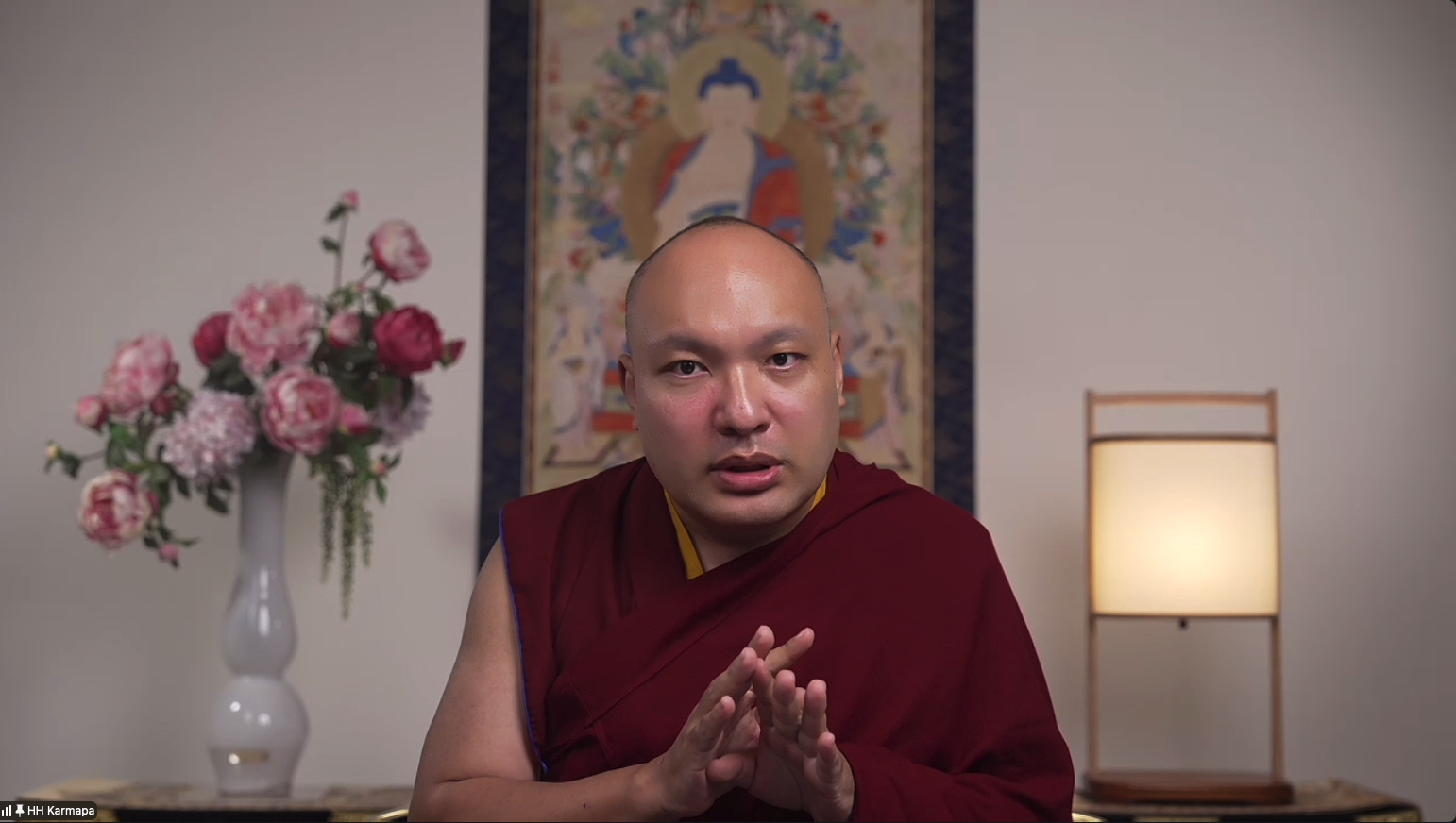
Opening the Arya Kshema Teachings, His Holiness offered his greetings to the dharma teachers present, especially Adzin Rinpoche, and all the nuns attending the teachings, and those listening over the internet.
This year, His Holiness is continuing his teachings on the Eighth Karmapa Mikyö Dorje’s Hundred Short Instructions, beginning with the two texts The Profound Instructions on Chö and The Instruction Manual on Chö.
1. The Eighth Karmapa’s Profound Instructions on Chö
The Profound Instructions on Chö comes from the pith instructions of one of the Seventh Karmapa Chodrak Gyatso’s gurus, Bengar Jampal Zangpo. He had two gurus, Bengar Jampal Zangpo and Goshir Paljor Döndrub. Bengar Jampal Zangpo is also the author of the Short Vajradhara Prayer. “In the old days this was called the Dortema in Tibetan; basically, it was called the Vajradhara Prayer,” His Holiness explained. “Later it became called the Short Vajradhara Prayer, and that became the most common name.” The instructions were passed down to Sangye Nyenpa Rinpoche, who then taught them to the Eighth Karmapa Mikyö Dorje.
Shamar Kunchok Yenlak later wrote a text, also called Profound Instructions on Chö, which is found in his collected works and serves as a commentary or addendum to Mikyö Dorje’s verses. Both texts became very widespread in the dharma communities of the Great Encampment as well as in the Karma Kagyu monasteries.
Karma Chakme Rinpoche wrote that because these texts were so widespread, the oral tradition of the Karma Kamtsang had not been stained by distorted Chö. In the past there were many distorted practices of Chö, and when one practices distorted Chö, many spirits come because of broken samaya. Thanks to the Eighth Karmapa’s work in verse and Shamar Kunchok Yenlak’s commentary, none of these spirits came. Karma Chakme Rinpoche himself also wrote a visualization sequence for the instructions.
For those in the Karma Kamtsang who want to practice Chö regularly but do not know how to work with the visualizations, His Holiness advised, “If you study the Profound Instructions on Chö by Mikyö Dorje in verse and practice on this basis, I think that itself is sufficient.”
He therefore decided to teach these instructions while combining them as much as possible with the visualizations, so that future practitioners wondering which text to use for daily Chö practice could simply rely on this one. Other instruction texts offer more direct and practical guidance for applying Chö in practice, and joining these to our regular practice would be very beneficial.
2. Why Chö Practitioners Need to Know Its History
Before beginning the actual instructions, His Holiness said it is important to understand what Chö practice is. Is it sutra or tantra in its meaning? What is its history? What are the lives of the lineage gurus, the distinctive features of Chö, and its different traditions?
Inside and outside of Tibet, there are more and more yogis and yoginis, as well as monks and nuns, who practice Chö. From one perspective, this is very good. “However, from another perspective, many of them know how to do the Chö practice. They know the melodies, and they know how to play the damaru and the bell,” Karmapa remarked, “but they really don’t understand what the actual meaning of Chö is.” Very few know when Chö began, who its founder was, or what the main points of the practice come down to.”
3. Padampa Sangye and the Shiche Lineage
The Eight Practice Lineages
Chö is included among the eight practice lineages, within the Shiche or Pacification lineage. The first to speak about the eight was probably Trengpo Tertön Sherab Özer, who spoke of the lineages in these words:
Prophesied by the Victor, protector of beings in the Land of Snows, who single-mindedly cared for the teachings alone, the dharma king of old, the divine emperor, is a second Teacher in this land of snow mountains.
He taught about the eight great pillars upholding the practice lineages. These were later called the eight chariots of the practice lineages, or simply the eight practice lineages. In his Treasury of Knowledge, Kongtrul lists them as the Nyingma, Kadam, Lamdre, Kagyu, Shangpa, Shiche, Six Yogas, and Approach and Accomplishment. The eight great pillars and the eight chariots of the practice lineages are synonyms. His Holiness explained, “These are different words, but the actual meaning is the same.”
The Life of Padampa Sangye
The Shiche lineage comes from Padampa Sangye, also called Dampa Sangye or Dampa Gyagar, an Indian siddha who came to Tibet during the later transmission of the teachings. There are different explanations of who he was. Some say he was the same person as the master Bodhidharma, who spread the Chan lineage to China; others say he was the same as the Indian master Kamalashila, who came to Tibet during the time of the Tibetan emperors. “Whether they are the same or not is something for scholars to research,” Karmapa said. “It’s not something I can say he was or was not.” What is well-known and undisputed is that Padampa Sangye came to Tibet during the later transmission, at the time of Lord Marpa and Milarepa, and that he met Milarepa.
According to the histories of the Shiche lineage, Padampa Sangye was born in South India and was ordained at Vikramaśīla Monastery. He received the bodhisattva vows from Serlingpa—Dharmakirti of Sumatra, the kindest of Atisha’s gurus—along with Serlingpa’s teachings on mind training and bodhichitta, which no one else had.
Padampa Sangye followed a great many gurus, including many male and female siddhas. He practiced extensively at Lion Fortress in east India and at Bodhgaya, had visions of many yidam deities including Manjushri, and achieved the supreme siddhi of the wisdom of the path of seeing. He is said to have lived to the age of 170; some say 500. In any case, he lived to a very old age.
Five Journeys to Tibet
Padampa Sangye traveled to Tibet five times. The first time, he entered through Tsari and traveled down to Kham, but he was not able to have much influence or bring benefit to many beings.
The second time, he went via Kashmir to Upper Ngari, where it is said he taught several people, such as Zhangzhung Lingkhawa and the Bönpo Tratsang Druk-la.
The third time, he traveled through Nepal with several merchants to the region of Tsang, where he accepted Kyo Sönam Lama, Mara Serpo, and others as students.
The fourth time, he went through Sha’uk Takgo in Mön. The First Karmapa Düsum Khyenpa also went there, and it is where the Eighth Karmapa Mikyö Dorje completed his Madhyamaka text, the Chariot of the Practice Lineage. From there Padampa went to Nyal, the birthplace of Gampopa, and on to Central Tibet. He had three great students known as Ma, So, and Kam: Ma Chökyi Sherab, So Chungwa Gendün Bar, and Kam Yeshe Gyaltsen.
The fifth time, he had first gone to China, where he spent twelve years. According to the Blue Annals, at the Five-Peaked Mountain, Wutai Shan, he saw an old sage walking with a staff and realized the sage was Manjushri. The sage told him there were many illnesses and epidemics in the area, and that if he could fetch the Vijaya dharani from Bodhgaya that very day, they would all stop.
Padampa Sangye replied, “But Bodhgaya is really far away. To go there today, get the Vijaya dharani, and return today is very difficult.” The sage then showed him a cave with a hole in it and said, “Go through this. If you go through this, you’ll be able to get the Vijaya dharani from Bodhgaya today itself.” Passing through the hole, Padampa arrived in Bodhgaya in a single instant, obtained the dharani, and returned to Wutai Shan. He showed it to the old sage, and the epidemic was overcome. This is also where Padampa Sangye met Manjushri face to face. The Chinese recorded these events in drawings and printed them, and Gö Lotsawa writes in the Blue Annals that prints of these pictures could be seen in Tibet.
His Holiness noted that the Chinese records contain the very same story from the Tang Dynasty, told about an Indian master called Buddhapālita, known in Chinese as Fotuo Boli Sanzang (Buddhapālita the holder of the three pitakas) who traveled from India to Wutai Shan and met Manjushri in the form of an old sage. Despite the similar name, he is probably not the same person as Buddhapālita, the student of Nagarjuna.
“Whether Buddhapālita and Padampa Sangye are the same or not is something I can’t say categorically,” Karmapa said. Buddhapālita lived during the Tang Dynasty and Padampa Sangye during the Song Dynasty that followed, so it is difficult to say they were contemporaries. “This is something that needs to be researched.”
After twelve years in China, Padampa Sangye returned to Tibet. He came to the area of Dingri in Latö, Tsang, and in the end passed away there.
The Decline and Preservation of the Lineage
Because Padampa went to Tibet several times, there were several Shiche lineages, known as the early, middle, and later lineages. The best known were the middle lineage, which developed from Ma, So, and Kam [Ma Chökyi Sherab, So Chungwa Gendün Bar, Kam Yeshe Gyaltsen] and the later transmission, which comes from Bodhisattva Kunga. These lineages later declined severely, and Minling Lochen Dharma Shri wrote a text that restored them. Later, Jamgön Kongtrul Lodrö Thaye, seeing how weak the lineage had become, included all the Shiche empowerments and instructions he could find in his Treasury of Precious Instructions. Because of this, the Shiche lineages are present now, in the sense of merely not being lost.
4. Shiche: The Dharma That Pacifies Suffering
The Shiche lineage includes different traditions, some more tantric and some more in the sutra tradition. But the best-known Shiche practices, those coming from Ma Chökyi Sherab, So Chungwa Gendün Bar, Kam Yeshe Gyaltsen, and Machik Labdrön, are primarily focused on the sutras. They are in essence transcendent prajna, but in accord with tantra, meaning they are very harmonious with Vajrayana practice. This is the main distinctive feature of the tradition.
His Holiness then explained why the tradition is called Shiche, or Pacification, as described in Gö Lotsawa Shönnu Pal’s Blue Annals. Pacification means pacifying suffering; it is the true dharma that pacifies suffering. The many instructions brought to Tibet by the scholars and siddhas of India were primarily for turning students’ minds away from non-virtue and purifying their mindstreams of afflictions. They were for training, purifying, and taming the mind, like applying antidotes to the afflictions in our mindstream. That was how all of the traditions worked.
Because of bad karma accumulated in past lives, we may have many illnesses in this lifetime, be deprived of food, clothing, and wealth, or be tormented by different things, especially non-human spirits like ghosts and demons. At such times, obstacles prevent us from practicing dharma. Shiche is the dharma we can use to immediately pacify all this suffering, so that we have no obstacles to practice. Because it swiftly pacifies the suffering of those afflicted by bad health, poverty, or harm, it is a very skillful means, and through it our dharma practice will go well. The name also echoes the mantra that pacifies all suffering taught in the Prajnaparamita Sutra.
Jamgön Kongtrul Lodrö Thaye wrote in his Treasury of Knowledge that, in general, all true dharma is similar in pacifying suffering and the afflictions. The general name is given to this particular lineage because its superior method frees us from the immediate, current sufferings of illness, bad health, and so forth. As Jamgön Kongtrul says, its essence is Prajnaparamita, but it is in accord with the Vajrayana and condenses all the critical points of sutra and tantra.
The Connection with Maitripa and Mahamudra
Padampa Sangye had over fifty gurus. Some he followed in pure visions, without meeting them in the ordinary sense of two humans meeting each other. One whom he actually met in person was the Dharma Lord Maitripa, who, together with Naropa, was one of the two most important gurus of Marpa the Translator.
Within the Kagyu, there is the path of means, the Six Yogas, and the path of liberation, Mahamudra, which comes primarily from Lord Maitripa. For that reason, Marpa’s tradition of Mahamudra and Padampa’s come down to exactly the same crucial points. Maitripa’s lineage of Mahamudra includes a tradition emphasizing sutra and a tradition combining sutra and tantra.
“Normally when we Kagyupas speak about Mahamudra, we talk about Marpa and Milarepa primarily practicing tantric Mahamudra,” His Holiness explained. “But later, from Gampopa on, we say that it emphasizes sutra Mahamudra.” Master Sahajavajra’s Commentary on the Ten Suchnesses, which is cited many times, likewise says that Prajnaparamita in accord with tantra is also called Mahamudra.
The Shiche instructions passed down from Padampa Sangye are therefore connected to Maitripa and share the same intent as the Mahamudra teachings. Milarepa and Padampa Sangye actually met and had a contest of miraculous powers. Both lineages, Kagyu and Shiche, come down to the same original source, the master Maitripa, whom both Padampa Sangye and Marpa the Translator followed as their guru. The Kagyu Mahamudra and Padampa Sangye’s Shiche come down to exactly the same point.
5. The Meaning and Origins of Chö
Two Spellings of Chö
Chö practice is a part of the Shiche tradition. According to Pawo Tsuglak Trengwa’s Feast for Scholars, the True Dharma Severance of the Maras, called Chö, is known to come from Machik Labdrön. Before that, there was no term Chö.
His Holiness explained that the word Chö can be spelled in two ways. In the negating sense, it is spelled གཅོད་ (Wylie: gcod) the way that means “cutting” or “severing.” As taught in the chapter on the maras in the Prajnaparamita, everything is gathered into the four maras, the tangible, the intangible, exaltation, and self-inflation, and Chö cuts through every rope of self-conceit. Because it forcefully cuts through ego-clinging and self-conceit, it is called Chö with the spelling that means severing.
In the affirming sense, it is spelled ་སྤྱོད (Wylie spyod) the way that means “conduct,” because it teaches the conduct of the bodhisattvas, the six transcendences, gathered into one. These days, the spelling that means severance is the more common and better known.
Chö as Conduct in Accord with Mantra
Gö Lotsawa Shönnu Pal explained this in more detail in the Blue Annals: Maitripa taught the conduct of the transcendences in accord with mantra. It is not actual mantra, but a way to practice the transcendences in accord with the Vajrayana, and for this reason it is called the area of conduct. As for how it accords with mantra, the Two Books say:
At a single tree, a charnel ground,
The house of the Mothers, at night,
In an isolated place, or outside a village,
Meditation is said to be best.
So it is good to practice in such isolated, remote places. The text continues:
After giving away the body,
Practice the conduct properly.
This refers to the practice of giving away the body. It also says:
If a demigod or Shakra
Should come before you, certainly
You should not be afraid of them—
Roam like a lion.
So in a terrifying place like a charnel ground, one should be like a lion roaming in the middle of the forest, without any hesitation or fear. Even within the practice of the transcendences, there are ways to practice like this. This is also said in the Hevajra Tantra, and it is the reason the practice is called Chö.
The Four Dharmas: The Basis of Chö
His Holiness explained that, in terms of the meaning of severing, the Condensed Prajnaparamita says:
For four reasons, bodhisattvas with strength and power
Are hard for the four maras to defeat and cannot be shaken:
They abide in emptiness, never abandon sentient beings,
Act as they say, and have the blessings of the sugatas.
This means practicing these four dharmas: the view of abiding in emptiness, the compassion that never abandons sentient beings, the bodhisattva discipline of acting as one says, and the blessings of the sugatas. These four are the basis of the practice of Chö.
Being blessed by the sugatas is practiced by going for refuge, supplicating the gurus of the lineage, and so forth. Acting as one says means always rousing bodhichitta, not acting outlandishly, and keeping one’s bodhisattva vows, never breaking them.
The compassion of never abandoning sentient beings means that when practicing Chö, one should not want to harm the non-human spirits. His Holiness noted that some people, when they practice distorted Chö, do many things to harm those non-humans. Instead, because one has some sort of power, one needs to have love and affection for the non-humans. Rather than harming the non-human spirits, one should have compassion for them: summon all the non-human beings, not let them engage in things that harm others, and then bring them onto the path of the bodhisattva. This is the way of never abandoning sentient beings.
As for the view of abiding in emptiness, His Holiness explained that Chö is primarily the practice of cutting through or severing our ego-clinging. It means giving up viewing the aggregates as a self, and not thinking of others as having attributes. The view of ego-clinging comes from viewing the aggregates as a self, so instead of viewing them that way, it is basically putting that out of one’s mind. When one gives up clinging to the aggregates as being a self, one is naturally liberated from ego-clinging in general.
The reason this is called Chö practice in the sense of severance, then, is that it uses forceful methods to give away our bodies and give up our attachment to a self. Because of this, our attachment to the aggregates as a self decreases and is eventually eliminated. That is the reason it is called Chö, or severance, as is said in the Blue Annals.
Male and Female Chö
These instructions come from Padampa Sangye, but there are both male and female instruction lineages of Chö. Those passed down through Kyo Sönam Lama and Mara Serpo of Yarlung are called Male Chö, and those passed down from Machik are called Female Chö. Padampa gave Male Chö to Kyo Shakya Yeshe and Mara Serpo of Yarlung; it is called the Six Bundles of Instructions and presents the meaning of the Short Text in Fifty Verses. Kyo gave it to his nephew, Sönam Lama, who then gave it to Machik Labdrön. The Chö passed down from her onward is called the female lineage, or Female Chö.
Machik Labdrön later had such great influence and became so well-known as a female siddha that the practice of Chö spread very widely. Before her, the name Chö was rarely used. “The lineage was there, of course, but the name and the fame were not so great,” His Holiness said. Her activity was so great that she became one of the most famous of all Tibetan women, and the most famous woman to have achieved siddhis through her practice.
These days there is no separate Chö or Shiche lineage, but every lineage has its own practice of Chö, with its own revelations, pure visions, and so forth. Yet the actual lineage can only go back through Machik Labdrön, and before her, to Padampa Sangye.
“There are more of us who are practicing Chö. We’ve all heard of Chö, and we’ve all practiced Chö,” Karmapa remarked. “But we sometimes wonder who actually began the Chö practice.” The foundation came from Padampa Sangye, but the particular, well-known practice of Chö and the name Chö came from the time of Machik Labdrön.

