

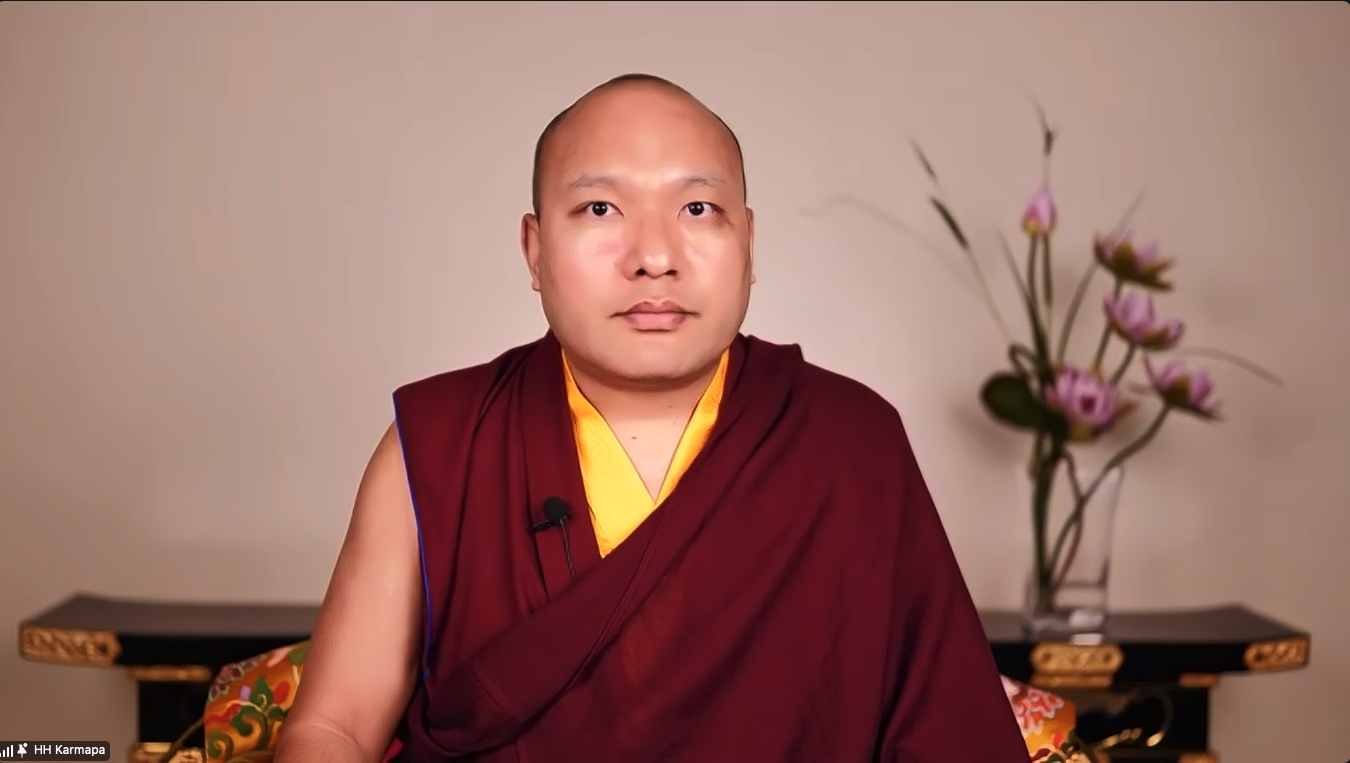
Origins of Secret Mantra • Day Seven
September 8th, 2025.
The Karmapa continued his discussion of the transmission of the Buddhist lineages. He explained that he would consider three primary explanations: according to the northern transmission, according to the Tibetan transmission, and according to the southern transmission. In the previous teaching he had detailed the six-volume text Chronicles of the Transmission of Dharma (付法藏因緣傳 Fù facán yīnyuán chuān) a text translated by Jí Jiāyè and others during the Northern Wei period, which is regarded by scholars as a compilation rather than a translation of an original Sanskrit text.
Now he turned to the two most important texts in the Northern transmission, the Aśokāvadāna (The Narrative of Aśokā), translated into Chinese by An Faqin during the Western Jin period (probably during the third century) and the Aśoka Sūtra, translated by Saṅghavarman during the Liang period (during the fifth century). These two texts are among the most important sources for studying Buddhist history during King Aśoka’s era. Moreover, there is a third text, the Divyāvadāna (Divine Narrative) translated from the Sanskrit into Chinese probably in the fifth century, which contains a version of the Aśokāvadāna.
The Foundation Stone: the Five-Generation Lineage according to the Aśokāvadāna and the Aśoka Sūtra
The Karmapa referred to a chart of the lineages.
These two texts contain a short five-generation lineage, and have five patriarchs:
1) Mahākāśyapa
2) Ānanda,
(Madhyāntika)
3) Śāṇakavāsin
4) Upagupta
5) Dhṛtaka (Dhītika).
This is similar to the one in the Chronicles of the Transmission of Dharma, translated by Jí Jiāyè during the Northern Wei period. [Buddha → Mahākāśyapa → Ānanda → Śāṇakavāsin→ Upagupta → Dhṛtaka → Vibhaga → Buddhanandi → Buddhamitra → Monk Pārśva → Puṇyayaśas → Aśvaghoṣa → Maśiva/Kapimala → Nāgārjuna → Āryadeva/Kāṇadeva → Rāhula → Saṅghanandi → Bhikṣu Arhat/Saṅghayaśas → Ghalaśala/Kumārata → Jayata → Vasubandhu → Manora → Haklena Yaśa → Bhikṣu Siṃha]
According to the Aśokāvadāna, Upagupta was the principal guru of the Dharma King Aśoka The Karmapa explained that he had put Madhyāntika’s name in parentheses because there is no clear description of his connection with either Śāṇakavāsin or Upagupta. Shortly before Ānanda’s death, Madhyāntika became his disciple, and these two texts describe how the lineage was entrusted to him. They also describe how in future he would go to Kashmir and establish Buddhism there.
However, there are some internal contradictions in the sequence in the Aśokāvadāna account. First it says that the teachings were passed down from Ānanda to Madhyāntika, who gave them to Śāṇakavāsin, who gave them to Upagupta. But then it also states that Ānanda transmitted the teachings to Śāṇakavāsin, saying, ” Mahākāśyapa entrusted the teachings to me and passed into nirvāṇa. Now I will pass into nirvāṇa, so you must bear the teachings of the Buddha and protect them.” So, the first statement contradicts the second.
Similarly, the Mūlasarvāstivāda Minor Topics of the Vinaya says,
It was prophesied that one hundred years after the Bhagavat passes to parinirvāṇa, a bhikṣu named Madhyāntika will appear, and he will enter the teachings here. Therefore, son, you enter the teachings.
The third fascicle of The Great Records of Travels to the Western Regions explains that Madhyāntika was born fifty years after the Buddha’s parinirvāṇa and was the upholder of Ānanda ‘s teachings on the meaning. In fact, most of the sources from the Northern Transmission explain that following Ānanda ‘s prophecy, Madhyāntika went to Kashmir to spread the teachings. However, they do not say much about his being a direct disciple. A few say that he was Ānanda ‘s student, but most say that he was predicted by Ānanda in his last testament, but do not say that he was a direct disciple.
According to the Sinhalese tradition, Madhyāntika went to Kashmir during the time of Aśoka on the instructions of Moggaliputtatissa. So, it seems he was sent to Kashmir by Moggaliputtatissa, probably around 160 years after the parinirvāṇa.
From one perspective, it seems as if Madhyāntika has been inserted into the lineage, and if so, why? Tāranātha’s History of Buddhism in India provides an explanation:
According to the tradition of Kashmir, Madhyāntika also must be counted as one in the succession of teachers who were entrusted with the dharma, because while living in the Central Land, he looked after the dharma for fifteen years. At that time, the disciples of Ārya Śāṇakavāsin were few in number. Only after Madhyāntika ‘s departure for Kashmir, Śāṇakavāsin looked after the dharma. Therefore, it is said that the successors of (those entrusted with) the dharma should be counted as eight.
If you count Madhyāntika, then that comes to eight.
According to others, the Teacher had himself predicted that Madhyāntika was to convert Kashmir. So, Ānanda directly instructed him to do so. However, Ānanda entrusted only Śāṇakavāsin with the dharma. Therefore, only seven are to be counted in this line of succession. The Tibetans follow this view.
In summary, according to the Northern Tradition, Madhyāntika was sent to Kashmir by Ānanda. In the Southern Tradition, he was sent by Moggaliputtatissa. In any case, there is no question that he was an extremely important figure in the spread of the Buddhist teachings in Kashmir and revered by Kashmiri Buddhists, particularly the Kashmiri Great Exposition [Mahāvibhāṣā] school, the Kashmir Sarvāstivādins. Many present-day researchers believe that later, when the school became very powerful, they insisted on inserting Madhyāntika into the lineage of patriarchs.
When considering the lineage of transmission, there should be either a relationship of preceptor and ordained monk or of master and disciple. There is, however, disagreement on whether Ānanda’s preceptor was Mahākāśyapa. According to the Mūlasarvāstivāda Vinaya, Ānanda’s preceptor was Daśabala Kāśyapa, and Jé Pawo Tsuklak Trengwa maintains that Daśabala Kāśyapa and Mahākāśyapa are two names for the same person. However, in the Mūlasarvāstivāda Minor Topics, it states that after the Buddha’s parinirvāṇa, there were four great śrāvakas present at the cremation, including the venerable Daśabala Kāśyapa and the venerable Mahākāśyapa. In this text, Daśabala Kāśyapa and Mahākāśyapa are different people.
The Pāli Vinaya states that Ānanda’s preceptor was Belaṭṭhasīsa. Most modern scholars therefore assert that Ānanda was not ordained by Kāśyapa.
The Karmapa suggested that we need to make a distinction between the transmission lineage which is the lineage of the elders and concerns the succession of Buddhist leaders, and the lineage of the vows, which traces the continuity of those who confer the prātimokṣa vows.
In the transmission lineage, the previous leader of the Buddhist teachings confers the responsibility of upholding the teachings to the next person who is capable of carrying this responsibility. The lineage of the vows, on the other hand, concerns the Khenpos or preceptors who give the vows. There is not necessarily a requirement that the previous patriarch should also be the preceptor of his successor.
Mahākāśyapa was the most respected figure in the saṅgha after the Buddha’s parinirvāṇa and was also the presiding figure during the First Council. In the Four Āgamas, (extant in Chinese translation and in Pāli where they are known as the four Nikāyas), it says that the Buddha gave half of his seat to Kāśyapa and told him to teach the Dharma. So, that is one historical event, the Karmapa asserted. The second is when the Buddha exchanged his own robe made of rags for Mahākāśyapa’s outer robe; Mahākāśyapa wore the Buddha’s robe until the end of his life. Through such respectful acts by the Buddha, after Śāriputra and Maudgalyāyana had passed away, the great Mahākāśyapa became the most worthy elder to represent the Buddha.
Similarly, though Mahākāśyapa may not have been Ānanda’s preceptor, because Ānanda had such great activity and renown, he was the most appropriate person to be entrusted with responsibility for the teachings. In the four Āgamas and the Vinaya, there are occasional mentions of disagreements between Mahākāśyapa and Ānanda, with the former criticising the latter. The Pāli Theragata (Verses of the Elders) and the Great Commentary on the Hundred Thousand state that Ānanda served as the Buddha’s attendant for twenty-five years. If Ānanda became the Buddha’s attendant immediately after ordination, then Ānanda would have been about 45 years old when the Buddha passed away. Even after the Buddha’s parinirvāṇa, Ānanda might have lived another thirty to forty years, and his activity was very influential. For example, at the time of the Second Council, of the eight most important Buddhist elders, six were students of Ānanda, and this is mentioned in the Vinayas of all the different schools.
According to the Aśokāvadāna, the third patriarch was Śāṇakavāsin, whose preceptor was Ānanda.
In the descriptions of the Second Council available in extant Vinayas, approximately 100 years after the Buddha passed into parinirvāṇa there were eight elders who were well-known. There are slightly different variations in the different scriptures of the different schools, but, basically, all of them mention three of the elders: Sabbakāmī [Pāli, Skt: Sarvakāmin/ Sarvagāmin] from the east, and Revata and Saṃbhūta from the west. In the Pāli Vinaya, Saṃbhūta’s name is given as Saṃbhūta Śāṇakavāsin, but not in the northern tradition. The Aśoka Sūtra mentions a Śāṇakavāsin who is also a student of Ānanda and lived at the same time. The Pāli Satta-satika-khandhaka (The Chapter on the Group of Seven Hundred, Culavagga, Kd. 22) says that the Saṃbhūta Śāṇakavāsin of the Second Council resided at a mountain called Ahogaṅga, while the Aśokāvadāna and the Aśoka Sūtra say that Śāṇakavāsin resided at Urumuṇḍa-parvata [Mount Urumuṇḍa]. Though the mountain names differ, both the northern and southern tradition say clearly that this mountain was a place that could be reached by travelling by boat. For these reasons, most researchers believe that the Saṃbhūta Śāṇakavāsin in the Pāli Satta-satika-khandhaka and the Śāṇakavāsin mentioned in the Chronicles of the Transmission of the Dharma are the same person.
In the Aśokāvadāna and Aśoka Sūtra, the fourth patriarch is Upagupta, who received the teachings directly from Śāṇakavāsin.
However, Upagupta’s dates are uncertain. It seems from the texts that the latter stages of Upagupta’s life were during the reign of King Aśoka which began some 160 – 170 years after the Buddha’s parinirvāṇa, but this would make him about 130 years old when Aśoka acceded to the throne (371 BCE). The question is whether he could have lived that long at that time. For this reason, many contemporary researchers say that the Northern transmission account has confused Kālāśoka (Black Aśoka) with the Dharma King Aśoka.
Further evidence comes from the Sūtra of Shariputra’s Questions (Skt. Śāriputraparipṛcchā), a text from the Mahāsāṃghika school, which says that Upagupta had passed away before the Maurya dynasty emperor Aśoka [Dharma King Aśoka] came to power, and that Upagupta lived around 100 years after the parinirvāṇa. This matches Tāranātha’s account, that Aśoka was a youth during the last part of Dhṛtāka’s life. However, Tāranātha says in his History of Buddhism in India that Aśoka’s reign began 100 years after the parinirvāṇa, so he too seems to confuse Kālāśoka with Dharma King Aśoka
The fifth patriarch was Dhṛtāka (Dhītika). He is mentioned in the Aśokāvadāna and other texts.
According to the Chinese text the Chronicles of the Transmission of Dharma, he was born in Mathurā, but Tāranātha says he was the son of a wealthy merchant in Uddiyana. Though he was a contemporary of Aśoka, there is no clear account of any connection between them. The reason, according to Tāranātha’s History of Buddhism in India, was that he was frequently ill during the last half of his life and unable to perform much activity. The date of his passing was near the end of Aśoka’s reign, some 240 years after the parinirvāṇa.
One issue that has to be considered is that, according to the Aśokāvadāna, the Great Exposition, and the Chronicles of the Transmission of Dharma, it was during the time of Upagupta that divisions within the Buddhist saṅgha increased and many of the Buddhist scriptures were lost. It was during his time that the power and influence of the patriarchs waned. The consequence of these divisions in the saṅgha was the split into schools, and then the unity of the Buddhist saṅgha was lost. No matter how learned or venerable people were, they respected their own schools and saw the leaders in those schools as foremost, so a single patriarch, respected by all, became impossible. Hence, the lineage of the patriarchs also ended. When we read the texts, we can see how the beginning of this process began during the time of Upagupta.
The content of both the Aśokāvadāna and the Aśoka Sūtra is framed in connection with King Aśoka‘s era. Linking the transmission lineage with a great dharma-protecting king greatly enhances its authority and historical significance.
In these two texts, the transmission lineage itself shows clear Sarvāstivāda characteristics. This is because the Mathurā region, where Upagupta propagated the teachings, became the principal area of the Sarvāstivāda school.
Likewise, the five patriarchs taught in the Aśokāvadāna and the Aśoka Sūtra [Northern Transmission] are similar to the five-generation lineage taught in the Pāli Vinaya of the Southern Transmission. The main difference between the two is that the Northern Transmission, the Sarvāstivāda tradition, and the Pāli Vinaya, the Vibhajyavāda tradition, disagree on who was the main guru of King Aśoka. The Northern Tradition says it was Upagupta, whereas the Southern Tradition says it was Moggaliputtatissa,
Variations in Other Vinaya Collections and Historical Texts
In the vinaya scriptures and historical documents of the Northern Tradition, there are some discrepancies in the history of the transmission. Whereas the Aśokāvadāna and Aśoka Sūtra have five patriarchs, the Chronicles of the Transmission of Dharma speaks about 24 patriarchs.
1. The Lineage of the Mahāsāṃghika
In order to consider the different ways in which they describe the transmission of the Dharma, we need to begin with the Mahāsāṃghika Vinaya. It does not clearly present the lineage transmission. However, when it describes the Second Council and lists the names of the arhats who attended the Second Council— the eight significant ones of the 700—the list matches the one in the Southern Tradition and the Mahāsāṃghika texts but disagrees with the Chronicles of the Transmission of Dharma and the Sarvāstivāda texts. This shows that the Mahāsāṃghika has its own particular account of the history.
There is also a text in the Mahāsāṃghika school called the Śāriputraparipṛcchā (Sūtra of Śāriputra ‘s Questions), which does discuss the topic of the transmission:
After my parinirvāṇa, Mahākāśyapa and others will [work together] and be a great support for the bhikṣus and bhikṣunis, no different from me. Mahākāśyapa will entrust it to Ānanda, Ānanda to Madhyāntika, Madhyāntika to Śāṇakavāsin, Śāṇakavāsin to Upagupta. After Upagupta, the Mauryan king Aśoka will appear. The Sūtras and Vinaya will spread widely in the world.
In this particular description of the transmission, Madhyāntika is inserted between Ānanda and Śāṇakavāsin, and has the status of patriarch. This differs from the Chronicles of the Transmission of Dharma, which says that Ānanda sent Madhyāntika to Kashmir to spread the teachings, so Madhyāntika heads a subsidiary lineage.
In the Aśokāvadāna, is considered a patriarch in an aside, but in the main text, Madhyāntika’s role in Kashmir is mentioned and he is not considered a main figure in the lineage.
2. The Chan school’s account of “Twenty-Eight Western Patriarchs”
Another account from the Northern transmission comes from Chinese Chan Buddhism (Zen). In Tibet this school is referred to as the Chinese “Hashang”.
The Karmapa used a table to illustrate this section.
Although the Chan school inherited the framework of the Chronicles of the Transmission of Dharma, it fundamentally transformed and extended it. It speaks of 28 Indian patriarchs from the Buddha all the way down to Bodhidharma. The Chronicles of the Transmission of Dharma only has 24. The Chinese Zen tradition adds Vaśiṣṭa, Puṇyamitra, Prajñātāra and finally Bodhidharma, who brought the lineage to China and spread it there. He is regarded as the most important patriarch and the pinnacle of the Chan lineage. The Chan school’s “Twenty-Eight Patriarchs” narrative was not intended solely for the history, but rather to establish that the teachings of Chan Buddhism are authentic; it holds a lineage of pith instructions, derived directly from the Buddha.
At first the Zen lineage follows the Chronicles of the Transmission of Dharma—with the addition of Madhyāntika as the third—fourth is Śāṇakavāsin, then Upagupta and Dhṛtaka. This is the same as in the Aśoka Sūtra. But then the lineages begin to differ. The Zen lineage has a few variations and then others added on such as Śubhamitra and Saṅgharakṣa and the twenty-eighth patriarch, Bodhidharma.
A Summary of the Northern Transmission
There are five different Vinaya translations, and among them, there are several different discussions of the transmission of the Dharma, but in actuality, these lineages of the transmission of the Dharma are primarily concerned with the lineages of Khenpos, or preceptors, i.e. the lineage of the vows. The Southern Transmission also primarily speaks about the lineage of the preceptors and ordained masters, in other words, the lineage of the prātimokṣa vows. The Sarvāstivāda is slightly different.
In the Northern Transmission, the Chronicles of the Transmission of the Dharma is the most important text when considering the transmission of the teachings. It is the longest and most detailed of the texts, combining many different sources, and has a longer unbroken lineage of 24 patriarchs.
The first five patriarchs were the foundation of the Buddhist lineage.
After the Buddha passed into parinirvāṇa, Mahākāśyapa was like the life-force of the saṅgha community. His greatest achievement was convening the First Council, unifying the sutra and vinaya collections, providing strong organisation for the saṅgha community, and being the undisputed leader in the early period after the Buddha’s parinirvāṇa. He gave the leadership responsibility to Ānanda.
Ānanda had been the Buddha’s attendant, and during the many years he spent serving the Buddha, he had the opportunity to hear most of the Buddha’s teachings, and so, for that reason, after Mahākāśyapa passed into parinirvāṇa, Ānanda led the saṅgha community for several decades. He had a very widespread activity, and, at the end of his life, entrusted the teachings to Śāṇakavāsin. At the same time, according to some accounts, he dispatched his disciple Madhyāntika to Kashmir in the northwest of India to spread the Dharma.
Then, after that, comes Śāṇakavāsin who entrusted the teachings to Upagupta. Their relationship was one of teacher and student, according to the Northern Transmission texts. Texts such as the Biography of King Aśoka clearly state that Upagupta was King Aśoka ‘s root teacher. Because of Upagupta’s display of miracles and his dharma teachings, King Aśoka converted to Buddhism, and that was the beginning of the transformation of the Buddhist teachings into a world religion.
Upagupta then entrusted the Buddhist teachings to Dhṛtaka.
This is very similar to the Mahāsāṃghika tradition and also to the Zen lineage, where they speak of the 28.