

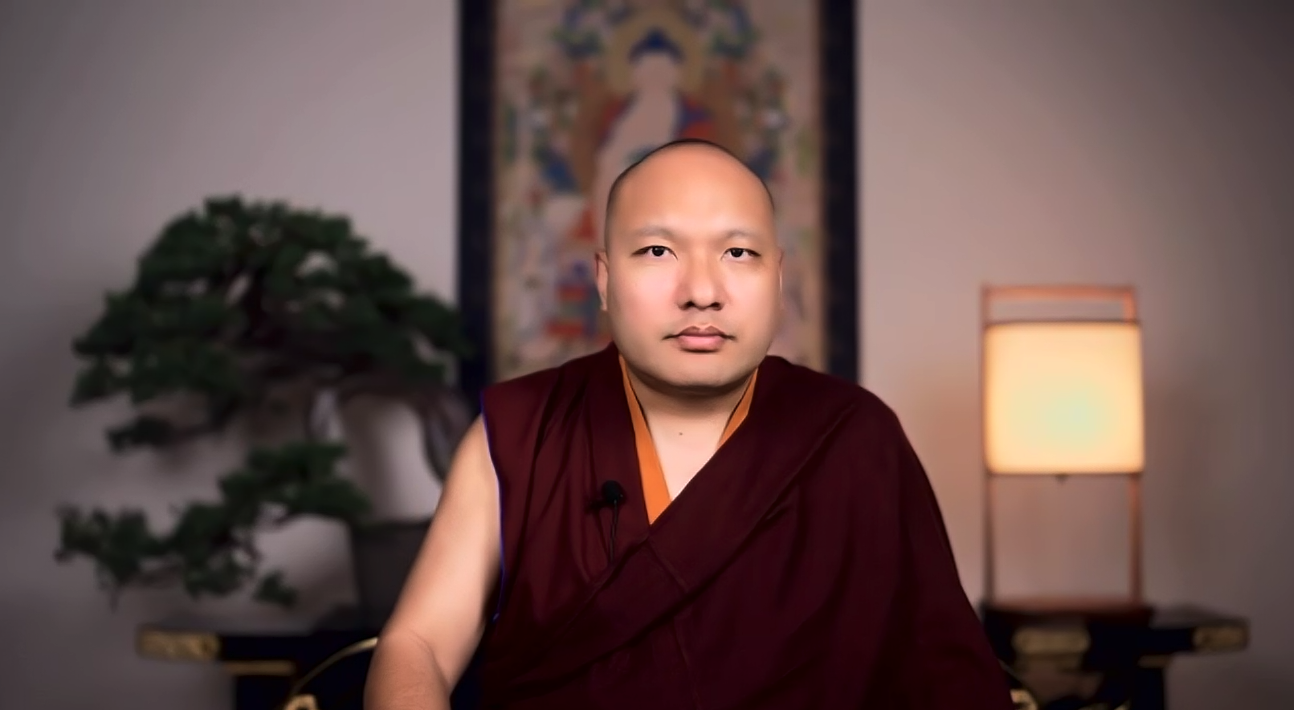
Origins of Secret Mantra • Day Four
August 27th, 2025.
On the fourth day, the Karmapa continued to speak about the bhikṣu Mahādeva. During the previous teaching Mahādeva was described according to the Sarvāstivāda, or the Vaibhāśika (Exposition) School. Their most famous text is The Great Exposition, or Mahāvibhāṣā, and contains the history of bhikṣu Mahādeva. According to that text, Mahādeva was someone who had accumulated three heinous misdeeds, was a very wicked person, and pretended he was an arhat. He didn’t have the qualities to be an arhat, but he pretended he did, so people started to doubt him. To dispel those doubts, he began to propound what he called, The Five points of Mahādeva. He summarized these five wrong views in one verse.
This verse is rather famous and is known in the Tibetan and is also contained in The Great Exposition and translated from the original Chinese into Tibetan by the master Chupak (Ch. Fa Zong). Compared to the normal words that Tibetans recite and know, there are some differences between the two.
From the Great Exposition:
Seduction by others, ignorance, doubt,
Someone else bringing one to results,
And the paths arising from words
Are the teachings of the Buddha.
From the earlier translation:
The gods are deluded by ignorance.
The path arises from their continuous sound,
There are those with doubt led by others,
This is the teaching of the Buddha.
The verse taught in The Great Exposition is easier to understand. When the earlier translation says, “The gods are deluded by ignorance,” that first line has the possibility of being misunderstood. For that reason, if these five views of Mahādeva are put into verse form, they would be this verse. We don’t have that verse in our Tibetan version, it occurs in prose; but appears in Chinese as verse and is very famous.
How did this verse come about? There was a monastery where Mahādeva lived called the Kukkuṭārāma monastery and most of the elder monks had passed away. One time on the fifteenth day during the poṣadha ceremony, the monks had alternated doing the ceremony. When it was Mahādeva’s turn to recite the Prātimokṣa Sūtra, he sat on the throne and having recited the Prātimokṣa Sūtra, he recited the verse he had written that summarized the five views.
At that time, among the saṅgha that had gathered, there were those who were learned and unlearned, those who maintained discipline, had achieved the path and had achieved enlightenment, and so forth; there were different members of the saṅgha. When they heard him recite this verse, they were surprised. They exclaimed, “You, fool! What you have said has never been heard in any of the three baskets! You are pretending these words are the words of the Buddha, but they are not the words of the Buddha!”
Many people were surprised and began to argue. There was a big dispute. They argued throughout the night, and when the sun rose the argument grew larger and louder. People from the city nearby came but could not stop it, and even the ministers came. They were unable to resolve the dispute as there was a huge controversy. When the king of that region heard of this situation, he left the palace and came to the temple and listened to both sides’ arguments. The king himself was unable to resolve it and became doubtful.
He probably liked Mahādeva from before, and asked Mahādeva: “Who is right and who is wrong? I can’t say who is sane and reasonable and who is not. How can we determine who is right and who is wrong?”
Mahādeva said, “In the Prātimokṣa Sūtra it says: ‘If there’s a dispute in the saṅgha, you should depend on the majority, you should listen to the one who has more supporters and not to the ones who have fewer. It’s good for you to do that.’”
When the king heard Mahādeva’s idea, he divided the monks into two: the faction that supported Mahādeva, and the faction who opposed Mahādeva. On the side of the noble ones, the arhats, there were many senior monks but just a few members of the general saṅgha. On Mahādeva’s side there were few senior monks who supported him but there were many younger saṅgha members. Since Mahādeva had more supporters, the king decided Mahādeva must be right, so the king rebuked the other side and demoted them, then he returned to his palace.
This did not resolve the controversy. The dispute remained. At Kukkuṭārāma monastery the saṅgha split into two groups holding different views: there were the elders (Sthaviravāda), the senior monks; and the second was called the group of the majority (Mahāsāṅghika) were the younger monks who supported Mahādeva. At that time, when the saṅgha was divided into two, the arhats left the monastery and prepared to go to other lands. When the ministers heard of this situation, they reported it to the king.
Upon hearing this, the king became angry. He had already decided who was right and wrong. The arhats and elders were unhappy with the king’s decision. The king became very angry and commanded the ministers: “You must take all the elders and arhats to the banks of the Ganges River, put them in a broken boat with a leaky bottom, and send them on that boat to the middle of the river. If the boat is leaky, they will sink. Then we will know whether they are noble beings or ordinary ones.”
The ministers followed the king’s orders, and all the arhats and elders were sent into the middle of the Ganges River. When they got to the middle of the Ganges River, the boat started to take on water—but because they were noble beings, they immediately displayed their miracles, they were like the king of swans spreading its wings, and they flew into the sky. They did not sink in the water. Likewise, because of their miraculous powers, they also took with them the monks who had not attained magical powers, they showed miracles and flew to the northwest through the sky. When they told this to the king, the king felt very remorseful because he had done something terrible to the noble beings, so he fainted and fell on the ground. They sprinkled him with water, and he revived.
The king immediately sent a messenger saying, “Search everywhere to find where those noble ones have gone!” The messengers went all over the land, and they discovered that the noble ones were in Kashmir. Although the king earnestly requested them to return, the arhats did not accept the invitation and did not consent to come back, so the king had nothing to do. The king then offered the entire land of Kashmir to the arhats and built temples for the saṅgha as a display of his great respect.
One day when Mahādeva was walking through the city, he met a fortune-teller. In India, fortune tellers are called, “people who can read the signs.” The fortune teller secretly prophesied to one of Mahādeva’s students saying, “That son of Śākya will die and pass away after seven days.”
When the student heard this, he became afraid and ran to Mahādeva and said, “The fortune teller says this!”
Mahādeva replied, “Of course, I knew that. I knew this from before.”
Later when Mahādeva returned to Kukkuṭārāma monastery, he publicized this and made announcements to the king and ministers that in seven days he would pass into nirvana, so they should go home. The king and ministers moaned and wept, and all his followers became very sad because they really liked Mahādeva. A week later, the bhikṣu Mahādeva died. The king, ministers, and all the people of the city moaned and wailed, and since they had his remains, they reverently gathered good wood, butter, oil, flowers, incense, along with various other materials, and piled them together as an offering. But when they tried to light the fire to cremate him, they couldn’t light the fire at all. Despite various attempts, the fire would not light. They didn’t know what to do, so they sought out the fortune teller.
The fortune-teller told the people: “If you try to cremate Mahādeva with such grand offerings it will not light. Instead, you must take dog feces, and then the fire will light. This cannot be purified by good offering materials—it must be defiled with dog feces.”
They did as he said, they gathered dog feces and spread it on Mahādeva’s face, and in an instant the fire blazed and the remains became ashes. A strong wind arose and scattered the ashes, leaving nothing as a remainder. For the Sarvāstivāda school, from beginning to end, Mahādeva was a wicked and unvirtuous person. This is the story from the Sarvāstivāda school, but whether Mahādeva was actually like that, the Karmapa would discuss later.
The Original Split
There are two main assertions among the other schools, but they also contain the biggest differences and contradictions among them. There is a lot of debate about the connection between Mahādeva and the original split of the Buddhist sangha into schools.
- Examining the reasons for the original split
- Comparing the northern and southern traditions
The Two Main Assertions Regarding the Original Split into Schools
Originally, this occurred at the time when the Buddhist sangha had a unified form, then gradually split into two schools. There are two assertions by the Northern and Southern Buddhist schools. The reason for splitting into two factions are two different assertions coming from the Northern and Southern Buddhist schools. Geographically, the Southern contains: Thailand and Burma, and those areas; the Northern: China, Korea, Japan, and probably included Tibet.
As for the history of these two traditions, those in the Southern tradition take the old histories of the Sri Lankan tradition of the Dīpavaṃsa (Chronicle of the Island) and Mahāvaṃsa (Great Chronicle). They take these histories as their basis and say that the immediate cause for the original split into two schools was the controversy over the ten impermissible points.
This arose from the eastern bhikṣus in Vaiśālī who expressed their opinions on these ten points: that they were permissible, and their actual opinion was that the Vinaya rules should be relaxed. That was the hope that they expressed. But the western bhikṣu Yaśa, (Tib. Dragpa) objected. Not only did he object, Yaṣa summoned many other elders to support him, and at the end of the discussion, they determined that the ten points were impermissible.
As the Karmapa explained the other day, the situation occurred that 10,000 bhikṣus were unhappy with the decision of the elders. They held a council separately, and that council became the Mahāsāṃghika school. This was around 100 years after the parinirvāṇa of the Buddha. Some scholars say this happened during the reign of King Kālāśoka (Black Aśoka).
The arhats, elders and senior monks had the conservative position that they couldn’t change things, and the more liberal younger monks had a disagreement, and because of the disagreement of the two, this caused the controversy. This was the explanation of the Southern tradition.
The position of the Northern Buddhist tradition according to the Wheel Distinguishing the Scriptural Traditions (Samaya-bhedoparacana-cakra) is that the immediate cause for the split into two schools was the bhikṣu Mahādeva teaching his five points, or five views. That controversy caused the original split when Mahādeva recited the Prātimokṣa Sūtra and the verse of the Five points (or Five Views). According to the generally accepted position, this happened between 116 and 160 years after the parinirvāṇa, approximately at the time of king Aśoka or during the Nanda dynasty, according to others.
During that time, bhikṣu Mahādeva sowed doubt about arhats. He said that arhatship was not the ultimate state. When he said this, a huge controversy occurred causing doubt, since being an arhat is the ultimate goal. In the end, the king supported bhikṣu Mahādeva, but due to that support, the elders who objected to Mahādeva had to go to Kashmir. This was how the controversy was described by the Northern tradition.
The Greatest Differences and Contradictions
We have now gone through brief explanations from the Northern and Southern traditions about the circumstances of the original split into schools. What are the greatest differences and contradictions between them?
There are basically four differences or contradictions:
- Disagreement over what was the main conflict that led to the split
- Disagreement about the date
- Differences of the dynasty
- Differences on who was Mahādeva
- Disagreement over the main conflict that led to the split
• The Southern tradition emphasizes that the cause is related to the ten points in its explanations, so it is primarily about the practices of vinaya discipline.
• The Northern tradition emphasizes view and philosophy: it is primarily about the five points of Mahādeva in its explanation, so is primarily related to the view and philosophy.
- Disagreements about the date
-
- There are large disagreements between the Southern and Northern traditions on the date of the original split into schools. The differences range from 100 to 160 years after the parinirvāṇa. For example, within the Sarvāstivāda, there is the explanation from the Wheel Distinguishing the Scriptural Traditions (Samaya-bhedoparacana-cakra), a text from the Northern tradition, and other sources of the Sarvāstivāda school that explain the split occurred 100, 116, or over 100 years after the parinirvāṇa.
- But the Southern tradition says it was approximately 100 years after the parinirvāṇa. The Dīpavaṃsa and Mahāvaṃsa both explain that original split occurred after the Second Council.
- Because of these disagreements, scholars have different assertions about the date of the original split. The sources of the Southern and Northern traditions disagree. There is not a unified decision because the sources of the Southern and Northern explanations do not agree.
- Differences of Dynasty
- The positions of the various schools have differences in the dynasty where the original split occurred. For example, the records of the Saṃmitīya school explain the original split was during the reign of Mahāpadma of the Nanda dynasty. Some schools do not clearly mention who was the king at the time of the controversy. The Sri Lankan explanation is that the Second Council was during the reign of King Kālāśoka (Black Aśoka), who reigned from 90 to 118 years after the parinirvāṇa of the Buddha.
- The Sarvāstivāda texts do not distinguish between Aśoka and Kālāśoka (Black Aśoka). These days scholars have researched whether it may have been Kālāśoka/Kākavarṇa or Nandin, but there are still many contradictions.
4. Disagreements over who Mahādeva was:
• Mahādeva the Fraudster
• Mahādeva the Ordinary Individual
• Mahādeva the Great Elder
• Mahādeva the Fraudster
Historical texts give many different accounts about who Mahādeva was. The Sarvāstivāda school of the Northern Buddhist tradition describes him as bhikṣu Mahādeva who accumulated heinous deeds and taught the five wrong views. This story comes from the Mahāvibhāṣā, the Great Exposition. The Mahāvibhāṣā was composed originally by Sarvāstivādins in Kashmir but the original has been lost and it is only extant in Chinese translation. It was also later translated into Tibetan.
According to the Sarvāstivādin explanation, he is “Mahādeva the Fraudster” a wicked person because he committed three heinous deeds and was a fraudulent bhikṣu. However, because The Great Exposition was written by the Sarvāstivāda school, which is a descendant of the Sthaviravāda, the School of the Elders, many modern researchers question the authenticity of this description of Mahādeva as wicked and consider it may have been written deliberately in order to discredit him.
So this is the first presentation of Mahādeva’s character. The Karmapa would elaborate about that later.
This Mahādeva was included among the Sthaviravādans, so modern researchers question whether the assertion that he was wicked was made to discredit him: they called him Mahādeva the Fraudster, stating that he was a fraudulent bhikṣu. Because it was written by the Sarvāstivāda school, it came from the school of the Elders creating much doubt and controversy.
• Mahādeva, the Ordinary Individual
According to Tang Xuanzang’s Great Records of Travels to Western Regions, Mahādeva appeared 100 years after the parinirvāṇa, basically at the same time as the dharma king Aśoka. Xuanzang does criticize Mahādeva a bit, but the tone is gentler, and he does not call him a wicked fraud; he considers Mahādeva to be an ordinary individual bhikṣu.
The Karmapa read from his own translation of Great Records of Travels to Western Regions:
King Aśoka of Magadha appeared during the first hundred years after the Buddha’s parinirvāṇa, ruled over the world with his virtue and power extending to all foreign tribes in the four directions. He deeply believed in the Three Jewels of Buddha, Dharma, and Sangha, and compassionately protected all sentient beings.
At that time, there were 500 arhats who had attained sainthood in the country, as well as 500 ordinary monks who had not yet attained enlightenment. The king revered both groups of monastics equally, making no distinction in his offerings to them.
Among them was an ordinary monk named Mahādeva, who was broad-minded, exceptionally intelligent, and enjoyed exploring names, forms, and meanings. After deep contemplation, he wrote treatises, but the theories he held contradicted the Buddha’s sacred teachings. All who heard his doctrines were stirred to controversy, causing division and dissent within the monastic community.
King Aśoka could not distinguish between ordinary monks and wise monks, and based only on personal preference, he favored the side he was close to. He therefore ordered all monastics to be summoned to the Ganges River, intending to drown them all in the deep current as punishment.
At that time, the 500 Arhats faced mortal danger, and they fled to another country. That other country was Kashmir where they went into seclusion in mountain forests and deep valleys. When King Aśoka learned of this, he was greatly frightened and personally came to apologize, requesting that the arhats return to their home country. However, the arhats refused. Therefore, to atone for his sins, King Aśoka built five hundred monasteries for these 500 arhats and donated this country to all monastics as a place for spiritual practice.
What this says is that Mahādeva was an ordinary individual. He wrote treatises that were in disharmony with the teachings, but it does not say that he accumulated the heinous sins, and so forth.
• Mahādeva, the Great Elder
The Wheel Distinguishing the Traditions (Skt. Samaya-bhedoparacana-cakra) by Vasumitra describes two Mahādevas, one earlier and one later. In Chinese there are different translations of this text. In Tibetan there is only one translation. In a Chinese translation made during the Tang dynasty, the text says that the earlier Mahādeva lived 100 years after the parinirvāṇa, and this was the one who caused the controversy over the five points. The later one lived 200 years after the parinirvāṇa.
There is one Tibetan translation from the Chinese. The presentation here primarily comes from the Tibetan, but as there are a few lines missing it would be difficult to understand, so the Karmapa inserted missing text from the Chinese.
It is said that sometime after the Buddha passed into parinirvāṇa and the sun of the Victor set, in the city of Kusumapura [an alternative name for Pāṭaliputra, present day Patna in Bihar] in the kingdom of Magadha, there was a king called Aśoka, an emperor with one parasol. It was during his reign that the original split of the sangha occurred.
The cause of the controversy was the four groups of the sangha that fell into disharmony and split into two factions. One was the Mahāsāṃghika, and the other was the Sthaviravāda.
Because this is difficult to understand, the Chinese added extra lines to clarify that there were two factions: the Mahāsāṃghika and the Sthaviravāda. This describes the first Mahādeva.
Then the second Mahādeva is described in the Tibetan translation:
In the 200th year, the ascetic Mahādeva went forth and lived on Caitya Mountain. He repeated those five points of the Mahāsāṃghika tradition and proclaimed them, so that there were then three branches the Caitika, the Aparaśaila (Western Mountain), and the Uttaraśaila (Northern Mountain) schools.
Tang Xuanzang’s translation of The Wheel Distinguishing the Traditions of the Schools describes the two Mahādevas, the earlier and the later. The first one caused the original split into schools and the second once again taught the five points and instigated a split within the Mahāsāṃghika school, the split into the sub schools, Caitika (Caityaśaila or Stūpa Mountain), Aparaśaila (Western Mountain), and Uttaraśaila (Northern Mountain). Between the two Mahādevas only a few decades elapsed, so some scholars say that the earlier and later Mahādeva were the same person.
When discussing the later Mahādeva in the texts of the Southern transmission, they called the latter one a mahāthera, a great elder. Elder here means someone who had been fully ordained for ten years or more, and the great elder is someone who has been fully ordained for twenty years or more. Within the Southern tradition, Mahādeva was also the person who first ordained King Aśoka’s son, Mahinda (Skt. Mahendra). Likewise, at that time King Aśoka wanted to send someone to spread the dharma in nine different regions. Aśoka sent this Mahādeva to spread the dharma in Mahisamaṇḍala (present-day Mysore). In this case, he sent this Mahādeva, the great elder, who spread the teachings.
In Northern tradition texts, in the Wheel Distinguishing the Scriptural Traditions, Mahādeva went forth in the Mahāsāṃghika school. First, he was a non-Buddhist, and then he became a Buddhist, and he lived in the Caitya Mountain in southern India. So the Mahādevas mentioned in the Northern and Southern traditions are actually similar. Both texts of the Northern and Southern traditions say he lived about 200 years after the parinirvāṇa. For this reason, many researchers say this latter Mahādeva was the same as the great elder Mahādeva of the Southern tradition.
We’ve now discussed three different Mahādevas: the fraudulent one, the ordinary one, and the great elder Mahādeva, a Mahādeva whom everyone respected.
The later Mahādeva was considered a very senior, respectable and venerable monk. Both the Southern and Northern transmissions say he lived around 200 years after the parinirvāṇa. (The Dīpavaṃsa says 236 years). The later Mahādeva is probably this great elder Mahādeva. Not only that, some people also say that the Mahādeva who taught the five points was a great elder. Tang Xuanzang’s student, Kuiji (who also wrote Notes on the Treatise on the Scriptures of Different Schools, a commentary on the Wheel Distinguishing the Scriptural Traditions not available in Tibetan) wrote a summary of the Yogācāra Levels in which he mentions Mahādeva. This text is also not available in Tibetan.
In Kujii’s summary, he wrote: “Whether he taught the five points, when people said he was wicked, it was because they were jealous of him, he wasn’t like that.” The Karmapa then read from his translation from Chinese into Tibetan:
Mahādeva was well known and the greatest of monks. He was late to achieve arhatship, but he was young, so the king and ministers paid him respect, but some in the sangha community were jealous. Because he was superior to everyone else, in the end he became an object of jealousy and hatred. His opponents slandered him by saying he had committed three heinous deeds, and a great controversy arose over the five points he had taught…
This Mahādeva was very famous, one of the most venerable monks, and a good elder but he appeared too late to achieve arhatship. The king and ministers respected him greatly, but elders had a grudge against him, they resented him, but actually he was a superior monk. Because of their jealousy, they accused him of committing the heinous deeds and teaching wrong views.
Many disputes erupted because of the slander. This is a sign of how the Māras’ activities increased following the Bhagavat’s parinirvāṇa. It is a demonstration of how from past times to the present, ordinary individuals have debated for the sake of individual fame and always slander others.
With points of doubt such as these, it became impossible to eliminate the dispute because of clinging to their own viewpoint, and in the end, there was the original split of the Foundation vehicle into two schools. It was like a piece of gold being split into many pieces or a piece of white fabric being ripped into tiny pieces, fulfilling the Buddha’s prophecy.
There were many people who criticized and slandered him, saying this was the actions of the māras. This is because in past times until now, people have always engaged in debates to gain individual fame, and slandered others. No one was able to keep an impartial viewpoint to decide for themselves. They always debated, argued, and held sectarian views and the result was the original split into two schools. If Kuiji’s explanation is taken as the basis then Mahādeva, was not as described by the Sarvāstivādins. They didn’t understand the meaning of the five views and attributed things to him which he had not said. This caused a great controversy.
A Summary of Various Scholars’ Explanations
There are many different versions of Mahādeva, sometimes he was like a god, or sometimes he was a monster. Then there were perhaps two Mahādevas, one earlier, and one later. Some scholars say they were the same person, since there was only a difference of several decades between them. Both had the respect and support of King Aśoka. This is not easy to resolve. This is why some scholars assert they are the same person and say that the dates are wrong.
The view of Mahādeva, whether he is an ordinary individual or venerable or a wicked person, or a great elder, is based on which school and which position is taken. The Sarvāstivāda says he’s terrible, some texts say he’s good. It depends on the description in each of the different schools. He could not be said categorically to be one way or the other. For the Sarvāstivāda school, he had grave misdeeds and killed his parents. For the Mahāsāṃghika, he was a very powerful and great monk, the main guru of King Aśoka, who ordained Aśoka’s son, Mahinda, who was sent to spread the dharma in southern India and in Sri Lanka, and was a great elder of the dharma. There are many different ways he is described.
Here the Karmapa raised several issues that needed to be considered regarding the story of Mahādeva.
The first is that the story of Mahādeva bears many similarities with stories of the elders at the time of the Buddha found in the Mūlasarvāstivāda Vinaya Vastu. There were several people who went forth after killing their mother, or killing their father, or killing an arhat. It says clearly that there were people who did this. As a consequence, the Buddha said that it was necessary to examine whether a person was able to go forth or not by asking the direct questions:
Have you killed your father, have you killed your mother? Have you killed an arhat?
Not just anyone could be ordained.
The Karmapa continued, At this point in the stories, particularly when talking about killing a father or a mother, they are very, very similar to the story of Mahādeva killing his father and mother. In particular, afterwards, Mahādeva regretted it. He heard a bhikṣu reciting a verse which said that the way to purify misdeeds was to practice Buddhism, so he went forth.
The Karmapa illustrated these similarities with a story from the Vinaya Vastu which parallels the story of Mahādeva exactly:
On another occasion, he went to Jetavana [Jeta’s Grove]. He heard a bhikṣu there saying:
Whoever has committed misdeeds
Should block them with virtue.
Like the sun and moon emerging from clouds,
They will shine in this world.
He thought, “Even wicked karma can be blocked, so I shall go forth among them.” He approached a bhikṣu and said, “Noble One, please ordain me.” The bhikṣu ordained him and gave him bhikṣu vows. Then he was extremely diligent and began to recite.
So it is possible that there was a particular formula for these stories and that Mahādeva’s story was constructed on that model.
The Karmapa gave another example of these similarities, this time from Nāgārjuna’s Letter to A Friend (Skt. Suhṛllekha), in the stanza which refers to four people who had committed heinous deeds: Nanda, Aṅgulimāla, Darśaka and Śaṅkara.
Those who formerly were careless
But then took heed, are beautiful and fair,
As is the moon emerging from the clouds,
Like Nanda, Aṅgulimāla, Darśaka, Śaṅkara.
Thus, it is possible that all these background stories in the Sarvāstivāda tradition were combined and attached to the life story of Mahādeva. And if that is the case, you have to wonder whether this part of the narrative about Mahādeva was made up.
Likewise, we have talked about the five points, or the five views, it is necessary to consider whether Mahādeva taught the five points or not.
Did Mahādeva teach the Five points or not?
The reason we have to question this is because of The Wheel Distinguishing the Scriptural Traditions. In Tibetan there is only one translation but in Chinese there are three. One is The Treatise on the Eighteen Schools has a different name but is the same text as The Wheel Distinguishing the Scriptural Traditions. The Treatise on the Eighteen Schools is listed in a Tang dynasty catalog as coming from the Later Qin dynasty. Not only that, but it may have been translated by the great translator Kumārajīva. Modern researchers say that its contents are the same as Paramārtha’s translation of The Wheel Distinguishing the Scriptural Traditions. They are very, very similar, although The Treatise on the Eighteen Schools must have been translated from a different manuscript, because there are some differences. Some people maintain The Treatise on the Eighteen Schools is a separate text.
There is also Paramārtha’s translation called The Treatise on the Differences Between the Schools, which is also a different translation of The Wheel Distinguishing the Scriptural Traditions. When it discusses the conditions for the original split, it says that the difference between the factions came down to the five points, but it does not say that Mahādeva taught them. Not only that, the Treatise on the Eighteen Schools states that the Five points were taught by three bhikṣus:
One bhikṣu was called Śakti. (The Karmapa explained that this may be a typo for Nāga.) The second was called Hetu. The third was called Bahuśruta. They taught the five points to people.
The five points are synonymous with the five views. There is no mention of a bhikṣu called Mahādeva. If the Treatise on the Eighteen Schools does date from the Qin dynasty, it is the earliest of the translations.
Later came Paramārtha’s translation, The Treatise on the Differences Between the Schools. Although the name differs, in actuality this is a translation of The Wheel Distinguishing the Scriptural Traditions. The text says that the Five Views were taught by four factions within the sangha.
During that time, the sangha community was broken and split. The broken and split sangha had four factions: the sangha of the great land, the sangha of the outlying lands, the sangha of the learned, and the sangha of the elders. These four factions taught the five causes presented by non-Buddhists.
These five causes are taught in a verse:
Soiling one’s robes because of others,
Ignorance, doubt, being led by another,
And the paths arising from words
These are teachings of the Buddha.
These are very similar to the words of Mahādeva. Basically, the bhikṣus split into four factions; and these four factions taught the five causes or the five points (The five causes and five points are the same here.) Paramārtha’s is the second oldest translation. It does not say that the five views were taught by the bhikṣu, Mahādeva.
Moreover, in his Explaining the Differences Between the Schools (Skt. Nikāyabhedavibhaṅgavyākhyāna), Master Bhavya (or Master Bhāvaviveka), states that the cause of the original split was the elder Nāga, and so forth, teaching the five points. In his treatise The Blazing Intellect (Skt. Tarkajvāla) he writes:
137 years after the Buddha’s parinirvāṇa, the king Mahāpadma of the Nanda dynasty gathered in the city Pāṭaliputra. An evil māra who transformed everything good into disharmony wore the robes of a bhikṣu and displayed various miracles, producing the five points, and causing great schism in the sangha. The learned elders Nāga and Vaiśvāsika praised the five points and taught them. Then the community split in two, the Sthaviravāda and the Mahāsāṃghika.
Master Bhavya says that the person who taught the five views was a bhikṣu who was emanated from a wicked māra but does not clearly say it was Mahādeva. The bhikṣu’s students, Nāga and Vaiśvāsika , spread these words and taught them. The people who spread these words were these two elders. Master Bhavya also did not say that Mahādeva taught the five views.
In Tāranātha’s History of Buddhism in India (Tib. རྒྱ་གར་ཆོས་འབྱུང་།), it says that after reading the sutra during sojong, Mahādeva recited the verse:
The gods are deceived by ignorance,
The path arises from the continuum of sound.
There have doubt led by others,
This is a teaching of the Buddha.
All the arhats and the senior monks said, “These are not the words of the sutra.” They objected. But most of the younger saṅgha members supported Mahādeva, and the dispute arose from that. After Mahādeva died, there was a bhikṣu named Bhadra [The Good One]. This Bhadra was actually an emanation of a wicked māra. He continued to teach the five points of Mahādeva and spread these later. However, Tāranātha’s History of Buddhism in India, says that Mahādeva taught the five points, but does not say it was related to the split of the saṅgha.
The Jonang scholar, Sabsang Mati Panchen and the Fifth Dalai Lama, and some others say that the ten impermissible points were taught by the bhikṣu Mahādeva. For that reason, Mahādeva had an additional misdeed because he taught the five points and the ten impermissible points, resulting in the Second Council being held. It is very clear in the Vinaya that it was not Mahādeva who taught the ten impermissible points, so the Karmapa believes they mistook the five points for the ten points. This needs to be researched further to understand and find the original source.
Sönam Tsemo, Sakya Pandita, and others, take the description of Mahādeva from Ācārya Bhāvaviveka’s Explaining the Differences Between the Schools as a source for the existence of the later Mahādeva, and in order to refute his wrong views, they held a third council.
In The Feast for Scholars (Tib. མཁས་པའི་དགའ་སྟོན།) Pawo Tsuglag Threngwa writes that there was an emanation of a wicked māra named Sangpo [Skt. Bhadra; En. The Good One] who appeared and disrupted the king’s orders and the sangha. His students Nāga, and so forth, spread his wrong views and because the view and conduct were in conflict, there was the split into the eighteen schools. However, the Karmapa suggested that many scholars mistakenly took the word sangpo to be the name of a person. The Karmapa thinks that sangpo is not the name of a person but means, “transforms all good into bad.” So then, the wicked māras turned all the good into the opposite. That interpretation causes this phrase to be understood differently. In addition, it only says that there was an emanation of a māra who wore a bhikṣu’s robes, but not that he was named Sangpo or Bhadra. It should not be understood that sangpo is a name, but that the māras transformed all that was good into bad. Otherwise, the sentence does not make sense.
With that the Karmapa concluded the teaching saying, “That is all I have to say today.”