

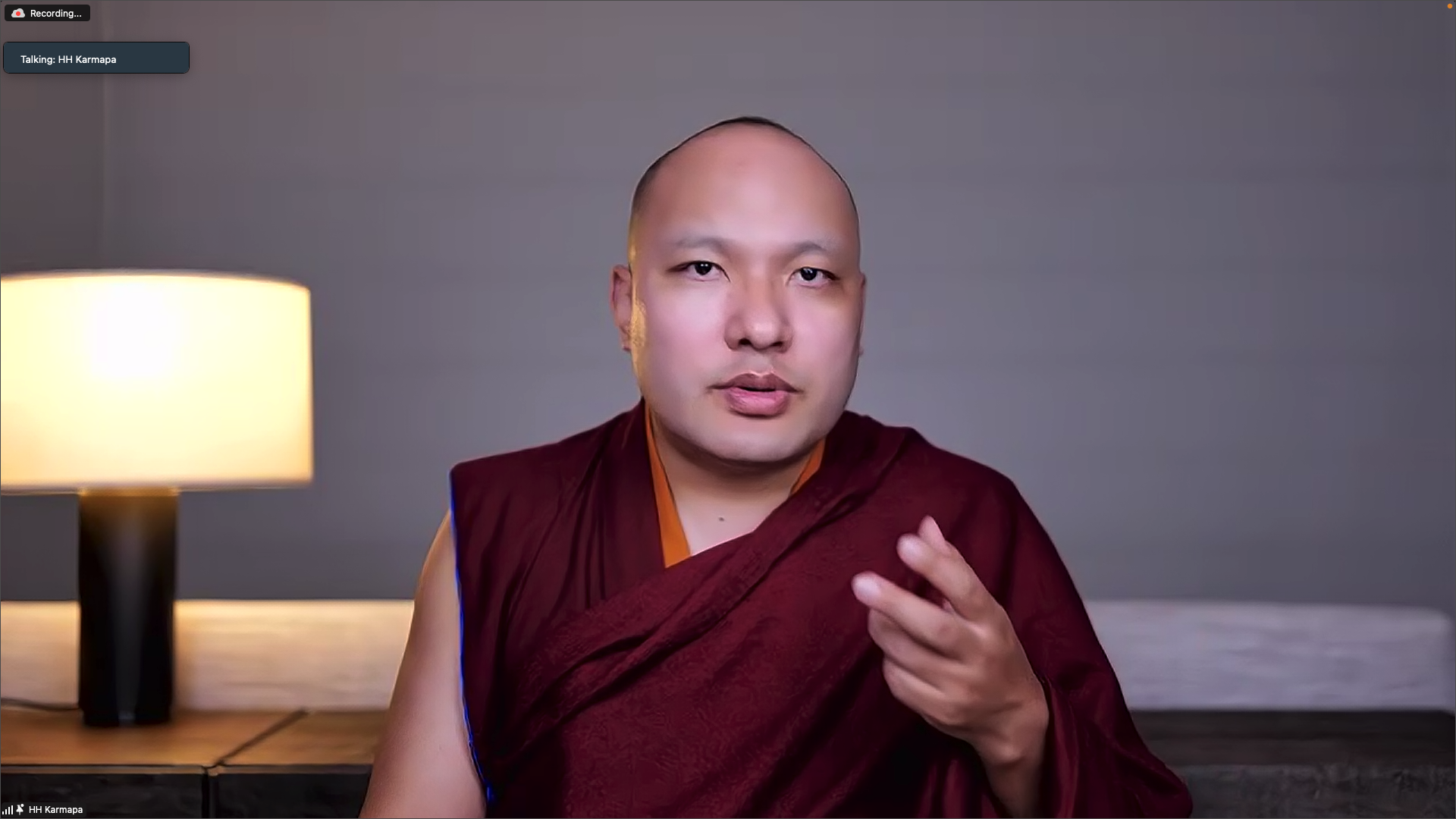
Origins of Secret Mantra • Day Six
September 4th, 2025.
For the teaching today, His Holiness Karmapa spoke about the position of the Korean scholar Lee Ja-Rang and gave a summary of the original split of Buddhism into two schools.
Lee Ja-Rang’s Position
First, His Holiness explained the work of Lee Ja-Rang. She is a Korean Buddhist scholar who published a paper in 1998 titled “A reconsideration of the cause of the initial schism in Buddhist monasteries.” In her work, Lee Ja-Rang expresses many enlightening opinions, so many researchers have taken an interest in her research and cited it.
Her most important analysis involves the original split of Buddhism into the two different schools of Sthaviravāda and Mahāsāṃghika. While all modern-day schools of Buddhism agree that this split occurred, there is no agreement regarding the cause of the schism and its particularities. Each extant school of Buddhism explains this schism in its own way.
Often, Sthaviravāda is considered to be the more conservative school, while Mahāsāṃghika is viewed as being more liberal or relaxed. With this idea in mind, Lee Ja-rang looked into the Sūtra of the Questions of Śāriputra (Skt. Śāriputraparipṛcchā-sūtra), which is thought to be most probably a Mahāsāṃghika text. She realized that in actuality, it was the Mahāsāṃghika school who objected to the Sthaviravāda practice of changing the vinaya, such as by adding more precepts and trainings. So in her analysis, the Mahāsāṃghika school wishes to preserve the original vinaya as it was, whereas the Sthaviravāda school wished to elaborate upon it. From this perspective, Mahāsāṃghika is the more conservative of the two schools.
In her analysis, Lee Ja-Rang cites the work of another scholar, named Bareau, who put forth the opinion that environmental differences between the east and west had a strong influence on the particular ways each school developed. For example, eastern regions like Vaiśālī were wealthier and had stronger economies, so the sangha was easily supported and lived more comfortably there. On the other hand, western regions like Mathurā were poor, so it was more difficult for the sangha there to find support. In addition, in the western regions, there were also many Jains and others who practiced strict austerities. Therefore, the Buddhist sangha in these western regions kept stricter discipline to compete with these other groups to successfully earn the respect and support of the laity.
As an example, Lee Ja-Rang cites the precepts taught in the “Training Dharmas.” Each school has a vinaya that includes the trainings – the rules dictating the daily behavior of monks and their interactions with laypeople. These rules are primarily focused upon external factors that other people would see when observing the monks.
Looking at the different training dharmas of the different schools, we see that each school has a different number of trainings. The Mahāsāṃghika vinaya Chinese and Sanskrit manuscripts have fewer than 70 trainings, which are the fewest of all the schools. Conversely, the Sthaviravāda schools have many more trainings; as a few examples, the Dharmaguptaka vinaya has 100 trainings, the Mūlasarvāstivāda vinaya Sanskrit manuscript has 108 while Tibetan translation has 108 (or 112) trainings, and the Chinese and Sanskrit Sarvāstivāda manuscripts each have 113 trainings.
Mahāsāṃghika, Chinese translation 66
Mahāsāṃghika, Sanskrit manuscript 67
Theravāda 75
Mahākāśyapa 96
Dharmaguptaka 100
Mahīśāsaka 100
Mūlasarvāstivāda, Chinese translation 97
Mūlasarvāstivāda, Tibetan translation 108 (or 112)
Mūlasarvāstivāda, Sanskrit manuscript 108
Sarvāstivāda, Chinese translation 113
Sarvāstivāda, Sanskrit manuscript 113
This shows that there is a great variation in the numbers of the trainings of different schools and that the Sthaviravāda schools of the western regions had higher numbers of trainings. In addition, review of the vinaya texts also shows that these schools had more detailed subpoints of the trainings. These additional and stricter trainings allowed the sangha to appear to be a better example so they could gain increased support from householders. It is for this reason they made many new precepts and made the original rules even stricter. On the other hand, the Mahāsāṃghika school simply continued to uphold the precepts that had already existed and did not create new ones in order to garner public support. They were able to sustain themselves by simply continuing the original tradition and upholding it properly.
Thus, according to Lee Ja-Rang, the original split into schools was not merely due to some incidental situation like the ten points or the five points; there was no single cause that led to the split. Instead, around the time of the beginning of the Second Council, the dharma spread through many regions of India that each had its own culture, history, and background. As the sangha spread to each new region, it adapted to the new environment so that it could survive. The sangha in the western region made the vinaya stricter and the trainings more specific in order to gain support from laypeople, whereas the sangha in the eastern region had no problem obtaining support from the laity, which allowed them to uphold the previous traditions. Therefore, because the environments to which the sangha was spreading were so different, in the end there was no way to avoid the split of the sangha into different schools.
For this reason, Lee Ja-Rang states that we need to reexamine the Mahāsāṃghika school. Throughout history, this school has been called the more careless faction, and it was said the others were more conservative and kept the old traditions. But that is not correct. If one reviews the Mahāsāṃghika texts, it is clear they were actually the school that upheld the original vinaya which had already existed – they were not careless but instead preserved the old traditions. In this way, the Mahāsāṃghika school was in fact the more conservative faction.
A Summary of the Original Split into Schools
Many modern scholars believe that although there are various ways to view the original split of the Buddhist sangha, such as attributing the split to disagreements about the ten points or the five points, they all come down to two discordant viewpoints – that of the Vinaya-holders and the Abhidharma-holders. His Holiness Karmapa noted that when we speak about this difference today, we do not often say outright that they are in conflict. But to give an example, he described the view of alcohol. Vinaya-holders state that consuming alcohol is a naturally unwholesome act, whereas Abhidharma-holders state that it is disobedient but not naturally unwholesome. This different way of viewing various disciplines has led to a kind of conflict between the two schools.
Common Sources: The Ten Points
When we review accounts of the Vaiśālī Council (the Council of the 700) in the Vinaya Piṭaka, we see that the original split of the schools is not mentioned. Instead, the main cause of conflict within the sangha was described as the ten points controversy.
Here, the Vinaya-holders were conservative and assiduous and wanted to strictly keep the vinaya without allowing any changes. They did not wish to allow for any adaptation of the vinaya for the time and place in which it was being practiced. For this reason, they said the ten points were not permissible.
The Abhidharma-holders, on the other hand, held a somewhat more tolerant position and were more progressive in their thought. In particular, they said it is permissible to relax discipline in some situations. They considered the essence of the dharma to be most important, and not just about the words. They advocated for considering the practical application of the words given the time and place in which they were being practiced, and they did not believe the words needed to be followed literally in all situations. As such, they asserted that it was appropriate to change the vinaya discipline according to the environment; they called the ten points tenable.
Common Sources: The Five Points
Similar to the ten points, the discussion related to the five points was also a cause for controversy between the Vinaya- and Abhidharma-holders. While the ten points is about vinaya discipline, the five points are primarily concerned with philosophy and doctrine. In particular, the five points questioned whether arhatship is the ultimate state, implying that it is not. This is a direct challenge to the Sthaviravāda school, as they believed arhatship to be the highest level of attainment. This was especially problematic for the Vinaya-holders, as those with the most seniority were called arhats; it was thus a way for those in the Mahāsāṃghika school to imply that the Sthaviravāda elders were not so important. It allowed for the criticism of the Sthaviravāda school from a philosophical standpoint.
Like the issue relating to the ten points, the Abhidharma-holders’ stance of the five points allowed for a broader and more relaxed view. Both relaxing the vinaya and questioning the rank of arhats allowed for the dropping of outdated traditions and views in favor of thoughtful rules that were more appropriate to the time and place. It is a position that allows rules to be doubted and questioned and does not require them to be rigid and unchanging. His Holiness Karmapa stated that this position of the Abhidharma-holders shows they were willing to think more deeply.
Scholars’ Conclusions
In the history of the sangha, there had long been differences between those who were more progressive and those who were more conservative. Going back to the First Council in Rājagṛha (modern-day Rajgir), we can see that Mahākāśyapa held a more conservative viewpoint when he criticized Ānanda, who was known to be more liberal (such as when he requested the Buddha to allow women to obtain ordination). Mahākāśyapa’s viewpoint was more conservative because he did not enter the Buddhadharma until he was older. He had been practicing as a non-Buddhist Hindu for a long time and had engaged in many ascetic practices, so he wished to continue those traditions when he became a follower of the Buddha.
This same kind of difference between the more progressive and more conservative factions within the sangha continued with the council at Vaiśālī in the debates over the ten points and the five points. All of these conflicts came down to a debate between the Vinaya-holders and the Abhidharma-holders. As the opposition between these two groups continued and increased as time went on, it reached a point where the sangha had to split into two schools because no one was able to resolve these differences.
We should remember this situation when we discuss the original split of the Buddhist sangha. From one perspective, the split was not good because it divided the sangha, and this is a cause for sadness. If Śākyamuni Buddha had been alive at that time, he simply could have ruled on the issue and everyone would have respected what he said. However, he was no longer physically present, so there was no one leader whom everyone respected, so the schools did split.
Nevertheless, we do not have to consider this to be only a negative situation. His Holiness Karmapa explained that we can think about this situation like a meadow with different flowers blooming. If the original school had not split, then the Mahāyāna would have had difficulty developing. Without the Mahāyāna, it would have been very difficult for there to be a secret mantra Vajrayāna. When the sangha split, it allowed for the teachings of the Buddha to change into different forms and to become better suited for different people and situations; the teachings were thus able to spread more effectively in all directions. From this point of view, this original split of the sangha made Buddhism even better.
Leadership in the Sangha after the Buddha’s Parinirvāṇa
His Holiness explained that last year he discussed the topic of leadership after the Buddha’s parinirvāṇa, but he would like to provide more detail now. Of course, when Śākyamuni Buddha was alive, he was the undisputed leader of the sangha. In the latter part of his life when he was elderly, the daily management of the sangha was primarily handled by Śāriputra and Maudgalyāyana. However, they were primarily assistants to the Buddha; they did not actually lead the sangha. Śākyamuni Buddha maintained leadership throughout his life.
At one point, Devadatta attempted to act as a substitute for Śāriputra and Maudgalyāyana. He asked if he could lead but the Buddha reprimanded him severely and said no, and this caused Devadatta to become upset and break away from the sangha, starting his own community. This action not only created a schism within the sangha, but it directly challenged the Buddha’s authority as leader. However, Devadatta was unable to effectively rival the Buddha, and so he could not shake the Buddha’s position as the main leader of the sangha.
After the Buddha’s parinirvāṇa, there was the question of who would lead the Buddhist sangha by keeping the community together and maintaining and spreading the teachings. Many different historical accounts provide different reports. There are three main traditions of explanation: the Northern transmission, the Tibetan transmission, and the Southern transmission.
The Northern Transmission of Buddhism
The Northern Transmission of Buddhism is very similar to the Tibetan Transmission, but there are a few differences if we examine them in detail. This is because the Tibetan transmission came primarily from India to Tibet, so it is separate in some ways. The Northern Transmission is described in the following way:
When we talk about the transmission of dharma, we mean that the dharma is passed from one individual to another. This does not mean that it is simply handed over to the next person; rather, the leader to whom it is passed must be someone who is greatly trusted. This person has the responsibility to propagate the teachings, and so they are only entrusted with the dharma if they have courage, bodhicitta, and the right aspirations.
If we look at the text called the “Chronicles of the Transmission of Dharma,” which was translated by Jí Jiāyè during the Northern Wei period, it lists twenty-four successive generations of the transmission lineage of Buddhism after the Buddha’s parinirvāṇa. Not counting the Buddha, but counting the transmission from Mahākāśyapa, these generations are:
Buddha → Mahākāśyapa → Ānanda → Śāṇakavāsin → Upagupta → Dhṛṭaka → Vibhaga → Buddhanandi → Buddhamitra → Bhikṣu Pārśva → Puṇyayaśas → Aśvaghoṣa → Maśiva/Kapimala → Nāgārjuna → Āryadeva/Kāṇadeva → Rāhula → Saṅghanandi → Bhikṣu Arhat/Saṅghāyaśas → Ghalaśala/Kumārata → Jayata → Vasubandhu → Manora → Haklena Yaśa → Bhikṣu Siṃha
As you can see, many great names appear, including Nāgārjuna, Āryadeva, and Aśvaghoṣa. The last leader is Bhikṣu Siṃha. During his leadership, he was based in the region of Kashmir. There was a king in that region who became hostile towards Buddhism and persecuted the sangha, and in the end, even Siṃha was killed. For this reason, this transmission lineage came to an end.
However, most contemporary researchers say this account of this complete lineage of twenty-four generations could not have actually happened historically. There are three reasons:
1. The text Chronicles of the Transmission of Dharma has six volumes. Although the work is attributed to a joint translation by Jí Jiāyè and Tányào, it was actually retranslated by Ji Yingye based on Tányào’s old translation, and it bears many traces of a compliation. Therefore, it is not a faithful translation of a single text but comes from many different sources selected by the translator. He took the best parts from other sources and put them together to create this work.
2. The second reason is that for more than a century after the Buddha’s parinirvāṇa, the sangha remained unified for 100 years and a few decades. It was at that time that the lineage split into different parts, and then it would have been very difficult for there to have been a single leader who was respected by all. Instead, each group had their own leader.
3. Thirdly, in the lineage reported here, many prominent masters such as Nāgārjuna and Āryadeva are included. However, this lineage is for Foundation Vehicle schools, so inserting prominent Mahāyāna masters into the lineage would not have been accepted by the Foundation Vehicle schools themselves.
It is thus more likely that this text is something like a biography of how great beings in the past protected the teachings. It was likely created to show that the Sarvāstivāda school had a valid lineage.