

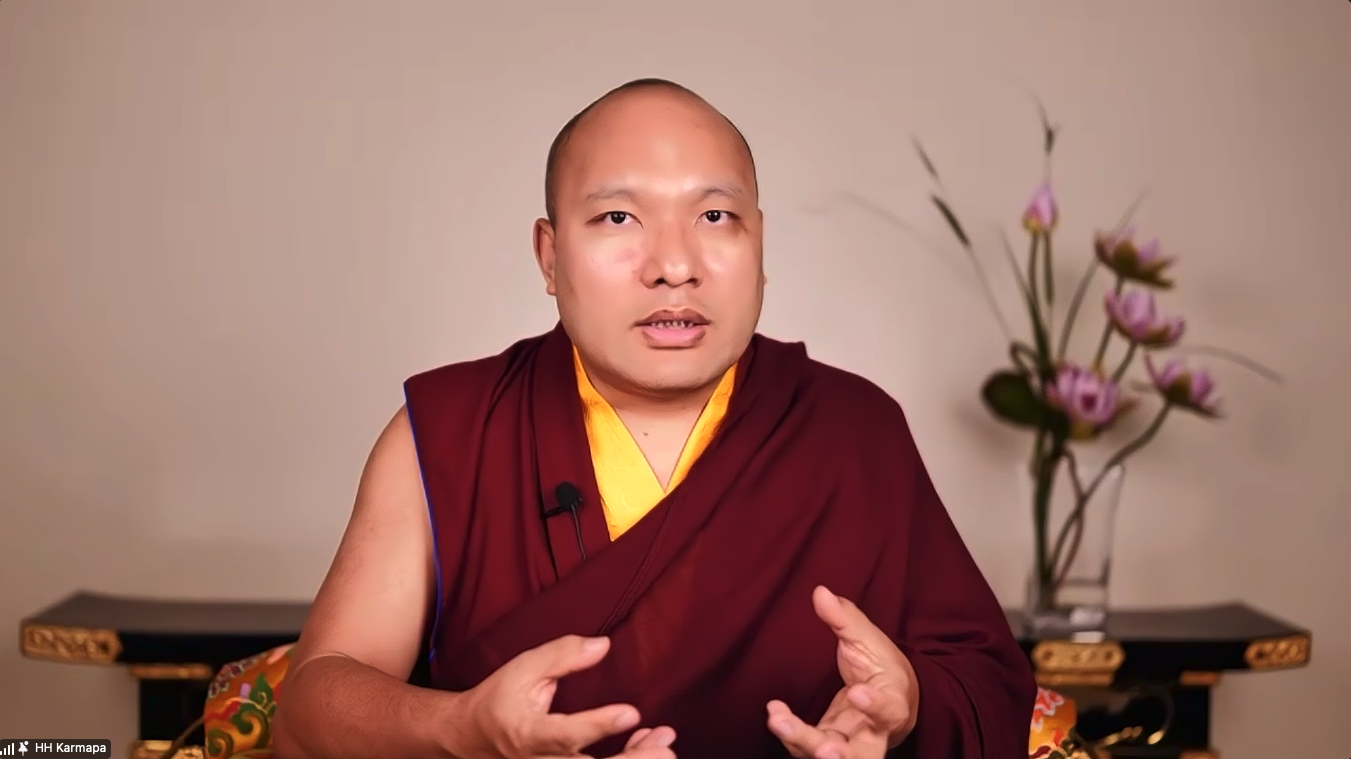
Origins of Secret Mantra • Day Nine
September 15th, 2025.
After greeting listeners, His Holiness continued teaching on the history of the transmission of the Dharma. Earlier sessions discussed how transmission was described in the Northern and in the Tibetan traditions. Today he began discussing a third topic, that is the Southern transmission. He then compared and contrasted different accounts within these three transmissions.
Southern Transmission : Two Lineages
There are two places where the Southern transmission lineage is illustrated. First, it is described in the Satta-satika-khandhaka, in the chapter on the Group of 700 [Culavagga, Kd. 22]. Second, an account is given in the Mahāsāṃghika Vinaya.
- The lineage in the Satta-satika-khandhaka
The Satta-satika-khandhaka of the Pali tradition gives the lineage of Vinaya transmission, which is a lineage of preceptors or khenpos from whom the vows were passed. This is in slight contrast to the Northern tradition that teaches the lineage of the patriarchs. One can trace this lineage of Vinaya from the Buddha to the time of the Second Council by reading the chapter on the Group of 700 as well as additional commentaries, such as the Samantapāsādikā written by Buddhaghoṣa.
The Vinaya Piṭaka lineage is as follows:
(Buddha) → Upāli ཉེ་བ་འཁོར། → Dāsaka དཱསཀ ། → Sonaka སོནཀ། → Siggava སིགྒབ། → Moggaliputta Tissa མོགྒལིཔུཏྟ་ཏིསྶ།
The main person who taught was the bhikṣu Upāli. Amongst all the Buddha’s many disciples, he was supreme in keeping the Vinaya. It is said that during the First Council in Rājagṛha (Rajagriha, today’s Rajgir) Ānanda compiled the Sūtras whereas Upāli compiled the Vinaya. Upāli was a specialist and the most learned in terms of the practice of the Vinaya; he was the absolutely indispensable one with respect to the Vinaya. Therefore, in this Pali tradition, Upāli is the first person in this lineage.
The fifth bhikṣu was Moggaliputta Tissa. He attended the Second Council and according to this tradition, he was King Aśoka’s main teacher. Karmapa elaborated on this point later this session.
- Mahāsāṃghika Vinaya
As with the account given in the Satta-satika-khandhaka, the lineage begins with the bhikṣu Upāli. From the 33rd fascicle of the Mahāsāṃghika Vinaya, it is as follows:
Buddha སངས་རྒྱས། → Upāli ཉེ་བ་འཁོར། → Vasubandhu དབྱིག་གཉེན། → Madhyāntika ཉི་མ་གུང་པ། → Śāṇakavāsin ཤ་ནའི་གོས་ཅན། → Upagupta ཉེར་སྦས། → the elders at the time of Aśoka མྱ་ངན་མེད་པའི་དུས་ཀྱི་གནས་བརྟན་རྣམས།
Karmapa asked listeners to note that this Vasubandhu was not the same Vasubandhu who authored the Treasury of Abhidharma. Rather the Vasubandhu mentioned in this lineage above was a bhikṣu who had been born in Rājagṛha and who was a direct disciple of Upāli.
The lineage is mostly the same as the Mahāsāṃghika transmission taught in The Sūtra of The Questions of Shariputra (Skt. Śāriputraparipṛcchā).
The Five Schools of Vinaya
Generally, in the Chinese translations, there are five different Vinayas or five different schools. In one account of Chinese Buddhism, just over 100 years after the Buddha’s parinirvāṇa to the time of the fifth patriarch, there was the monk called Upagupta. In the last part of his life, Upagupta had five particular students given the title Dharmagupta (En. Dharma Protector; Tib. Chösung ཆོས་སྲུང་། or Chöbepa ཆོས་སྦས་པ།). They gave five different explanations of the Vinaya, thus becoming the five schools of the Vinaya.
These five scriptures or schools of the Vinaya are:
- Dharmaguptaka Vinaya. This is the longest one. The Vinaya Vibhaṅga has sixty fascicles, and the Bhikṣu Prātimokṣa and the Bhikṣuṇī Prātimokṣa each has one fascicle.
- Sarvāstivāda Vinaya. This has sixty-one fascicles for the Vinaya Vibhaṅga, one for the Bhikṣu Prātimokṣa, and one for the Bhikṣuṇī Prātimokṣa.
- Mahīśāsaka Vinaya. The Vinaya Vibhaṅga has thirty fascicles, and one each for the Bhikṣu and Bhikṣuṇī Prātimokṣas.
- Kāśyapīya Vinaya. This is not translated completely into Chinese.
- Mahāsāṃghika Vinaya. The Vinaya Vibhaṅga has forty fascicles, and there is one for each of the Bhikṣu and Bhikṣuṇī Prātimokṣa.
With the exception of the Kāśyapīya Vinaya, these five different Vinaya scriptures of the five different schools are complete.
The Chinese tradition says there are five patriarchs at the time of Upagupta but the Tibetan tradition says there are seven. However, some modern scholars say that the five Vinayas during the time of Upagupta were different in name only; it was not until the period of Aśoka that five different Vinayas actually appeared.
According to Xuanzang’s Chinese translation of The Wheel Distinguishing the Scriptural Traditions, before the original split into the Sthaviravāda and Mahāsāṃghika schools, there were four factions in the sangha: the Nāga faction, the Outlying Land faction, the Learned faction, and the Elders’ faction. The Tibetan translation of this text only mentions two factions, the Elders’ faction and the faction of the Nāgas. It is not very clear in the Tibetan translation so it can be easily misunderstood. This is probably a question with the translation.
Basically, in Xuanzang’s translation, there ended up being four factions of the Vinaya. The text also stated that in addition to the four factions, there was a group of Upholders of the Abhidharma led by Upagupta. The Karmapa said that if one counts Upagupta’s group, then there would be five factions of the sangha. He continued by explaining that these five factions may have been differentiated because they were possibly from different locations or they spoke different languages. Likewise, the bhikṣus who went forth may have been of different ethnicities.
Thus there were four or five factions of the sangha. The first three, that is the Nāga, the Outlying Land, and the Learned factions, became the basic material from which the Mahāsāṃghika school was later formed. The remaining two factions, namely the Elder faction and the Upholders of Abhidharma, were the seeds of what later became the Sthaviravāda school. His Holiness will speak more about this later when he discusses the split into eighteen schools.
Of the five Vinayas that are translated into Chinese, only the Mahāsāṃghika school states the lineage of the Vinaya vows from Upāli down to Upagupta clearly. As Karmapa showed earlier today, the Mahāsāṃghika Vinaya states that Upagupta then transmitted the teachings of the Vinaya to the elders at the time of Aśoka. None of the other Vinaya schools, such as the Dharmaguptaka or the Mahīśāsaka, state the lineage of the vows clearly. Karmapa clarified that although there was a lineage in the Mahīśāsaka Vinaya, it was compiled later.
The Lineage of Vows in Tibet and the Origin of One’s Ordination Vows
In Tibet, the lineage of the vows is considered but it is primarily the lineage of the khenpos or the preceptors. There’s the Lower Vinaya, the Upper Vinaya, and the Middle Vinaya, all of which were compiled later. They are not found within the Mūlasarvāstivādin Vinaya scriptures, nor is it clearly stated which students were entrusted with the transmission.
Karmapa emphasized the importance of knowing from where one’s full ordination (bhikṣu and bhikṣuṇī) vows come. He stated that the vows arise from the sangha present at one’s ordination ceremony, the sangha being a group of four or more individual bhikṣus. In other words, one’s bhikṣu vows come from the group, not from a single individual nor the preceptor. Bhikṣuṇī vows are similar; it is taught that although both bhikṣuṇī and bhikṣu sangha need to be present at a bhikṣuṇī’s ordination ceremony, the vows arise only from the sangha of bhikṣus.
Therefore, if one were to consider from where the Vinaya transmission comes, one should look at the sangha that was present at the ceremony, not just the khenpo (preceptor). However, the khenpo is so impressive as one who has gone forth (that is leaving a conventional householder life in order to join a monastic community) that later there developed a custom of considering the lineage of the khenpo’s vows. Karmapa continued by explaining that once khenpos have gone forth, one must take care of them. It is important to be close to khenpos. Although considering the lineage of the khenpo is considered a lineage of the vows, one has not really examined the lineage of the vows of the people who were present at the ceremony. Therefore, in the Tibetan tradition, when one speaks about the lineage of the vows, it is probably referring to the lineage of the khenpo at the ceremony. His Holiness felt this was important for people to know.
Comparing Southern and Northern transmissions – Three Examples
When considering the transmission of the Dharma, there are the Northern, the Tibetan, and the Pali traditions. When compared, there are several similarities and discrepancies in these transmissions. His Holiness highlighted a few primary ones this session and at the end, raised some questions. First, he spoke about the connection between the Śāṇakavāsin and Sambhūta Sānavāsī. Second, Karmapa addressed differences in the accounts regarding the identity of Aśoka’s main guru. Third, he spoke about several histories about the figure(s) named Madhyāntika. Related to that was the account of 500 Madhyāntikas or arhats.
His Holiness reminded listeners that as discussed in previous teachings, the Southern transmission references the scriptures in the Pali tradition, observed in Sri Lanka and so forth. The Northern transmission primarily refers to texts in China although it sometimes includes Tibetan texts. The Karmapa expressed it may be clearer if the Tibetan transmission is referred to as the Tibetan transmission because sometimes the Chinese and the Tibetan traditions match but other times they do not.
The Northern tradition focusses primarily on the lineage of the patriarchs, that is the people who transmitted and entrusted the teachings from one to another. The lineage of patriarchs is:
Mahākāśyapa འོད་སྲུང་ཆེན་པོ། → Ānanda ཀུན་དགའ་བོ། → Śāṇakavāsin ཤ་ནའི་གོས་ཅན། → Upagupta ཉེར་སྦས།
It is said Upagupta was King Aśoka’s main spiritual teacher. The fifth patriarch could be Dhṛtaka (Dhītika). This is from the Sūtra of Aśoka and the Aśokāvadāna in the Chinese translation.
In contrast, the Southern transmission lineage is not that of the patriarchs but of the preceptors as shown at the beginning of today’s teachings.
(Buddha) → Upāli ཉེ་བ་འཁོར། → Dāsaka དཱསཀ ། → Sonaka སོནཀ། → Siggava སིགྒབ། → Moggaliputta Tissa མོགྒལིཔུཏྟ་ཏིསྶ།
In the Southern tradition, the last preceptor, Moggaliputta Tissa, is said to be King Aśoka’s main spiritual teacher. Therefore, King Aśoka’s main spiritual teacher is not the same in the Northern and the Southern traditions. His Holiness elaborated on this point shortly afterwards.
- The Connection Between Śāṇakavāsin and Sambhūta Sānavāsī
Karmapa began this topic by comparing the descriptions of Śāṇakavāsin in the Northern transmission with those of Sambhūta Sānavāsī in the Southern transmission.
In the Northern tradition, Śāṇakavāsin was included in one of the transmissions of the Dharma. In the Southern tradition, there was an elder named Sambhūta Sānavāsī. His Holiness asked whether there a connection between these two, whose names are similar, or not.
Sambhūta Sānavāsī was a western representative of monks at the Second Council that took place 100 years after Buddha’s parinirvāṇa. He was one of the eight most famous elders of that time and he lived to be 120 years old. Karmapa pointed out that the name “Śāṇakavāsin” in the Northern tradition is very similar to “Sambhūta Sānavāsī” [“Sānavāsī” is a Pāli form of Sanskrit “Śāṇavāsin/Śāṇakavāsin”]. Furthermore, the time in which they lived was basically the same, and they were each accorded similar status and respect. Consequently, many researchers believe the Śāṇakavāsin of the Northern transmission and Sambhūta Sānavāsī, the elder from the Second Council, are the same person.
Unlike Śāṇakavāsin, Sambhūta Sānavāsī is not named in the Vinaya transmission of the Southern tradition. His Holiness offered one reason. In general, Karmapa said, 100 years after the Buddha’s parinirvāṇa, there were several main elders representing the Sangha. Representatives from the east included Sabbakāmī and those from the west included Revata and Sambhūta Sānavāsī. Although in different Vinayas, the eight elders were generally described differently, in all of the accounts, Sabbakāmī (Pāli; Skt. Sarvakāmin/Sarvagāmin), Revata, and Sambhūta Sānavāsī are named and are the same. However, Sambhūta Sānavāsī was not identified in the lineage of preceptors in the Southern transmission, as previously stated, because the Southern Vinaya tradition does not speak about the patriarchs. Rather the tradition accounts for the lineage of the preceptors from Upali and his disciples. The main hypothesis is that Sambhūta Sānavāsī was a student of Ānanda, and Ānanda was primary in the transmission in the basket of the Sūtras, holding the lineage of the Dharma, not the Vinaya lineage. This is the primary reason why Sambhūta Sānavāsī is not named in the Vinaya transmission of the Southern tradition.
- King Aśoka’s main guru
Karmapa elaborated on the discrepancy regarding King Aśoka’s main teacher. He reminded listeners that according to Chinese sources, Aśoka’s main teacher was Upagupta, whereas the Southern tradition states that Aśoka’s guru was Moggaliputta Tissa. However, there are some similarities. In both traditions, it is said that Aśoka’s teacher lived in places accessible by boat and as a result, Aśoka invited his teacher by sending a boat for him.
In the Southern tradition, Moggaliputta Tissa lived on Mount Urumaṇḍa. In contrast, the Northern tradition says Urumaṇḍa was Upagupta’s residence. Upagupta on the other hand was said to have been invited from Mount Ahogaṅga but according to the Northern tradition, Mount Ahogaṅga was Moggaliputta Tissa’s [Pāli; Skt. Maudgaliputra Tisya] residence. The places were reversed but in both, the teacher was invited from the mountains and Aśoka received his teacher by boat. For now, continued Karmapa, since many centuries have passed and since this is a very old, ancient history, it cannot be determined whether Upagupta and Moggaliputta Tissa were the same person, nor can it be determined which was actually Aśoka’s main guru. It is possible that both had some influence on King Aśoka; both could have been his teacher.
In the Tibetan tradition, Jetsun Tāranātha’s history of the Vinaya is slightly different from the Northern tradition. He wrote that when King Aśoka was young, there was a fifth patriarch named Dhṛtaka who had just passed away. There was no connection between King Aśoka, Upagupta, and Dhṛtaka. According to Tāranātha, King Aśoka’s main teacher was a monk named Yaśa, the arhat who convened the Second Council. The Pali tradition says that Yaśa lived to the age of 160.
- Madhyāntika
Madhyāntika prominently figures in the dissemination of the Dharma in Kashmir, and there are similarities and differences in accounts of him in the Northern and Southern traditions.
According to the scriptures of the Northern traditions such as the Aśoka Sūtra and the Aśokāvadāna, Madhyāntika was Ānanda’s last student before he passed into parinirvāṇa. In terms of the dates, Madhyāntika was probably a contemporary of Upagupta, the person who displayed miracles and brought Aśoka to Buddhism and was therefore Aśoka’s main guru. Ananda told Madhyāntika to go to Kashmir to spread the Dharma. There, Madhyāntika subdued malicious nāgas and taught the people of that region how to detach saffron crocuses so they could grow saffron and earn their livelihood. This Madhyāntika was a very important figure in benefiting the people of Kashmir.
Karmapa then compared this Northern account with a Southern description. Sinhalese history mentions that Moggaliputta Tissa, Aśoka’s main teacher, encouraged nine great masters to spread the Dharma in nine different regions. Among them was Madhyāntika [Pāli: Majjhantika]. With a group of five bhikṣus, he was sent to Kashmir and Gandhāra. Karmapa explained that in order to have a sangha, one needs four bhikṣus. Without a sangha, one cannot perform the actions of a sangha. In particular, full ordination must come from the sangha so you need to have at least five sangha members. This is the reason why Madhyāntika left for Kashmir and Gandhāra with five bhikṣus. Madhyāntika then subdued five malevolent nāgas and taught the Āsīvisopama-sutta in Kashmir.
What can be understood from both the Northern and Southern traditions is that Madhyāntika spread the teachings of Buddhism and subdued malicious nagas. His Holiness said these accounts match well so probably the Northern and Southern traditions are speaking about the same person.
- The Account of Ānanda and 500 Madyāntikas
Karmapa wanted to share his own ideas about this topic, which he drew from the Mūlasarvāstivādin, or the Minor Topics of the Vinaya. Here it is said that when Ānanda was about to pass away and depart in nirvana, he thought it wouldn’t be right to pass away in either Vaiśālī (Vaishali) or Magadhā; if he died in Vaiśālī the Magadhā armies would come to take his relics and if he died in Magadhā, the Vaiśālī armies would attack. In other words, the kings of Vaiśālī and Magadhā would war over his relics. In order to prevent a conflict, Ānanda decided to pass away in the middle of the River Ganges on neither the Vaiśālī nor the Magadhā side.
There are many signs or omens when great beings pass away and one of them is an earthquake. When Ānanda thought “I’m going to pass away”, the earth quaked six times. As an aside, the Karmapa added that he was told a story about the Sixteenth Karmapa’s passing. Just before the Sixteenth Karmapa passed away in Chicago, there was a small earthquake. At that time, his students thought this was a sign that the Sixteenth Karmapa would soon pass away.
Returning to Ānanda’s story, the earth quaked six times just before his passing. When the earth quaked, there was a sage who through miraculous powers was able to bring 500 students immediately to Ānanda. The sage and the students declared that they wanted to become fully ordained and then pass away. Ānanda emanated or created an island in the middle of the Ganges River where the ordination would take place. Ānanda said the words of ordination to these students three times, as is required for ordination. When Ānanda stated the words of ordination the first time, the 500 students achieved the result of non-returners. Upon the third time, the students achieved the result of arhat.
These now fully-ordained students were then named according to where they were ordained (the middle of the Ganges River) or according to when they were ordained (in the middle of the day). In Sanskrit, both of these names is “Madhyāntika”. As a result, in the Tibetan translation it indicates that some were named “Middle of the River” and some were named “Middle of the Day”; Tāranātha said there were 500 of each. Normally, in the Minor Topics, His Holiness explained, one can choose which name to use but he noted again that the Sanskrit name for “Middle of the River” and “Middle of the Day” is Madhyāntika. Their sage was called the Great Madhyāntika.
Once they attained the state of arhatship, the students said to Ānanda, “Just like Subaddha, the last person who saw the Buddha and received full ordination before the Buddha’s parinirvāṇa, we cannot bear to see our preceptor pass away, so we shall pass into nirvāṇa first.” Although Subaddha actually passed into parinirvāṇa before the Buddha passed away, Ānanda told these students that was not okay for them to pass away first. He replied,
Sons, the Buddha entrusted the teachings to Mahākāśyapa and passed into parinirvāṇa. The elder Mahākāśyapa also passed them to me before he passed away. Now I am about to pass away so I’m going to entrust these teachings to you and you need to protect these teachings. The Buddha prophesied that necessities and places to stay would be easy to find in the land of Kashmir, so it is the best place to practice dhyāna.
The Buddha also predicted that one hundred years after his parinirvāṇa, a bhikṣu named Madhyāntika would appear, and he will spread the teachings in Kashmir. Therefore sons, you must bring him into the teachings.
The students agreed and said they would do exactly that.
Issues regarding accounts of Madhyāntika
- An Earlier and a Later Madhyāntika?
His Holiness raised a few questions at this point. He said that the way this account is described in the Minor Topics, it seems like there should have been an earlier and a later Madhyāntika. The earlier would be the student(s) at the time of Ānanda’s passing while the later one would be the person who spread the Dharma to Kashmir. When Ānanda told these students to bring him into the teachings, he could be saying they need to find the future bhikṣu Madhyāntika and ordain him. Ānanda’s last student(s) replied, “I’ll do this.”
Another reason there may have been an earlier and a later Madhyāntika was that in sources from the Northern tradition and from Tāranātha’s work, it appears that Ānanda preserved the teachings for about thirty to forty years. By his calculations, Karmapa felt that Ānanda could not have passed away more than fifty years after the Buddha’s parinirvāṇa. Even if in Ānanda’s statement “bring him into the teachings”, “him” refers to the land of Kashmir [Skt. Kaśmīra is a masculine noun] and not a future individual named Madhyāntika (as in “bring Kashmir into the Dharma”), the Buddha still prophesied that a bhikṣu named Madhyāntika would appear and spread the Dharma in Kashmir 100 years after his passing. If the Madhyāntika whom Ānanda ordained just before his passing (40-50 years after the Buddha’s parinirvāṇa) was the same Madhyāntika who was to spread the Dharma in Kashmir 100 years after the Buddha’s passing, that would mean Madhyāntika would have waited fifty or sixty years after ordination before going to Kashmir. His Holiness suggested this would be unusual.
Using similar logic, the sage who brought 500 students to meet Ānanda called the Great Madhyāntika may not have been the same person who went to Kashmir to spread the Dharma. In order to have 500 students, the sage must have been at least forty or fifty years old when he met Ānanda, reasoned Karmapa. If he were fifty years old at that time and then and had to wait another fifty or sixty before going to Kashmir, he would be quite old. He could only go to Kashmir if he had miraculous powers. Going there like an ordinary person, by walking or so forth, would have been very difficult.
- 100 or 50 years?
Karmapa addressed the question of whether the 100 years could be considered differently. He referred to the Mahāparinirvāṇa Sūtra which says:
The Buddha predicted before, “There will be a monastery for practicing dhyāna in Kashmir, and 100 years after I pass into parinirvāṇa, a bhikṣu called Madhyāntika will appear. He will uphold the teachings and spread them in the region of Kashmir.
This says that the bhikṣu Madhyāntika will appear 100 years after the parinirvāṇa. This account is similar to the one in Minor Topics.
However, an alternate way to think about 100 years is considering them as half years, which would equal fifty whole years. Therefore, Ānanda’s direct disciple and final student could have been the one to go to Kashmir. There is a source for this. In Tang Xuanzang’s Great Records of Travels to the Western Regions, an account reads:
Fifty years after the Tathāgata passed into parinirvāṇa, Ānanda’s student, the arhat called Madhyāntika who had achieved the six clairvoyances and eight liberations, knew of the Buddha’s old prophecy and with great delight went to that region [of Kashmir].
Xuanzang’s record states that Madhyāntika went to Kashmir fifty years after the Buddha’s parinirvāṇa, not 100. Xuanzang travelled to Kashmir and spoke to ordinary people, collecting oral histories from the area and explaining what he was told.
Likewise from Tāranātha’s History of Buddhism in India:
The Kashmiris must definitely count Madhyāntika as a patriarch, because when Madhyāntika preserved the teachings in the Central lands, Noble Śāṇakavāsin had a few students. Madhyāntika went to Kashmir and Śāṇakavāsin preserved the teachings.
In this text, it is said that Ānanda held the teachings for forty years before passing away. The following year Aśoka passed, and then King Ajātaśatru (Ajatashatru) also passed away. Ajātaśatru’s son Udayabhadra took the throne. By this point, Madhyāntika had held the teachings for seventeen years before going to Kashmir. From this calculation, this is about fifty years after Buddha’s parinirvāṇa that Madhyāntika went to Kashmir.
- Upagupta’s Ordination
The Mūlasarvāstivādin’s chapter of Medicine teaches a different history. It is said that Madhyāntika ordained Upagupta. This does not match what is generally accepted in Sarvāstivādin accounts of history, namely that Upagupta was ordained by Śāṇakavāsin.
- Ordaining 500 Arhats
For the final set of issues brought up in his research of Madhyāntika, Karmapa returned to the subject of 500 Madhyāntikas or 500 Arhats. He asked, the sage with his 500 students went forth, but how could 500 people go forth and be ordained within a short time? The records state that ordination took place at noon and according to Tāranātha’s History of Buddhism, they were ordained in just one hour. This would be very difficult. Some people say that there is a method of giving vows by creating boundaries of cords and that Ānanda used this method when ordaining these students on the island in the middle of the Ganges. Ordaining such a large number of people in short a short time was the first question posed by His Holiness.
The second question raised was how the sage reached Ānanda so quickly. Ānanda had decided to pass away in the center of the Ganges River. This had been a spontaneously, unplanned decision that happened in order to prevent a war between the kings of Vaiśālī and Magadhā. If Ānanda made this decision spontaneously, how did the sage and his 500 students know about it? The Mahāparinirvāṇa Sūtra says that the main sage had been on a snow mountain and that he had clairvoyance. He recognized that the earthquake was a sign that Ānanda was passing away. But how did he reach Ānanda in such a short time? The Minor Topics state that the sage had miraculous powers so he could reach Ānanda instantly. However, how did his 500 students get there? It is unlikely all of them had their own clairvoyance or miraculous powers. Basically, Ānanda thought “may all my students come to me” and he emanated an island. Because he was thinking of them, the students immediately were brought to Ānanda.
Next, Karmapa addressed a story, which had perhaps been mixed up, about 500 Arhats, recorded in Xuanzang’s Great Record of Travels to the Western Regions. Xuanzang wrote about a time during Aśoka’s reign. At that time, there were 500 Arhats as well as a sangha of ordinary individuals. There was also the bhikṣu Mahādeva who wrote incorrect treatises that contradicted the Buddhist teachings. The arhats did not accept Mahādeva’s position, but the king took Mahādeva’s side. Unhappy, the king made the arhats cross the Ganges in leaky boats. The 500 arhats had miraculous powers so when they reached the middle of the Ganges, they flew off to the region of Kashmir. The king, regretting what he had done, invited the arhats back. When the arhats did not accept his invitation, the king built 500 monasteries and offered them to the arhats. Karmapa wondered whether the Sarvāstivādins took the story of the 500 Arhats and their crossing the Ganges and made up a new story about 500 Madhyāntikas going forth in the middle of the river, or whether the two stories were confused because many years had passed in the interim and they were both related to the Ganges River.
Lastly, Karmapa pointed out that 500 is a common number in the Vinaya, giving examples such as 500 ṛṣis (rishis), 500 fishermen, 500 merchants, 500 monks. He explained that “500” probably did not mean exactly 500 but that it indicated plurality. Similarly, in Tibetan when one speaks about 100 sādhanās, it means there are many but not exactly 100 sādhanās. One doesn’t count each person when one says “hundreds of people”, he explained. Similarly in the scriptures, 84,000 queens does not mean 84,000 queens. A king would not be able to count them all and having a house for 84,000 people would be really difficult for the king! Instead, 84,000 may mean eight queens, and because of her great skills, her qualities, and her goodness, each queen is worth 1,000 or 10,000 people. It is poetry and rhetoric. These numbers are not always exact but suggest many.