

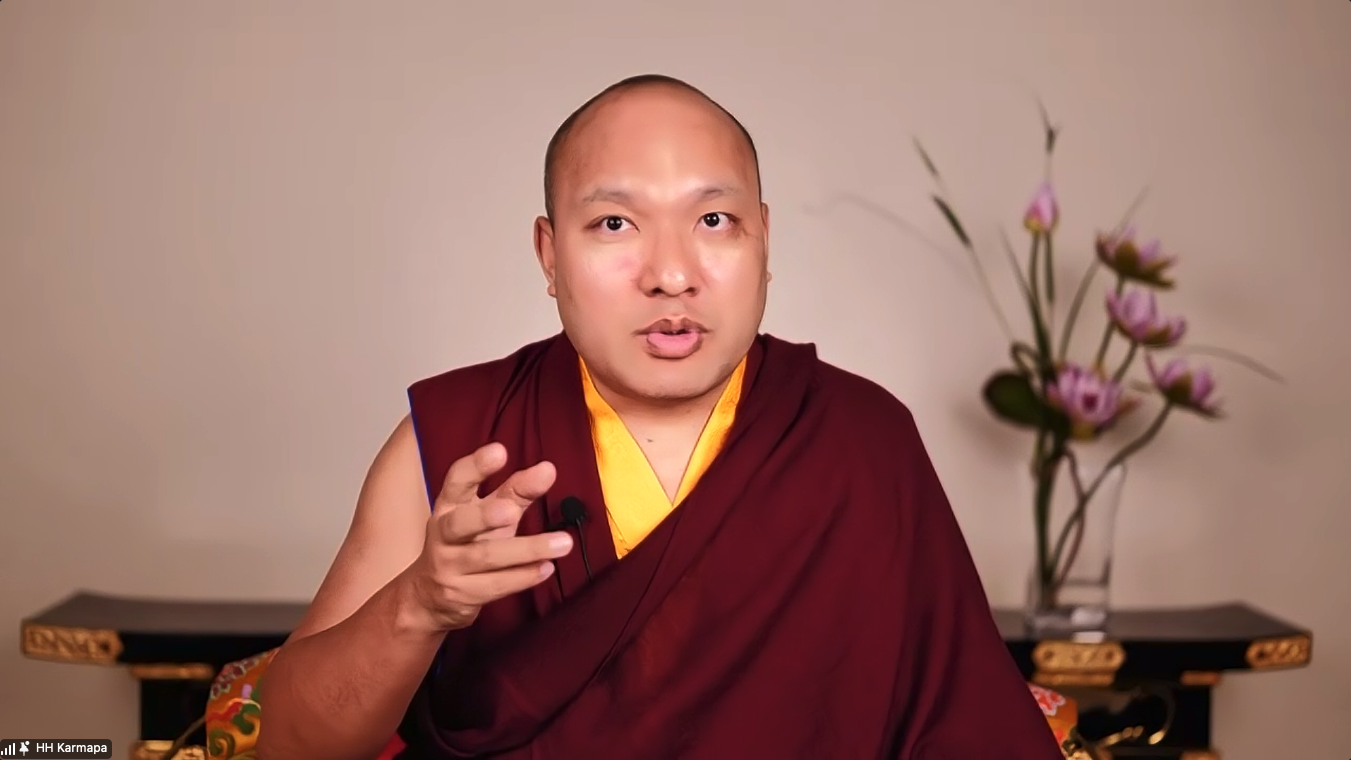
Origins of Secret Mantra • Day Eight
September 12th, 2025.
Today, His Holiness Karmapa discussed the transmission of the dharma, emphasizing that the lineage of the patriarchs is important because it provides foundational information about early Buddhist history. From the time of the Buddha’s parinirvāṇa until the time of the Dharma king Aśoka, some 100 or 200 years, Buddhism spread from central India out to the entire region of India. Early in his reign, Aśoka was a cruel king, but when he saw the destruction of war, he went for refuge to the Buddhadharma. From that time onwards, Buddhism spread beyond the borders of India and became a world religion. Aśoka was a very powerful king – he was the first person to unite the land of India. Because of his great power, he was able to support the spread of Buddhism to many countries.
Although there were not many generations between the time of the Buddha’s awakening and Aśoka’s reign, many changes in Buddhism occurred during this 100-200 year time period. One way to consider these changes is by looking at what happened during the First, Second, and Third Councils. Another way to understand is to consider the history of Bimbisāra and Ajātaśatru, two kings of Magadhā, during this time period. Finally, one could also refer to the biographies of the Buddha’s greatest disciples such as Mahākāśyapa, Ānanda, and others.
One perspective for thinking about this time period is provided in the Prātimokṣa Sūtra:
“After I’ve passed into parinirvāṇa,
This will be your teacher.”
The self-arisen one respectfully
Praised the assembly of the bhikṣus.
Here, the Buddha says that after his parinirvāṇa, we are to take the Prātimokṣa as the teacher and as his successor. This is one method of determining the Buddha’s successor.
Another method is to extrapolate from what was happening in the community when the Buddha was alive. At that time, the Buddha gave half of his seat to Mahākāśyapa and had him teach the dharma. For this and other reasons, Mahākāśyapa became the first leader of Buddhism and the first patriarch. If you think about any religion, not just Buddhism, after the founder passes away, the main students naturally become the leaders of the religion.
There is no contradiction here between the Pratimokṣa as the successor of the Buddha and his human disciples as his successors. This is similar to Gampopa; when Gampopa was about to pass away, he left as his last testament: “Whoever in the future thinks that they will not meet me should read my Jewel Ornament of Liberation [Tib. ཐར་པའི་རིན་པོ་ཆེའི་རྒྱན།].” and Precious Garland of the Precious Path [Tib. ལམ་མཆོག་རིན་ཆེན་ཕྲེང་བ།].” In this example, Gampopa also says his compositions are his successors, but likewise Gampopa also had many students who succeeded him. In particular, he had four main lineage holders who continued to sustain the lineage of Gampopa and the teachings of the Dakpo Kagyu. So it is clear that a successor of a great teacher can take the form of both written teachings as well as human teachers, such as Phakmodrupa.
This is a bit different than the transition of a lineage. For example, in the Mūlasarvāstivāda accounts it says there are seven patriarchs and each one transmits the complete teachings onto the next; each of these patriarchs then is in turn considered the leader of the religion. In addition, another way to think about it is as a lineage of preceptors and as the Khenpo from whom one takes their Vinaya vows – this person is said to be the leader. The Chinese Chan tradition offers yet another way to consider lineage. Here, they have twenty-eight different lineage masters, and this lineage of patriarchs is described as being the ultimate lineage of realization or lineage of blessings. Thus when one hears reference to the lineage of transmission, it is good to remember there are many different ways this can be considered.
The Lineage of Transmission as Taught in the Tibetan Tradition
Next, His Holiness discussed the way the subject of lineage is taught in the Tibetan tradition. Although at a gross level the Tibetan tradition is included within the northern tradition, at a more subtle level it can be considered separately. There are several different Tibetan accounts of the transmission of the lineage of patriarchs, but the main account is from the Mūlasarvāstivāda Minor Topics of the Vinaya [Skt. Vinayakṣudrakavastu]. Here, it lists seven patriarchs as follows:
[The Karmapa used slides which gave the Tibetan equivalent of the names]
Mahākāśyapa (འོད་སྲུང་ཆེན་པོ།) → Ānanda (ཀུན་དགའ་བོ།) → Śāṇakavāsin (ཤ་ནའི་གོས་ཅན།) → Upagupta (ཉེར་སྦས།) → Dhītika (དྷི་ཏི་ཀ །) → Kṛṣṇa (ནག་པོ།) → Sudarśana (ལེགས་མཐོང་།)
The texts explains:
Venerable Upagupta, you should know! The Blessed One entrusted the teaching to Venerable Mahākāśyapa and passed into parinirvāṇa. Venerable Mahākāśyapa entrusted it to my preceptor, and my preceptor entrusted the teaching to me and passed into parinirvāṇa. Son, I too will pass into parinirvāṇa. Now you must completely protect the teaching, and you must diligently practice all that the Blessed One has spoken.
Thus it is clear that Mahākāśyapa passed the lineage on to Ānanda, and then Ānanda was Śāṇakavāsin’s preceptor. Śāṇakavāsin is speaking in the above passage, and he is instructing Upagupta to protect the Buddhist teachings after he himself passes into parinirvāṇa. Then after Upagupta, the lineage passed to Dhītika, Dhītika in turn entrusted it to Krṣṇa, and next Kṛṣṇa passed it onto Sudarśana. These are the seven patriarchs listed in the Minor Topics of the Vinaya.
Among these seven lineage holders, the first five match the first five listed in the accounts of the Chronicles of the Transmission of Dharma [付法藏因緣傳], a Chinese compilation of Sanskrit texts, as well as the Aśokāvadāna [and Aśoka Sūtra]. However, the last two are different compared to other sources on the lineage of transmission. This leads us to a further study of the last two patriarchs listed here.
Kṛṣṇa (The Black One)
The Arhat Kṛṣṇa was born in the region of Aṅga in the east and was the son of a rich merchant. More information about the details of his life’s story can be found in Tāranātha’s History of Buddhism in India [Tib. རྒྱ་གར་ཆོས་འབྱུང་།]. While some accounts such as the Aśoka Sūtra and the Chronicles of the Transmission of Dharma exclude Kṛṣṇa as a patriarch, there is another tradition that considers him a member of the lineage. This latter tradition is not limited to the Tibetan Mūlasarvāstivāda but is also included in a Chinese transmission of the Mūlasarvāstivāda as well as in the Chinese Sēngyòu Catalogue of the Tripiṭaka (Ch. 萨婆多部师资记目录) from the year 510 CE.
This catalogue is considered the oldest catalogue of Chinese Buddhist texts and it lists two different lineages; Kṛṣṇa is mentioned in one of them. In its List of Heads of the Sarvāstivāda, this work states:
Arhat Mahākāśyapa (དགྲ་བཅོམ་པ་འོད་སྲུང་ཆེན་པོ།) → Arhat Ānanda (དགྲ་བཅོམ་པ་ཀུན་དགའ་བོ།) → Arhat Madhyāntika (དགྲ་བཅོམ་པ་ཉི་མ་གུང་པ།) → Arhat Śāṇakavāsin (དགྲ་བཅོམ་པ་ཤ་ནའི་གོས་ཅན།) → Arhat Upagupta (དགྲ་བཅོམ་པ་ཉེར་སྦས།) → Arhat Ci Shizi (Ch. 慈世子:there is a problem identifying the Tibetan equivalent of this name)→ Arhat Kātyāyana (དགྲ་བཅོམ་པ་ཀཱཏྱཱ་ན།) → Arhat Sudarśana (དགྲ་བཅོམ་པ་དབྱིག་བཤེས།) → Arhat Kṛṣṇa (the Black One) (དགྲ་བཅོམ་པ་ཀྲྀཥྞ། (ནག་པོ།))
In this same catalogue, another text, the Rough Lineage of Buddhabhadra, gives a variant of the lineage. Buddhabhadra (359-429 CE) was a Sarvāstivādin teacher who came to China from India in the fourth century and resided at Ci Kung monastery in Chang’an city,. He provides a lineage of seven people, including Kṛṣṇa after Vasumitra.
Ānanda (ཀུན་དགའ་བོ།) → Madhyāntika (ཉི་མ་གུང་པ།) → Śāṇakavāsin (ཤ་ནའི་གོས་ཅན།) → Upagupta (ཉེར་སྦས།) → Kātyāyana (ལྔ་པ་ཀཏྱ་ན།) → Vasumitra (དབྱིག་བཤེས།) → Kṛṣṇa (ཀྲྀཥྞ།)
So, this catalogue provides two different lineages of the Sarvāstivāda, and both of them include a person named Kṛṣṇa. Therefore, it is probable that Kṛṣṇa was an ancient Sarvāstivāda master.
Sudarśana
The last patriarch listed in the Minor Topics is Sudarśana, and like Kṛṣṇa, this person is not included in the Chinese Chronicles of the Transmission of Dharma nor the Aśokāvadāna. According to Tāranātha’s History of Buddhism in India, Sudarśana was the son of the king Darśaka of the Kṣatriya caste in the western region of Bharukaccha [today’s Bharuch in Gujarat]. The Aśoka Sūtra, Aśokāvadāna and others do not list Sudarśana as a patriarch, but the Aśoka Sūtra does include a student of Upagupta named Sudarśana. In the section of this text called “The Circumstances of Sudarśana” (善見因緣), Sudarśana is said to have lived in the land of Kashmir and to have attained the fourth worldly dhyāna. Due to his accomplishments, he was worshipped by kings and nāgas and they would come to him for council.
At that time in the region of Mathurā, there was a drought. Upagupta thought to use this circumstance to subdue Sudarśana, so he commanded the Nāga King to prolong the drought for twelve years. Thus, omens appeared showing that the drought would last for twelve years, and everyone in the country realized this would happen. The people became upset and confused, so they went to Upagupta and asked him to please make it rain, lest their crops fail. But Upagupta advised them to go see the monk Sudarśana in Kashmir and to request his help instead.
So the people of Mathurā went in a procession to see Sudarśana to ask him to make the rain fall. As he had miraculous powers, Sudarśana returned with them to Mathurā and ended the drought; he caused such a great amount of rain to fall, there was even flooding. When this happened, everyone saw that Sudarśana had great power, and probably even more power than Upagupta. Because of their devotion to him, they followed him wherever he went.
However, one time Upagupta was present, yet all the people still followed Sudarśana. This led Sudarśana to become proud, but he quickly recognized his pride and realized he still had work to do – he had not yet achieved the ultimate result. Then he prostrated to Upagupta and asked him to teach the dharma. At first, Upagupta criticized him and chastised him for not properly maintaining the precepts by thinking himself superior to Upagupta. Yet in the end Upagupta relented and gave him dharma teachings. Sudarśana was a very diligent student and eventually attained arhatship. This story is taught in the Aśoka Sūtra. So while this sūtra does not include Sudarśana as a patriarch as does the list in the Minor Topics, it does include Sudarśana as a realized student of Upagupta, so it is similar.
However, the Chinese scholar Yinshun, who lived during the Republican period, identified the Sudarśana (དགེ་མཐོང་/ལེགས་མཐོང་ or Gethong/Lekthong, both meaning “The One Who Sees Well”) mentioned in the Aśoka Sūtra as being the same Sudarśana (ལེགས་མཐོང་ or Lekthong) from the patriarchal lineage in the Mūlasarvāstivādin Minor Topics of the Vinaya. He made a powerful argument in his work Research on Buddhist History and Geography that the seven-generation lineage transmission provided in the Mūlasarvāstivāda Minor Topics is incorrect, and he provides three main reasons. First, he notes that the transmission of the first five lineage holders, from Mahākāśyapa to Dhītika in the Minor Topics, matches that provided in the Aśokāvadāna. Yinshun believes these match because the Mūlasarvāstivāda Minor Topics took the Aśokāvdāna as its source. However, in the succession list in the Minor Topics [Upagupta → Dhītika → Kṛṣṇa → Sudarśana], Sudarśana is said to be a student of Kṛṣṇa, not Upagupta; thus, there is a contradiction seeing that the Aśokāvdāna deems them contemporaries. Second, Yinshun identifies a chronological conflict in the Minor Topics. Specifically, while Śāṇakavāsin was named as one of the eight well-known elders during the Second Council, the Minor Topics states that the Second Council was held much later than possible to have allowed Śāṇakavāsin to be an elder at that time if we believe the patriarch lineage provided in this text. Third, the Aśokāvadāna states that Upagupta met Aśoka one hundred years after the Buddha’s parinirvāṇa. However, the Minor Topics explains that seven generations of transmission had occurred, ending in Sudarśana, and that Aśoka and Sudarśana were contemporaries. This is another contradiction that further complicates research into Buddhist history. In brief, Yinshun believes the account provided in the Minor Topics is not credible, and that Sudarśana and Upagupta were contemporaries, as explained in the Aśokāvadana and the Aśoka Sūtra.
Regarding the Dates of the Second Council
His Holiness stated that he does not know if Yinshun’s analysis of the transmission lineage is reasonable or not, but noted that both his second and third reasons are related to the timing of the Second Council. There is uncertainty about the dates of this council. In the Minor Topics, it states “…these great beings all passed into nirvāṇa. One hundred and ten years had passed since the Bhagavat Buddha passed into parinirvāṇa…” Part of the confusion comes about because there is a difficult word to translate in the Sanskrit. One way to understand it is to say that all of the patriarchs had passed away before the Second Council; it makes sense to understand the original text in this way. However, if we understand it this way, a problem arises.
In the Minor Topics, it says the Buddha prophesied that one hundred years after his parinirvāṇa, a rich merchant in Mathurā would appear who would become like a Buddha and perform a Buddha’s activities. This person would be like a Buddha but without marks and signs, and his name would be Upagupta. This is a problem for the timeline presented above because if it takes one hundred years for Upagupta to appear, that leaves only ten years for all the patriarchs after him to come to power and pass away before the Second Council occurs. This is impossible.
But Tāranātha says that, when we look closer at the Sanskrit, we see the word yadācit can be translated in different ways depending on the context. This word can be translated as “when” or “at that time,” but in this context it should be translated as “when.” [which implies its counterpart “then” in the following part of the sentence]. In Tāranātha’s History of Buddhism in India, it says that the Second Council was held 110 years after the Buddha’s parinirvāṇa. However, the texts of some schools of Buddhism teach that this event occurred 210 or 220 years after his parinirvāṇa. In some Indian manuscripts of historical texts, Noble Dhītika and Aśoka are said to be contemporaries, and the second council occurred after Great Sudarśana and King Aśoka had both passed away. This alternate figure can possibly be explained because in India, there is a tradition of counting a half-year as a year, so 220 half-years is the same as 110 years. In the Buddha-purāṇa written by Kṣatriya paṇḍita Indradatta, it states that Upagupta appeared fifty years after the Buddha’s parinirvāṇa and the patriarchal succession was completed at 100 years. If explained this way, it would contradict the Buddha’s prophecies and the authoritative Indian historical texts.
This explanation is the traditional Tibetan account of the transmission of the lineage.
Regarding the Twenty-Four Patriarchs
Another account of the transmission of the lineage is the account of the twenty-four patriarchs. This account comes from the Chinese Chronicles of the Transmission of Dharma, so it is not as well-known in Tibet because it was never translated into Tibetan. However, some authors mention this account of the twenty-four patriarchs. In his History of the Dharma, Butön Rinpoche refers to a commentary on the Sūtra on the Descent into Laṅka (Skt. Laṅkāvatāra Sūtra) which teaches of nineteen succession holders, from Vibhaga to the Bhikṣu Siṃha, in addition to the first five, thus making it twenty-four – this list is identical to that provided in the Chronicles of the Transmission of Dharma. With regard to this, Gö Lotsawa Shönnu Pal said in his Blue Annals (Tib. དེབ་ཐེར་སྔོན་པོ།) that there are two commentaries on the Descent into Laṅka in the Tengyur: the Commentary on the Noble Descent into Laṅka composed by the Kashmiri master Jñānaśrībhadra, and the Commentary on the Noble Descent into Laṅka Called the Ornament of the Tathāgatagarbha of the Mahāyāna Sūtra composed by the Chinese master Jñānavajra (Yeshe Dorje). While neither of them explains about these twenty-four patriarchs, it is probable there is an additional commentary on the Descent into Laṅka translated from Chinese in the olden days that is not included in the usual Tengyur.
The oldest of the commentaries is the Commentary on the Travels to Laṅka written by the Sung dynasty master Borchen (Ch. 宝臣). Regarding the line “Who will uphold the true teachings?” it says: “This comes from the Sūtra of the Great Illusion [Skt. Mahāmāyā-Sūtra] and the Chronicles of the Transmission of the Teachings.” His Holiness wondered whether this was related. However, this merely mentions the title of the Chronicles, but does not list the twenty-four patriarchs, so there may have been an annotated commentary brought to Tibet. However, this issue would need further research.
In addition, in later Tibetan commentaries, twenty-four patriarchs are also mentioned, but it is unclear where this number originated. However, in his work Catalogue of the Derge Kangyur: The Vine of Youthful Moonlight That Fully Opens the Lily (Tib. སྡེ་དགེ་བཀའ་འགྱུར་དཀར་ཆག་ཀུནྡ་ཡོངས་སུ་ཁ་བྱེ་བའི་ཟླ་འོད་གཞོན་ནུའི་འཁྲི་ཤིང་།), Situ Panchen states:
Thus, the seven patriarchal transmissions of the teaching that appear in the Vinaya fragments are complete with that. From this point forward, although the transmission of the teachings known to the śrāvakas is unclear, according to what appears in the commentary on the Descent into Laṅka renowned in the Mahāyāna…
As this Tibetan scholar notes, the list of twenty-four patriarchs contains great masters such as Nāgārjuna, Āryadeva, and so on. They are all included in this lineage as well. Thus, naturally, the Mahāyāna transmission lineage has been blended with the lineage of twenty-four patriarchs.
Regarding the One-Page Transmission of the Teaching
There is also a document in Tibet related to the transmission of the teachings that Gö Shönnu Pal obtained—a single incomplete Chinese text manuscript with beginning and end missing, which he translated into Tibetan. This is what now resides in the miscellaneous section of the Derge Tengyur as The Transmission of the Teaching (Tib. བསྟན་པའི་གཏད་རབས།). Parts of the manuscript are missing, so Ānanda and Mahākāśyapa are not included, although it is likely they were in the original list. The list in this text is as follows:
Madhyāntika (ཉི་མ་གུང་པ།) → Śāṇakavāsin (ཤ་ནའི་གོས་ཅན།) → Upagupta (ཉེར་སྦས།) → Dhītika (དྷི་ཏི་ཀ།) → Kṛṣṇa (ནག་པོ།) → Sudarśana (ལེགས་མཐོང་།)
This list belongs to the Kashmiri Sarvāstivāda, and it accords with what Tāranātha mentions: that the Kashmiris have a tradition of including Madhyāntika as part of the lineage. This is also confirmed in the list from the Ekottara-Āgama’s [Numerical Discourses] summary verses:
Mahākāśyapa (འོད་སྲུང་ཆེན་པོ།) → Ānanda (ཀུན་དགའ་བོ།) → Arhat Madhyāntika (དགྲ་བཅོམ་པ་ཉི་མའི་གུང་བ།) → Arhat Śāṇakavāsin (དགྲ་བཅོམ་པ་གསོ་མ་ཅན། an alternate translation of ཤ་ནའི་གོས་ཅན།) → Arhat Upagupta (or Rakṣita, as an alternate translation of the same name) (དགྲ་བཅོམ་པ་ཉེ་སྦས་སམ་སྲུང་བ་ཅན།) → Arhat Buddhimitra (དགྲ་བཅོམ་པ་བློ་ལྡན།) → One born in the land of Takṣaśilā (ཡུལ་དམར་བུ་ཅན་དུ་སྐྱེས་པ་ཞིག །)
It is possible the one born in the land of Takṣaśilā is Sudarśana or Kṛṣṇa, but there is no further discussion of who that might be. It is also possible it is a mistake in the text. Some translate Marbuchen [Tib. དམར་བུ་ཅན།] as ‘Pāṭaliputra’ while others equate it with another place in India. In any case, the two lists above have some small differences from the Mūlasarvāstivāda tradition’s record, but it is fundamentally a Sarvāstivādin account. It would appear that the authors who held rather stricter views would include Madhyāntika into the list of patriarchs.
One point worth noting in the list provided in the one-page Transmission of the Teaching is that the last patriarch is said to have been Sudarśana, who was also known by the name Siṃha, which corresponds to the name of the final patriarch listed in the Chronicles of the Transmission of Dharma.
Kunkhyen Pema Karpo also has a dharma history text called The Sun that Makes the Lotus of the Teachings Bloom (Tib. བསྟན་པའི་པདྨོ་རྒྱས་པའི་ཉིན་བྱེད།), and this text notes that while the commentary on the Descent into Laṅka (which Butön Rinpoche refers to) mentions a lineage of twenty-four patriarchs, Sudarśana is not included among them. However, it seems like he should be included. If we consider Sudarśana and Siṃha to be the same person, then the timeline works out for Nāgārjuna to appear, just as the Root Tantra of Mañjuśrī (Skt. Mañjuśrīmūlakalpa) predicts Nāgārjuna to appear after seven patriarchs, four hundred years after the Buddha’s parinirvāṇa, with Sudarśana as the seventh patriarch who transmitted the teachings to Nāgārjuna.
He also thinks that the list of twenty-four patriarchs in the said commentary on the Sūtra on the Descent into Laṅka merely refers to the transmission lineage of that sūtra. So, he accepts the lineage of seven patriarchs ending with Sudarśana, prior to Nāgārjuna,
This completes the discussion of the Tibetan transmission of the lineage.