

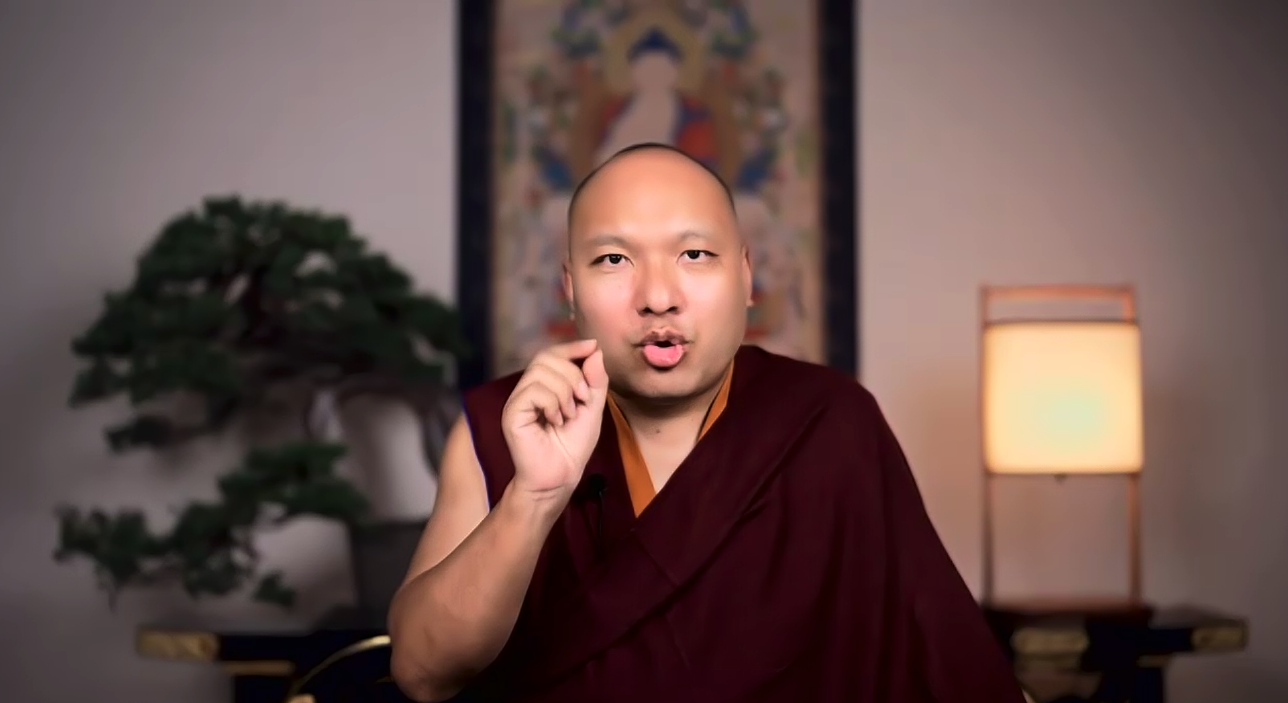
Origins of Secret Mantra • Day Three
22 August 2025
In his introduction to today’s teaching, the Karmapa discussed the importance of studying the traditions of early Buddhism.
There is a tendency among Tibetan Buddhists to view the Foundation Vehicle [Theravāda] as almost a different religion. While many of us do not know the actual content of their teachings, the terms Śrāvakayāna or Hīnayāna are often used pejoratively. Such an attitude is false. Many of us think that the two original schools [Sthaviravāda and Mahāsāṃghika] and their subsidiary schools are distinct from the Mahāyāna. His Holiness stated:
However, when you look at the actual situation, whether we’re talking about the Mahāyāna Vinaya or the Mahāyāna Abhidharma, it’s basically all the same as the Foundation Vehicle Abhidharma and Vinaya, so if we’re going to look at its source, we have to look at the Foundation Vehicle.
The reason that there is such a poor understanding of the Foundation Vehicle schools is because, in general, Tibetan Buddhist study does not have a tradition of exploring the teachings and the histories of early Buddhism or the eighteen schools. Secondly, it focuses solely on the Mūlasarvāstivāda Vinaya and Abhidharma and not their counterparts in other schools since there are no translations of these texts into Tibetan. Although, it is worth noting that Tāranātha’s History of Buddhism in India and other texts do write about the 18 schools, and in the Karma Kamtsang, the Eighth Karmapa, Mikyö Dorje discusses them in his Collected Works, in the Questions and Answers with Penchen Dor Gyalwa.
We have the tradition of studying the “five great texts” and, among them, the Vinaya and Abhidharma are considered of the higher class since their content is deemed quite complicated, but if we don’t understand those two well, then it is difficult to understand the two original or the subsidiary schools and having an insight into their historical development would be very fruitful for us.
Another important point is that some people say that the Mahāyāna is not the words of the Buddha. However, if we have a good understanding of the Foundation Vehicle texts, we can see the connections between them and the Mahāyāna and prove that the Mahāyāna teachings are the real, true words of the Buddha.
Most difficult is the status of the Secret Mantra Vajrayāna. There are many people who say that it was not taught by the Buddha. However, the Karmapa argued, it is possible to show from Foundation Vehicle texts (such as the teachings on the Mahāmāyūrī mantra) that the Secret Mantra Vajrayāna was present in the Buddha’s teachings from the very beginning.
The Karmapa then resumed the previous day’s teaching on the Ten Impermissible Points and events pertaining to the Second Council.
The Second Council, held between one and two hundred years after the parinirvana, was a significant event in Buddhist history. To quote His Holiness Karmapa:
I see this council as being closely connected to the circumstances of the initial split of the sangha into two schools. When we research early Buddhism, we see that this council had in many different ways a profound influence on the spread and the future of Buddhism.
It is possible that even before this council, there had been differences of opinion or opposition among the Buddhist sangha, but the sangha continued to be in essence a single community. However, once the controversy over the ten points came out, the differences in opinion within the sangha became more pronounced, and eventually what had been a schism turned into two main schools. Eight elders were chosen to represent the sangha of seven hundred arhats and twenty thousand sangha members and settle the controversy over the ten points. According to some scholars, including Namikawa Takashi, the eight elders were not only the people who resolved that particular controversy but also very influential figures from the time of the Second Council until the split. As the most senior elders of the time, in terms of Buddhist view and administration of the sangha, they were widely acknowledged as leaders. The sutras, vinaya, and other scriptures were finalized at that time, so from one perspective, the eight elders were the ones who laid the foundation of Buddhism. They were significant figures with a deep connection to the development of early Buddhism.
Ānanda’s Influence on the Second Council
One point that deserves attention is that we have been discussing how the various scriptures list a variety of names for the eight elders (Sarvakāmin [Skt; Pāli: Sabbakāmin] (or Sarvagāmin [Skt; Pāli: Sabbagāmin]), Revata, Saṃbhūta, Yaśa Kākandakaputra [Pāli: Yasa Kākandakaputta], Sumana, Śāḷha [Pāli: Sāḷha], Kubjaśobhita [Pāli: Khujjasobhita], and Vṛṣabhagāmika [Skt; Pāli: Vasabhagāmika]); clearly mentioning that most of them were students of Ānanda although a minority had a master-disciple connection with Aniruddha (see the table). Moreover, the Tibetan history, such as Butön Rinchen Drup’s History of Buddhism in India and Tibet, says that most of the present seven hundred arhats were also Ānanda’s students. Thus when the foundations of Buddhism were being laid, Ānanda and his students were the most influential figures in the administration of the sangha.
A table showing who of those eight elders had a master-disciple connection with Ānanda according to various texts (the ones marked with 🔆 are students of Ānanda, while those marked with 🌀 are students of Aniruddha)
|
Sabbagāmin |
Sālha |
Khujja-sobhita |
Vasabha-gāmika |
Revata |
Sambhūta |
Yasa Kāk-kandaka |
Sumana |
|
|
Theravāda Khandaka |
🔆 |
|||||||
|
Dharmaguptaka Four-Part Vinaya |
🔆 |
🔆 |
🔆 |
🔆 |
||||
|
Mahīśāsaka Five-Part Vinaya |
🔆 |
|||||||
|
Sarvāstivāda Ten Āgamas |
🔆 |
🔆 |
🔆 |
🔆 |
🔆 |
🔆 |
||
|
Dīpavaṃsa and Mahāvaṃsa |
🔆 |
🔆 |
🔆 |
🌀 |
🔆 |
🔆 |
🔆 |
🌀 |
A summary of the controversy in the context of the issues that developed one or two hundred years after the Buddha’s parinirvana
Buddhism had spread from Central India into the western regions. From the elder Yaśa’s route when he searched for supporters, we can deduce that Buddhism had crossed from central India into the western regions. There were differences in customs between the two regions leading to different opinions about the vinaya.
When in Vaiśālī, the elder Yaśa saw the Vṛjiputra (Sons of Vriji) bhikshus of that area accepting gold and silver, he said that it was in violation of the rules of the vinaya. That was the main point among the contested ten because the Vṛji bhikshus had decided to relax the vinaya rules regarding accepting gold and silver, eating after noon, and so forth. Seven hundred elders and twenty thousand sangha members had gathered and, in the end, chose eight representatives to engage in the discussion. It was decided that the ten points were not in accord with the vinaya the Buddha had promulgated. This can be considered as an early sign of the future split into two main schools. The disagreement created a controversy, the Vaiśālī bhikshus were dissatisfied, the rift grew deeper and deeper, until eventually the split into two main schools occurred. Most of the elders and the leaders of the council were students of Ānanda.
According to the Sthaviravāda accounts because of the controversy over the ten points, two events occurred: the first of these was the Second Council and the second was the original split into two schools. Both events occurred in the same era, but the Second Council was slightly earlier because the original split occurred over a longer period of time. So, we will first discuss the Second Council and then the original split into schools.
The Second Council
There are two sources of information on the Second Council, the Sthaviravāda and the Mahāsāṃghika accounts.
The Sthaviravāda Account
After it had been decided that the ten points were impermissible, they took the opportunity of the gathering of the seven hundred elders and twenty thousand bhikshus to hold a Second Council to compile the Buddha’s words. All the elders gathered in the city of Vaiśālī to accomplish this task. Thus, sometimes it is called the Vaiśālī Council after the location, and sometimes the Council of the Seven Hundred after the number of participants.
It is generally accepted that the main purpose of the Second Council was to correct the Vinaya Piṭaka, but in actuality they re-compiled all three piṭakas. The proof is that it says in Buddhaghosa’s (Skt. Buddhaghoṣa) Samantapāsādikā [The All-Pleasing], the most well-known commentary on the Vinaya in the Foundation Vehicle school: The bhikkhu Sabbagāmin [Skt. Sarvagāmin] replied, “Venerable, now we should recite the dhamma and the vinaya. We must select those who know the three piṭakas. They chose bhikkhus who knew the three piṭakas and gathered in the Valuka Grove in Vesālī [Skt. Vaiśālī], no different from how Kassapa [Skt. Kāśyapa] had compiled the piṭakas of dhamma. They cleansed the Buddha’s teachings of impurities, through inquiry into the basis of the piṭaka, the suttas, the branches, etc
During this Council, both the “Dharma” (the basket of the scriptures) and the “Vinaya” were compiled. During the First Council, the compilation had been compiled through questions and answers about the location where the Buddha taught it, the time, the individual to whom it was taught, and so forth. But from the quotation given above, we can see that when they compiled the Dharma during the Second Council, there was even more question and answer than in the previous Council and in a different manner, and that they were able to organize the contents into order. We can also infer that the little bit of the Abhidharma piṭaka that had been compiled during the First Council was prepared in a more complete fashion. Because all three piṭakas of the Sūtra, Vinaya, and Abhidharma were completed in this Second Council, it is also called the “Complete Recitation” Because they were recited in full. According to the Sri Lankan history the Mahāvaṃsa (Great Chronicle) this council lasted for eight months.
There are disagreements in the scriptures on the date of the Second Council. The Sarvāstivāda Vinaya, the Mūlasarvāstivāda Minor Topics, the seventh fascicle of Xuanzang’s Great Record of Travels to the Western Regions, and other texts assert that it was held 110 years after the parinirvana. The Samantapāsādikā, Dīpavaṃsa (Chronicle of the Island), and Mahāvaṃsa, which are primarily the Foundation Vehicle scriptures, explain that it was held 100 years after the parinirvana.
The Indian scholar S.R. Goyal explains on the basis of the Samantapāsādikā, Dīpavaṃsa, and Mahāvaṃsa that the Second Council occurred during the reign of King Kalāśoka (395-367 BCE). According to the Mahāvaṃsa, this council was held when the king provided suitable facilities. However, not all texts agree that it was during the reign of Kalāśoka. Some scholars call it just a hypothesis.
Another explanation is that after the Second Council, the Vṛjiputra bhikshus in Vaiśālī were displeased and held their own council. Most of the bhikshus (except the eastern elders) gathered for it, so it was called the Council of the Majority, the Mahāsāṃghika. This was separate from the Council of the Seven Hundred. As explained in the Dīpavaṃsa:
So this was the manner in which the elders (Pāli: thera; Skt. sthavira) and the majority (the mahāsāṃgha) initially split. It is said that at that time, the king of Vesālī supported the majority bhikkhus (the eastern bhikkhus belonging to the Mahāsāṃghika faction), and expelled the western bhikkhus (belonging to the Sthaviravāda faction [the predecessor of today’s Theravāda] which may have included the eastern elders).
Due to this, there also was a geographical difference between the bhikshus of the Sthaviravāda and Mahāsāṃghika, because there were the two eastern and western camps. The western camp respected all the precepts, major and minor, and were more interested in how they ate, drank, and so forth. The easterners respected the fundamental precepts but relaxed the minor precepts. Thus the main impetus for the split occurred because of the vinaya rules. This was the main cause that produced the early schools.
Some scholars differentiate the early split and the original split which formed the two schools. Initially, the Vinaya disagreements occurred and that was the early split, then, the disharmony gradually increased and disagreements in the view appeared as well. Eventually, the disparity grew so strong that it led to the original split i.e. the formation of the two schools.
The Mahāsāṃghika Assertion
On the Mahāsāṃghika side, the Mahāsāṃghika Vinaya (translated into Chinese) does mention the Second Council but does not give a date for when the Second Council occurred. It explains that it occurred because of a controversy over accepting gold and silver. In both the First and Second Councils, they first determined the main purpose, a framework of five main points, upon which they compiled the words of the Vinaya piṭaka. The five main points of the compilation were: prohibitions regarding the bhikshu’s residences; local laws; dharmas made specifically for some disciplined bhikshus; and dharmas made specifically for some elder bhikshus. They agreed that these must be practiced on the basis of the four main precepts and should not be practiced according to one’s local custom. These “five pure dharmas” are taken as the basis for the Vinaya piṭaka and thus considered very important. They are pure because of summaries; pure because of method; pure because of discipline; pure because of seniority; and pure because of local customs.
The seven hundred elders also requested Upāli’s student Dhāsāra to compile the vinaya. At the end, he said, “Accepting gold and silver is not permissible. Elders, those who need alms bowls ask for alms bowls. Those who need robes ask for robes. Those who need medicine ask for medicine.” So according to the Mahāsāṃghika description of the Second Council the incident that caused it was because of accepting gold and silver, it’s not a question of the ten points.
A Summary of the Second Council
The two councils, the First Council held at Rājagṛha (modern-day Rajgir) and the Second Council held at Vaiśālī, are the two most important councils in terms of Buddhist history because the basic form of the three piṭakas was established. In particular, the four āgamas and the rules of the vinaya taught by the Buddha were compiled and organized, thus preserving the dharma for liberation, which is as priceless as a wish-fulfilling jewel.
Among all the councils held in India, the first and second councils were accepted by all the later schools, but later councils were recorded only in the particular scriptures of each school.
The Five Points of Bhikshu Mahadeva (also called the Five Views)
There are different explanations of the first split in the sangha, or the original split into schools, in the Southern and Northern transmissions of Buddhism. The Southern transmission refers to the Buddhist tradition in Thailand, Sri Lanka and so forth, they have their, this is what we call the Southern. The Northern transmission is what we call Japan, China, Korea, and finally, also Tibet.
To summarize: according to the Southern transmission, between 100–200 years after the parinirvana, there developed different views of the vinaya between the bhikshus of the eastern and western regions. The controversy over the ten points occurred, and in the end, the bhikshus from the west, led by the elders from the west, prevailed. The ten points were over-ruled. Then in order to correct the teachings and make the vinaya discipline more precise and stricter, the elders held the second council in Vaiśālī, the place where the controversy had first erupted.
However, according to the Northern transmission, the original split into schools was not because of the ten points. So what, according to the Northern transmission, were the circumstances that led to the original split of the sangha and two schools. They are explained to be the five points or the five views of Mahādeva.
Before we speak about the five views, we need to know bhikshu Mahādeva’s story as it is given in The Great Exposition, (the Mahāvibhāṣā) in the 99th fascicle.
The Story of Bhikshu Mahādeva
In ancient times, in the country of Maruta in India, there lived a merchant who had married young and had a handsome son. They named him Mahādeva or “Great God.” However, not long after the son was born, the merchant took his wealth and went to another country for trade, where he remained for many years. The son grew up and became a very handsome young man. He and his mother fell in love and began an incestuous relationship. Later, when he heard that his father was returning, he became frightened. He conspired with his mother to kill his father, thus committing his first heinous deed. When gradually the word spread, they could no longer stay in that place, and they fled to the city of Pāṭaliputra.
Mahādeva then encountered a venerable arhat from his homeland. He suspected the arhat might tell others about killing his father, so he killed him, thus accumulating the second heinous deed.
Later still, when he saw his mother becoming fond of another man, he became angry and thought: “For your sake I committed two great misdeeds and wandered to other lands experiencing many hardships, and now you abandon me to be happy with another man. Who could tolerate such a treacherous woman?” So he killed his mother, thus accumulating the third heinous deed. However, he had not completely severed his roots of virtue and still had some faith in the Dharma. Strong remorse arose in his mind. He could not sleep at night and could not sit still during the day. His mind was troubled, and he wondered how these great misdeeds could be purified.
When he heard that the śramaṇas, sons of the Śākya, had methods for completely purifying misdeeds, he went to the Byagag monastery. Outside the temple gate, he heard a monk reciting slowly: “A person who has committed great sins / Can eliminate them by cultivating virtue / This illuminates the world / Like the moon emerging from clouds.”
Upon hearing this, great joy arose in him. Knowing that by taking refuge in the Buddha’s teaching his sins would certainly be purified, he went to a monk and earnestly requested ordination. Hearing his request, the monk ordained him without properly inquiring about obstacles, and he was given the name Mahādeva. The monk gave him instructions and teachings.
Mahādeva was also intelligent, so that not long after his ordination he had grasped all the words and meanings of the three piṭakas, memorised them, and with pure speech became able to teach well. All the people of Pāṭaliputra took refuge with him. Hearing of his renown, the king also repeatedly invited him to the palace, respectfully making offerings, and requesting him to teach the Dharma.
Once, while staying at the monastery with the saṅgha, he had a nocturnal emission in a dream. Since Mahādeva had previously proclaimed to be an arhat, his student who saw his soiled robes, asked: “Since arhats have exhausted all of the defilements, how did this happen to the teacher?” Mahādeva replied: “The māra of the Child of the Gods [the māra of deceptive appearances] caused this disturbance. You shouldn’t doubt me.” He explained, “There are two different types of defilements: the afflictive and the impure. While arhats do not have afflictive defilements, they do have impure ones. Although arhats have exhausted the afflictions, they have not abandoned urine, feces, snot, and so forth. However, the children of the māras of the Child of the Gods are always jealous of the Buddha’s teaching and when they see those cultivating virtue, they try to cause harm. They even try to harm arhats. Therefore, my emission is not my problem; it is their fault. You shouldn’t doubt me.” This is the first of the five views of Mahādeva, the first wrong explanation that he gave.
Again, to please his students and make them respect him, Mahādeva would deceive them and say, “You have attained this and that fruit of the śramaṇa path.” At that time, his students would bow respectfully and say: ” If what you say is true, why don’t we ourselves know that we are stream-enterers, once-returners, non-returners or arhats [the stages of the noble ones]?” He replied: “Arhats also have ignorance, so you should not lose faith in yourselves. Ignorance has two types: that which is afflicted, which arhats do not have, and that which is non-afflicted, which arhats do have. Therefore, you do not know yourselves.” This is the second wrong view. The Karmapa explained Mahādeva is saying that arhats don’t have afflictive obscurations, but they do have cognitive obscurations.
Then the students said: “The noble ones are said to be free from doubt, but we have doubts about the four noble truths. Arhats have seen the nature of things truly, and they’ve seen the four truths directly, and they don’t have any doubt, but we do. ” Mahādeva replied: “Arhats also have doubts. There are two types of doubt: first, doubt of a subtle nature, which arhats have abandoned; second, doubt about what is appropriate and inappropriate, which arhats have not abandoned. Even pratyekabuddhas possess this, so why mention that you śrāvakas have doubts about the truths? Therefore, do not disparage yourselves.” This is the third wrong view.
Later, when his students were reciting sūtras that stated arhats possess the eye of wisdom and are able to know their own liberation directly, they asked: “If we are arhats, we should realize this ourselves. We should be able to enter the path by ourselves. How is it that the teacher has initiated us but we have no direct realization?” He said: “Some arhats enter through others’ power alone without knowing it themselves. For example, although Śāriputra is supreme in wisdom and Mahāmaudgalyāyana is supreme in miraculous powers, if the Buddha does not give prophecies, even they do not know their own entry. So, it happens that sometimes you have to enter the path because of someone else’s direction. Therefore, you need not question this.” This is the fourth wrong view.
However, since Mahādeva’s virtuous roots were still not severed despite committing various misdeeds, in the middle of the night he would think about how great the misdeeds were he had accumulated, and wondered which realm he would fall into, and how intense the suffering would be. He became frightened, repeatedly crying out “Suffering!” and “Is anyone worse than me?” And he would wail. The nearby students who heard this became doubtful. In the morning, they asked: “How is your health?” Mahādeva replied: “I am very well.” The student said: “If so, why did you cry out ‘Suffering!’ in the middle of the night?” He replied: “I was calling the noble ones, so you need not doubt. The noble ones will not manifest unless called from the heart, so I called ‘Suffering!’ repeatedly in the middle of the night.” This is the fifth wrong view.
The Karmapa concluded the teaching at this point.