

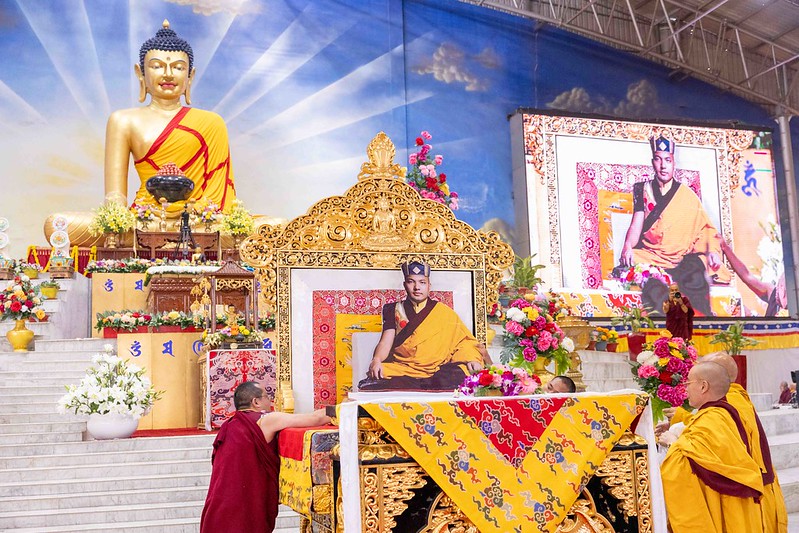
Becoming a Scholar and Going Forth
6 February 2025
After greeting everyone, the Gyalwang Karmapa resumed his discourse on the Life of Atisha at the point where technical difficulties the previous day had interrupted the teaching.
He began with a summary of Atisha’s life.
Atisha’s Early Life
Until Atisha reached the age of 10, he studied grammar and crafts and other common areas of knowledge. Then until the age of 21, he studied higher areas of knowledge such as grammar, epistemology and logic, and so forth. Thus, until he was 21, he was a lay devotee, holding the five precepts, and primarily a student.
Then, from the time he was 22, he started to practice the secret mantra. He received empowerments and practised secret mantra, becoming a yogi. The first Vajrayana guru from whom he received an empowerment was called Rahulagupta. It seems probable that, as they were contemporaneous and for other reasons, this is the same Rahulagupta who was also the main guru of the scholar and siddha Khyungpo Naljor. During the latter part of Khyungpo Naljor’s life, after he had gone to Tibet, and was performing various activities there, he had a pure vision of Rahulagupta, who had come to give him precious instructions. In this vision, Rahulagupta gave him the empowerment and initiation of Six-Armed Mahakala.
Atisha’s main guru was Avadhutipa, whom he followed for many years, receiving many tantras and pith instructions of the secret mantra. When he had reached a high level of Vajrayana practice, he engaged in yogic awareness conduct for either six or three years. “Yogic awareness conduct” means that he took a consort to various unfixed locations whether in the middle of a forest or some other location and engaged in yogic awareness conduct. The commentaries on the tantras explain that once one has attained the level of the path of joining, one could engage in such practices.
So, when Atisha was young, he engaged in a lot of secret mantra practices. He received many instructions on mantra and followed many gurus. So, basically, he practised yoga first, mastered the topics of mantra and studied widely. This was the opposite of other Indian Mahasiddhas of the secret mantra, who began as monastics and then later went off into the forest or isolated places to engage in yogic practice.
Atisha Becomes a Monk
Then, just as Shakyamuni Buddha went forth at the age of 29, Atisha also went forth when he was 29. He entered the sangha and from thence forth was a committed monastic.
Initially, he had believed he could reach buddhahood in one lifetime, solely through tantric practice, so he had devoted himself to the life of a yogi. However, there were so many different signs and visions that encouraged him to go forth.
One night he had a vision of an heruka, who appeared in the sky in front of him and said: “Child of noble family, if you keep doing the practice of Avadhutipa’s conduct, that will not be enough for you to get anywhere. So, you need to go forth and become a monastic, and if you do, then in the future, you will foster many monastic students.”
That was one of the omens that showed him he should go forth.
Atisha had a further dream. This time he was in a big temple where the Buddha Bhagavan Shakyamuni was seated at the head of a large sangha of bhikshus eating their midday meal. Atisha himself was at the end of the row. While he was sitting there, at the end of the row, the Buddha saw Atisha and pointed his finger at him, saying, “Something happened to that person, so he didn’t go forth.”
That dream was another sign that he should go forth.
Then he dreamt that he saw Maitreya in a temple. Normally, Maitreya wears the attributes of a bodhisattva but in Atisha’s dream he was clothed as a monk. As Atisha approached Maitreya, Maitreya scolded him saying, “This is a place for monastics. It’s not a place where you householders can come. You aren’t allowed in here.”
These signs made Atisha think that he should become a monk, otherwise nothing would succeed.
At that time in India there were many Foundation Vehicle schools, so Atisha was unsure where he should be ordained. He asked his landlord in Nalanda, a layperson who knew dharma well, for advice as to which was the best school in which to ordain. The landlord asked him, “Are you going to continue your tantric Vajrayana practice or not?” “I’m going to become a monk but I’m also going to continue tantric practice,” replied Atisha. “Then among all the different schools, it’s best for you to enter the Mahāsāṃghika school,” the landlord advised, probably thinking that this school was a little less strict.
And so, at the age of 29, Atisha was ordained at the Mahabodhi Temple in Bodhgaya by Master Shilarakshita, a great vinaya master of the Mahāsāṃghika vinaya. There were many subdivisions within the Mahāsāṃghika school, and Shilarakshita was in the lineage of Master Buddhajñāna. Atisha received the ordination name of Dīpaṃkara Śrī Jñāna. Dipam means ‘lamp’ and kara means ‘to do’, or ‘doer’, so dipamkara means ‘lighter of the lamp’. Śri means ‘glorious’; and jñāna means ‘wisdom’. The last part is according to the tradition where the ordinand also receives the last name of the lineage holder. The Khenpo who named him was in the tradition of Master Buddhajñāna so all the people in that lineage had the word jñāna as the last part of their name.
Dromtönpa’s praise of Atisha says:
Without attachment to sensory pleasures,
He left the wealth of royalty
And became a bhikshu of the Mahāsāṃghika school.
I supplicate glorious Atisha.
There are many different rules for monastics, and from then on, Atisha refrained from breaking even the smallest rules, let alone the major ones. For example, he would not eat flour that had been stored in a clay pot. The reason for this is that clay pots were also used for fermenting beer, and the Mahāsāṃghika considered abstaining from alcohol one of the root vows. They practised that very strictly. Even if there were no leftover beer in the pot, there was still a possibility there might be some remnants.
This is what is said. Usually, though, we speak of the four root vows plus abstaining from alcohol, and when I looked in Chinese translations of the Mahāsāṃghika vinaya texts, I could find no mention of abstaining from alcohol as one of the root vows.
Atisha’s Various Names
Next the Gyalwang Karmapa discussed the other names that Atisha is known by.
His ordination name was Dīpaṃkara Śrī Jñāna, but the most common name that he is known by in Sanskrit is Atisha [Skt. Atīśa]. In English, the name means “pre-eminent” or “the best”.
There are, however, several different explanations of its meaning. Some would say ati means “excellence,” and āśya means “intention” so his name means “the one with the most excellent intentions”, meaning someone who has great altruism.
Another explanation is that ati means “extremely” and śanti means “peaceful,” so put together Atisha means “extremely peaceful”.
Yet another explanation is that the first syllable of his name, A, means “great yogi”; ti means “great pandita”, and śa means “great bhikshu”. The A could be understood as in avadhutipa—a great yogi—ti refers to pandita, and śa could be understood as śramaṇa, the Sanskrit term for a great practitioner.
How was he given this name “Atisha”? There are two different explanations of this. One comes from from Panchen Sodrak’s history of the Kadampa, the Ornament of the Mind. It says that the name was given by the king Jangchup Öd who saw that Atisha had superior knowledge and compassion, was a greater scholar than others and was even superior to the other panditas and had the ability to greatly illuminate the precious teachings of the Buddha. So Jangchup Öd called him “Atisha” to describe his greatness. A second explanation comes from Sakyapa Kunga Sonam’s history of the Kadampa which relates how King Dharmapāla [from the Pāla dynasty centred in north-eastern India and parts of Nepal] acknowledged Atisha’s superiority among all the panditas and siddhas in India, invited him to Vikramaśīla, and gave him the title “Atisha”. However, this is doubtful because the dates conflict. Dharmapāla was active during the 9th century CE, and Atisha lived more than a century later.
This is an area requiring further research, His Holiness concluded.
In Tibet, the best-known name for Atisha is Jowo Je
In Central Tibet, in Lhasa, there are the two Jowo statues; these are a particular type of statue of Buddha Shakyamuni in saṃbhogakāya form with ornaments. Also, in Tibet, the term ‘Jowo’ is used for the king or leader. Sometimes Jowo is used to address people who are older or senior to you. The eldest son, your big brother is called Ajo or Jo-la.
In any case, in Tibet, Jowo is a word of praise. It means the supreme person; someone whom you consider to be extremely important. So, for the people for whom you have great regard, whether they are humans or gods, you use the term Jowo Je. It shows that you are really treasuring that person.
Hence, Atisha is known in Tibet as Jowo Je because of his great importance and the immense kindness he showed to Tibetans. He’s like an elder brother or a great being. This use of Jowo Je shows how close Tibetans feel to him, and how much gratitude for his kindness and the great respect they have for him.
Studies at Vikramaśīla and Odantapurī
Once he had been ordained, at the age of 29, until he was 31, Atisha studied both the Foundation Vehicle texts and Mahayana texts with many different gurus. He stayed mainly at Vikramaśīla Mahavira, as well as at Odantapurī Mahavira. These were the two most well-known monastic universities in India at that time and were both sponsored by the kings of the Pāla dynasty. In those days, Vikramaśīla was at its height and more famous than Nālandā.
So at Vikramaśīla, Atisha primarily studied the Vinaya of the four root schools of the Foundation Vehicle: the Mahāsāṃghika, Sthaviravāda, Saṃmitīya and the Sarvāstivāda .Each had its own, slightly different, individual practices, but Atisha was able to understand them all and knew the distinctive features of each school.
His principal guru at Odantapurī was Dharmarakṣita, with whom he studied the Great Exposition Treatise (Skt. Abhidharma Mahāvibhāṣa Śāstra) the 800-fascicle text written by the Arhat Upagupta, said to be the basis for all four Foundation schools. This huge text normally takes twelve years of study to complete, but Atisha worked so diligently that he completed his studies in seven.
As to the Mahayana, he studied Mahayana texts with the pandita Shantipa, who was the guardian of the eastern gate at Vikramaśīla, while Naropa was the guardian of the northern gate. Shantipa was known as “The omniscient one of an age of strife.” Many of the Tibetan masters who had visited India, such as Marpa Lotsawa, had studied with him, thus he had a very great connection with Tibet. He was also viewed as the second most well-known scholar, after Naropa.
At that time in India, there was a great inter-mixing and overlap between Buddhist and non-Buddhist views, and there were many Buddhist masters who were unable to clearly distinguish between the two. Atisha said that there were only two people who knew the difference between Buddhists and non-Buddhists, Atisha and Shantipa.
Studies with Many Gurus
Atisha’s studies were not restricted to Vikramaśīla and Odantapurī; he travelled extensively and studied with many gurus. His namthar say that he sailed across the oceans to visit Sumatra and Sri Lanka (Copper Island), He also studied in Central India, and underwent many difficulties in order to study with different gurus. According to various accounts of his life, he studied with any number between 30 and 157. Of these, there were 12 gurus who were both scholars and realised practitioners, and of these there were three gurus who had actually seen the truth. These three were Guru Avadhūtipa (there are two Avadhūtipas, Elder and Younger, and this was probably the Younger); Kamalarakshita, who was a practitioner of Yamantaka; and Naropa’s student the Younger Dombhipa, again there was an Elder and a Younger Dombhipa.
He studied the Middle Way view with Avadhūtipa. With Kamalarakshita he studied the Autonomist Yogachara Middle Way school. Kamalarakshita had initially been a Mind Only scholar but became a Middle Way master when he reached the path of seeing.
As to Dombhipa the Younger, Atisha never actually met him in person. However, he had supplicated him sincerely and, for that reason, he encountered Dombhipa through a strange dream in which he saw three people, the guru and his two monk students. They were each holding a kapāla—a skull cup made from a human cranium. And from these skull cups, they were eating human flesh. Instantly, Atisha lost faith.
“This isn’t good,” he said. “If you hold monastic vows and wear robes and you’re holding a skull cup and eating human flesh, isn’t that a serious offense?” he questioned.
“Does the Buddha have any confusion?” Dombhipa asked.
“He does not,” Atisha replied.
Then he dreamt that Dombhipa gave him a piece of human flesh, a finger, to eat, and so he ate it. Immediately, he entered the state of samādhi, which lasted after he woke up until noon of the next day; he enjoyed the bliss of samādhi and stayed resting in equipoise.
However, Atisha still had some doubt. “Are these the blessings of buddhas and bodhisattvas or of Dombhipa?” he wondered.
Later, when a mantra practitioner touched Dombhipa’s feet, Dombhipa said, “You and I have no karmic connection. There is a student of mine whose name contains the word ‘jñāna’. I gave him some blessings. You should go to see him, because he’s the one you have the karmic connection with.” The mantric practitioner did as Dombhipa told him, went to Atisha and supplicated him for teachings. Atisha asked who had sent him, and the mantric practitioner recounted the story of his meeting with Dombhipa. Only then did Atisha know that the samādhi had been the blessing of Dombhipa. So, although Atisha never met Dombhipa in person, because he had been blessed by him in a dream, he considered him to be one of his gurus.
Bodhichitta
Among all of his gurus, Atisha had three gurus in particular who taught him bodhichitta, Dharmarakṣita, Maitriyogi, and Suvarṇadvīpa. All three had reached very high levels in the practice of bodhichitta. Dharmarakṣita and Maitriyogi are the sources for the mind-training teachings in the Kadampa tradition.
As for the first, Dharmarakṣita, according to the oral histories, there was a man who became ill and needed human flesh and blood for medicine to cure his illness. So, this guru, without any hesitation, cut some flesh off his body and gave it to him. For us, such an amazing story is difficult to get our heads around. In any case, Dharmarakṣita did not merely train in exchanging self for other but was able to give his own flesh and blood. He was at a very high level of mind-training practice.
Maitriyogi was also a great master of bodhichitta. Once someone was beating a dog with an iron rod. When Maitriyogi saw the man abusing the dog, he had such great compassion for the dog that he took the dog’s suffering, all of its pain, onto himself, so that the dog was freed of any sensation of suffering. There had been welts on the dog’s body from the beating, but they disappeared and reappeared on Maitriyogi’s body instead, where they exuded blood and pus. From this story, we can understand how high the level of Maitriyogi’s practice of loving kindness and compassion was.
The third was Suvarṇadvīpa, and he was said to be the embodiment of bodhichitta, so it was if the guru himself was a living bodhichitta. Because of this, the level of Suvarṇadvīpa’s realisation of loving-kindness, compassion, and bodhichitta, or his level or practice was at an extremely high level. Among all the gurus Atisha followed, out of the 150 or so, he was the one for whom he had the greatest faith and devotion and the deepest connection. When he heard the names of his other gurus, Atisha would join his palms at his heart like this. [The Gyalwang Karmapa demonstrated the namaskar of respect at this point.] But whenever he heard Suvarṇadvīpa’s name, he would immediately raise his joined his palms to his forehead and shed tears. Just hearing or thinking of his guru’s name would cause him to shed tears.
Later, in Tibet, when Atisha was asked why out of all of his gurus, he had such great faith and devotion for Suvarṇadvīpa, his response was that it wasn’t because some were better or worse, or that there were higher or lower qualities among them, but that Suvarṇadvīpa
put bodhichitta at the core of his practice and achieved the pinnacle of altruism.
All of his gurus had great qualities of learning; they were all great masters, were considered to be the greatest scholars, and were respected by the masters of all the Buddhist schools.
Before he left for Tibet, Atisha himself was highly regarded. Even Naropa told him, “These days, the master of the teachings is you.”
The teaching concluded at this point with the Aspiration for the Stages of the Path.